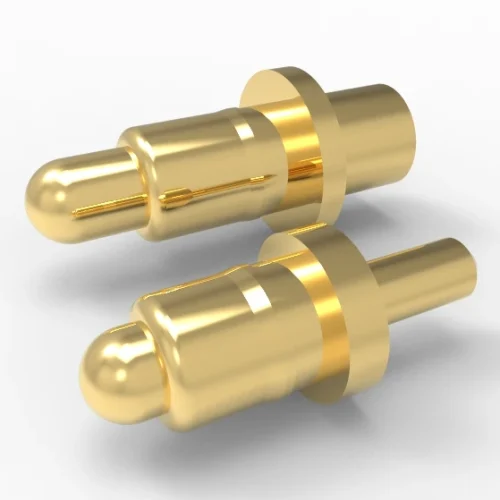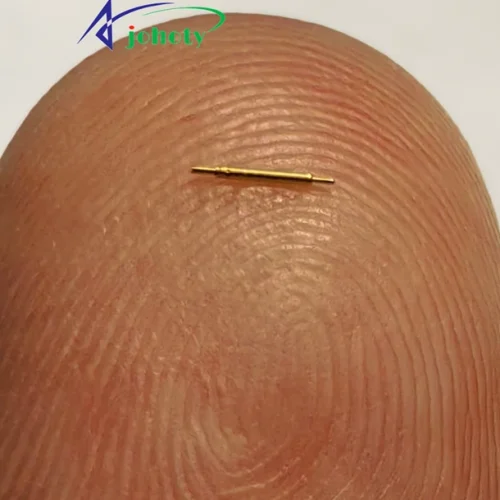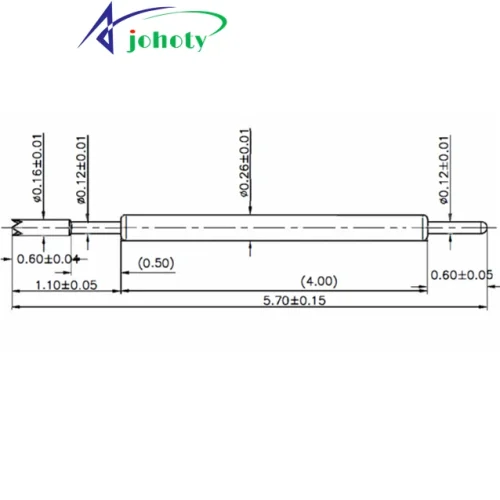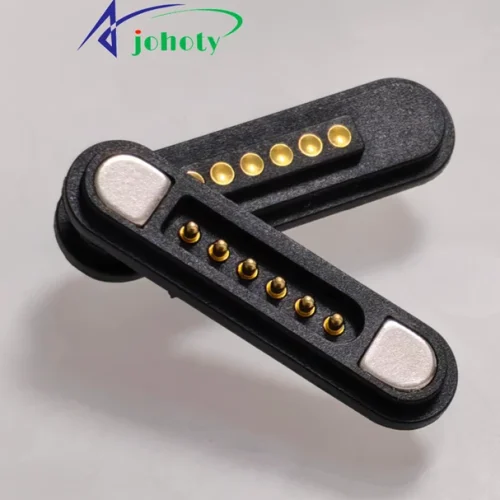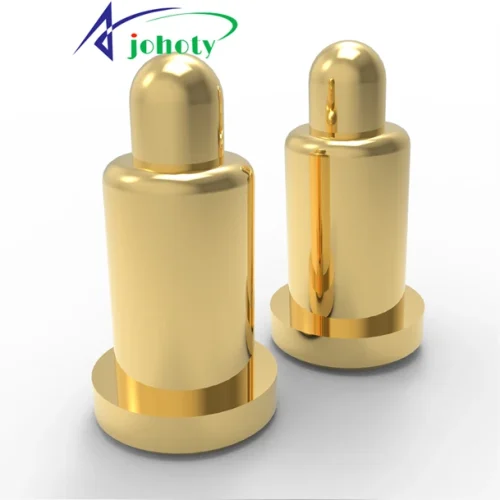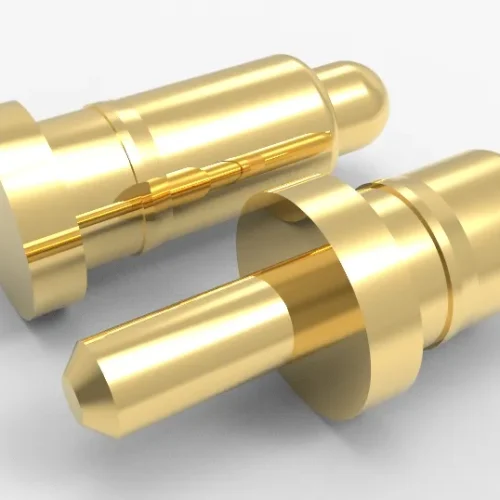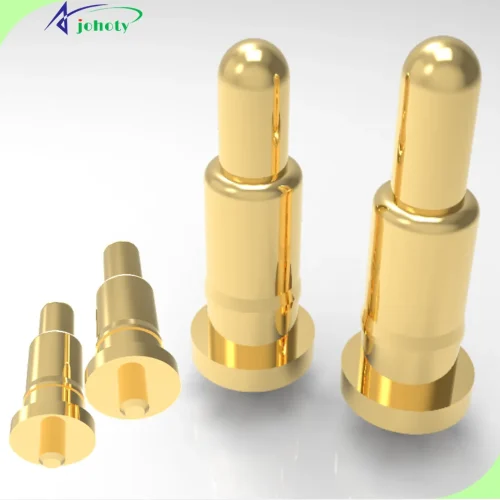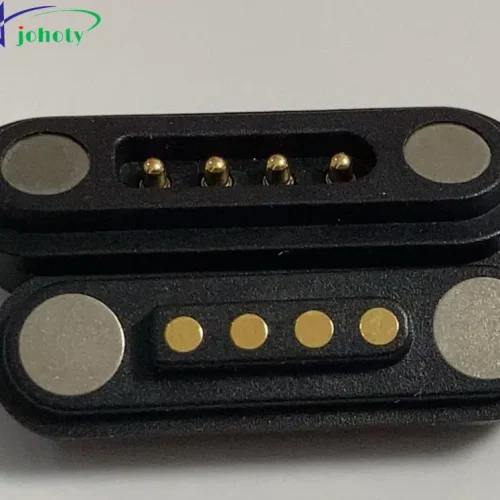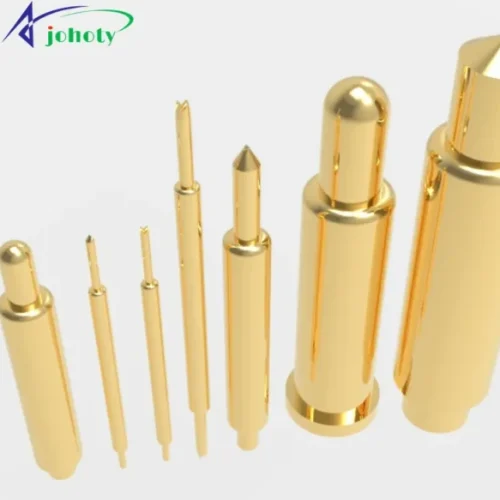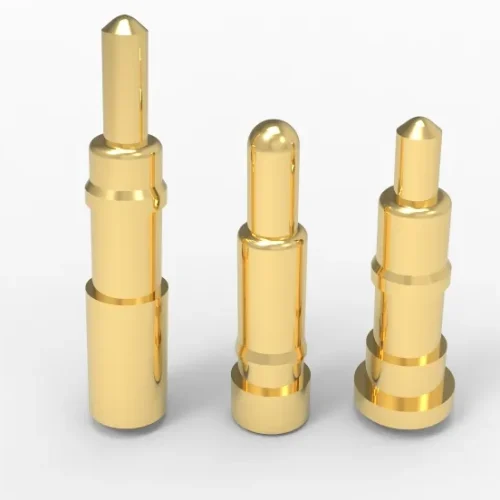


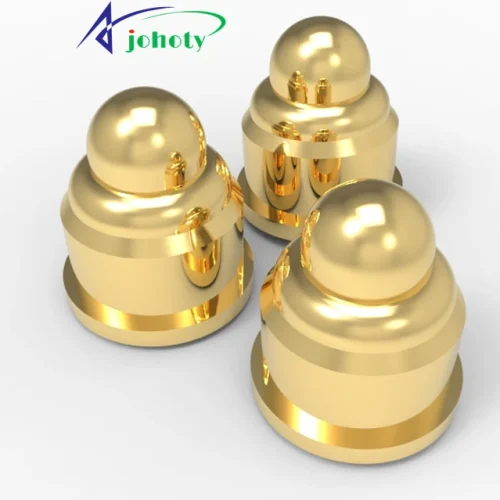
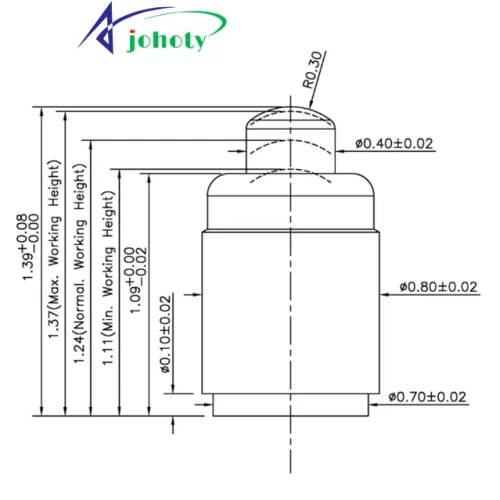
Specifications of Johoty Low Profile Pogo Pins
| Specifications | Value |
|---|---|
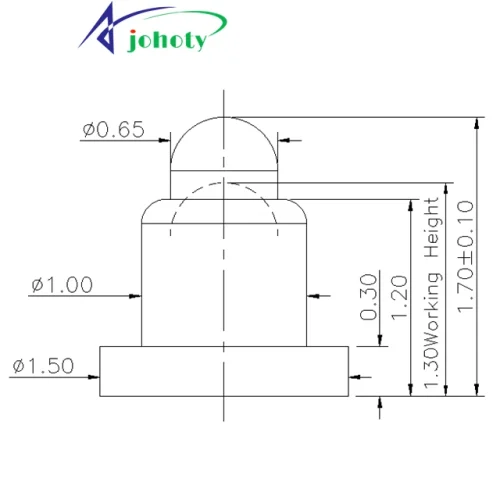
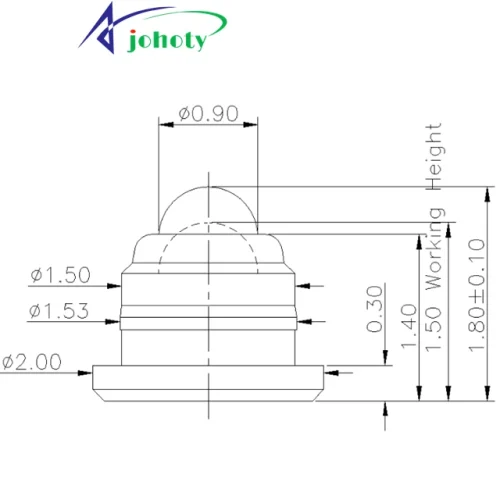
| Overall Height | 1.39 ~2.00mm, Johoty can customize pogo pin as low as 1.39mm for FPC,or board-to-board. |
| Barrel OD | ≥0.50mm, custom. |
| Total Stroke | ≥0.10mm, custom. |
| Spring Force | ≥15 gf at working stroke, force SLS is as low as 5gf for IC test. |
| Mounting | SMT, Through-hole, Right-angle, custom. |
| Reflow Profile | 265℃ peak, 10s above 230℃ (SMT), |
| Coplanarity | ≤0.05 mm, |
| Positional Tolerance | ±0.05 mm, |
| Rated Current | ≤2.0 A @ ΔT≤30℃, custom. |
| Rated Voltage | ≤220 VDC, custom. |
| Contact Resistance | Initial ≤15 mΩ, ≤100 mΩ after lifespan, |
| Plunger Material | BeCu, Brass, SUS304, |
| Barrel Material | Brass, Phosphor Bronze, BeCu, |
| Spring Material | Stainless Steel, Beryllium Copper, SWP-B, SUS631, Inconel, custom, |
| Plating | Ni 50~150 µin + Au 5~200 µin custom, or composite coating, |
| RoHS | Compliant with RoHS, REACH, Johoty can provide you with MSDS, SGS, Test Reports, etc. |
| Mating Cycles | >10,000 cycles @ working stroke, |
| Operating Temp | From -40℃ ~ +125℃,Johoty can customize continuous 350℃, peak 500℃. |
| Salt Spray | ≥24 h, ASTM B117 |
Catalogs of Low Profile Pogo Pins
Low profile pogo pins mainly focus on:
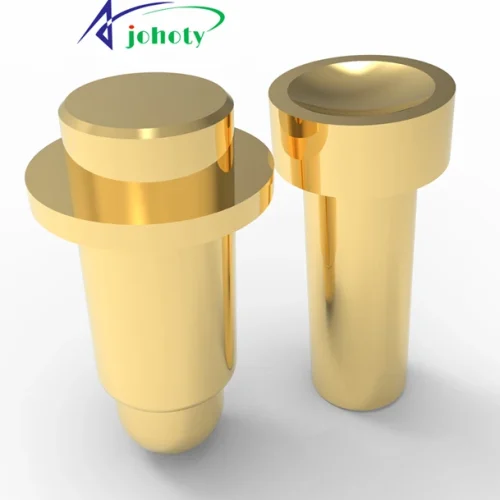
SMT pogo pins, resolve the issue of insufficient gap between reflow soldering furnaces and limited clearance under PCB boards. So, the ultra-flat surface mount SMT pogo pins will be a powerful solution. Utilizing suction cup friendly flat bottom surface, supporting vacuum picking and placing. Working height as low as 1.50mm and directly laid on PCB surface to minimize current path and optimize heat dissipation.
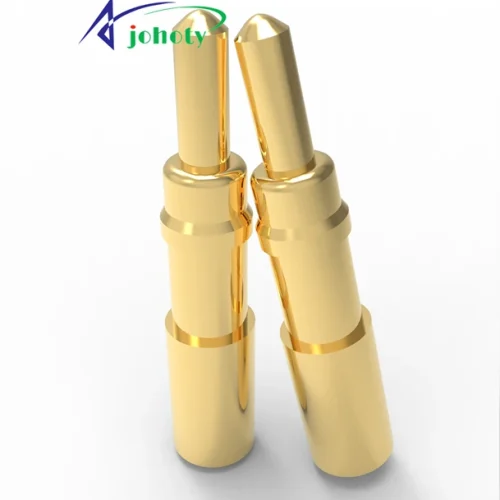
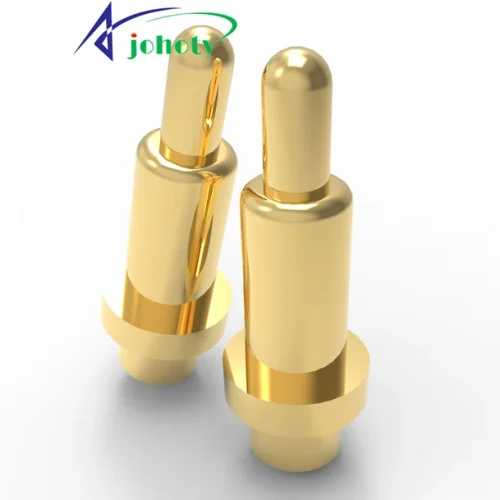
Through hole pogo pins, Can pass the vibration test of your product and withstand frequent rough insertion and removal. Ultra-thin through-hole structure, tail pins penetrate the PCB, and physical anchoring is strengthened through the through-hole. Although the overall height is low, the solder joints are full and the tensile strength far exceeds that of the surface mount. Specially designed for military, industrial handheld, or medical equipment. It provides a mechanical commitment of welding and stability at depths as low as 1.39mm.
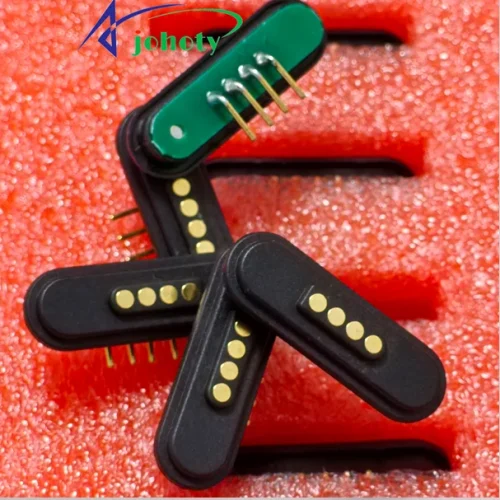
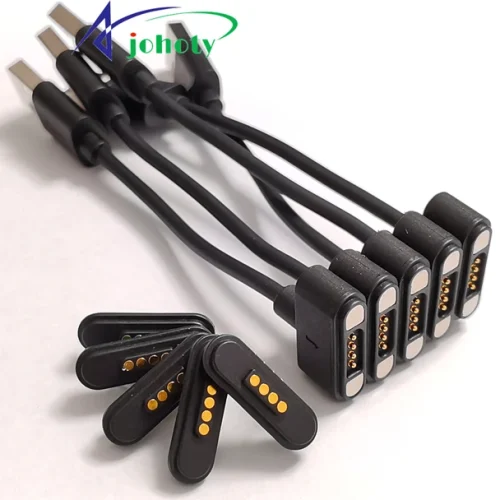
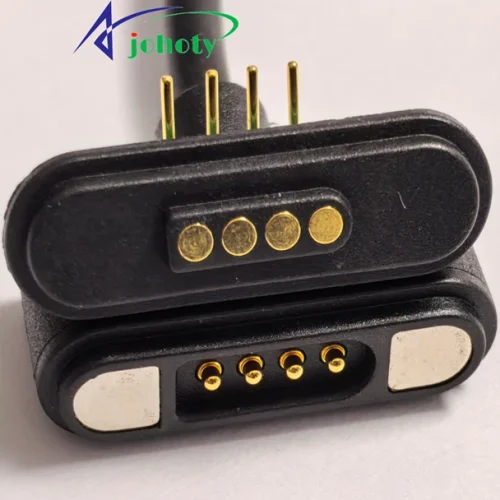
Right angle pogo pins, lateral contact, SMT horizontal mounting. When the components are fully covered on the PCB and the Z-axis direction is tightly aligned. They are mounted perpendicular to the side of the PCB and the conduction direction is parallel to the board surface. This low profile pogo pin is a standard logic for smartwatches/wristbands and TWS headphone charging cases. Utilize the idle space at the edge of the board to achieve ultra-low impedance conduction on the side. Make the stacking thickness of the motherboard with the battery or antenna module exceed the physical limit.
Why are Johoty Low Profile Pogo Pins Worth Choosing?
| Challenges | Solutions |
|---|---|
| Insufficient height, limited space | Ultra-low height structural design: At a height of<2.00mm, the precise internal slot structure ensures stable and sufficient working force, avoiding contact failure caused by hard collisions. |
| Transient contact interruption/signal jitter | Optimized spring force curve+extremely low and stable contact resistance: precise number of spring coils and materials, maintaining a contact force of >15gf throughout the entire working height. The contact resistance is controlled <20mΩ for signal integrity. |
| Assembly difficulties, yield loss | Fully compatible with SMT process: strict control of Coplanarity<0.10mm. Tape&Reel packaging supports automatic picking by high-speed surface mount machines to improve production throughput. |
| Insufficient lifespan and poor reliability | Advanced coating system and wear control: Depending on the application, hard gold-plating or PdNi-plating can be selected. With Johoty strict 50,000 or 100,000 cycle life verification, the mechanical and electrical performance are consistent and stable. |
| Strict environmental challenges | Comprehensive environmental adaptability testing: temperature and humidity cycling, salt spray testing, vibration and mechanical shock measurement data. Johoty low profile pogo pins operate stably under harsh working conditions. |
Traceability of materials and coatings:
Material certification: Original factory material certification reports can be provided for beryllium copper, stainless steel, gold, palladium, etc.
Coating control: Johoty not only talks about gold plating, but also provides a report on the thickness range of the coating. Such as 4-5μm for nickel base and 0.1-0.8μm for gold surface. Traceable to specific incoming batches to ensure consistency at the source of quality.
Accurate verification of electrical performance:
Contact resistance distribution: Johoty provides a CPK report on contact resistance, demonstrating the consistency of batch low profile pogo pins. Rather than just giving an ideal value. You can see that the data distribution is narrow and stable.
Current carrying capacity curve: If there is a current demand, we provide a temperature rise curve graph at rated current. Clearly indicate that the temperature rise reaches its limit under current, helping you make the safest design.
Reliability Test Report:
Data available: You can obtain reliability test reports from the Johoty CFT team, including:
Life testing: mainly includes elastic impedance testing, contact resistance change curve and elastic force change curve after 10.000 cycles.
Environmental stress: Appearance and electrical performance photos of low profile pogo pins after salt spray testing, as well as temperature cycling test data.
Consistency guarantee for mass production:
Key dimension CPK: For the height and coplanarity of low profile pogo pins, Johoty internally controls CPK≥1.33.
Shipment inspection: Johoty follows AQL 0.65 or stricter sampling standards for shipment inspection. Johoty believes in data, not the slogan of full inspection.
Compliance and Certification:
Industry certification: Johoty has the ability to meet ISO 9001 and RoHS, REACH, CA65 environmental compliance certifications. We can provide compliance statements or certified third-party test reports as needed to ensure your supply chain is worry-free.
Design low profile pogo pins under space constraints
Gold standard for solder pads and mating pads: 1.1%
To ensure <30mΩ and long-term environmental reliability, Johoty will follow:
Pad Diameter: Johoty recommends it to be 1.2 to 1.5 times the diameter of the plunger tip. For example, for a plunger tip with φ1.00mm, it is recommended pad diameter be Ø1.2mm ±0.05mm. If it is too small, you can see contact displacement, if too large, there is potential increase parasitic capacitance.
Finish: Chemical nickel gold is mandatory. Nickel layer thickness: 3-5μm, gold layer thickness is 0.125-0.5μm. It is strictly prohibited to use OSP or pure tin. It’s to avoid micro oxidation that may cause the top pin of low profile pogo pins to get stuck.
Pitch & Tolerance Stack-Up:
Min Pitch: Johoty recommends pitch to be ≥1.27mm. When it is <1.27mm, you need to consider the EMI and plastic strength of adjacent pogo pins.
Tolerance Compensation: If the design exceeds 10 pins, the combination of PCB drilling positioning errors and processing errors may exceed the floating amount of pogo pins.
Introducing a guiding structure: Johoty suggests designing guide pins with a diameter of Ø2.0mm at both ends of the connector. Prioritize intervention before pogo pin contact, compensate for XYZ axis deviation, and avoid plunger tip scratching the solder pad.
Lateral-Force & Wear Mitigation:
Lateral Force Limit: Johoty recommends a maximum allowable lateral force of less than 0.5N. We recommend using a zero insertion force horizontal sliding structure in the design. Don‘t press vertically, completely eliminate lateral scratches.
Life extension: If your design requires vertical compression, ensure that the angle between the flange axis and the mating surface is <1°. Any angle of inclination will convert compressive force into lateral force, accelerating the wear of low profile pogo pins coating.
Definition of Reflection Work Interval:
Full stroke: Johoty defines the distance from the free height of the plunger tip to the bottom stop as a full stroke.
Working stroke: Johoty often sets 60% to 80% of the full stroke as working stroke.
For example, if the full stroke is 0.5mm, it is recommended to pre-press 0.10mm. And the working compression should be between 0.30mm and 0.40mm.
Taboo: Johoty will prohibit working in a 0% preloaded or 100% fully compressed state. The former causes instantaneous breakage, while the latter leads to spring stress relaxation and barrel creep.
High frequency grounding and EMI shielding:
Grounding Pitch: For signals above 1GHz, Johoty recommends placing grounding pins on both sides of the signal pin. And the spacing between grounding pins should be less than λ/20.
Inductance control: The loop inductance of <1.50mm pogo pin is usually between 1.5nH and 3.0nH. The grounding path flows directly back to the main ground layer to avoid introducing parasitic inductance through long lines.
Applications of Low Profile Pogo Pins
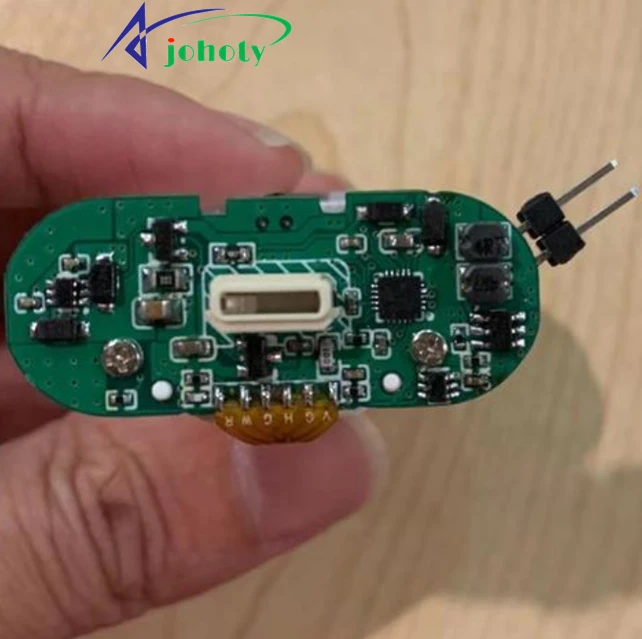
Flagship TWS earphone charging case:
Challenges: The latest generation high-end headphone compartment needs to be designed in a card style. The PCB is stacked on the shaft side, and the installation height of the charging pin is strictly limited to within 1.50mm. Supports 2A current to cope with fast charging, and ensures no wear on the coating after more than 10,000 insertions and removals.
Solutions: Choose Johoty lower profile pogo pins, with a total height of only 1.20mm after compression. The working stroke is 0.40mm and provides a stable spring force of 35gf to ensure low impedance contact.
Results: Successfully assisted the customer in reducing TWS thickness by 15%. After 10,000 cycles, the contact resistance remained stable at <20mΩ. Johoty lower profile pogo pins did not experience any elastic attenuation in low spaces.
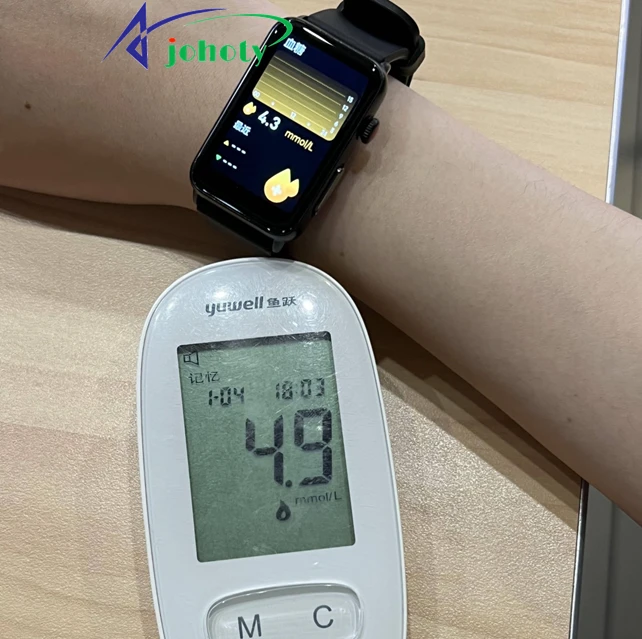
Continuous blood glucose monitoring instrument CGM:
Challenges: Skin mounted medical devices are extremely sensitive to thickness and require stacking of batteries, FPCs, and controllers inside. The connector height must be controlled below 1.50mm. Weak bioelectric signals need to be transmitted, with contact resistance fluctuations less than ± 5mΩ to prevent data loss.
Solutions: Low profile pogo pins using Johoty gold-plated hard gold technology. The height after mounting is 1.35mm, equipped with shockproof design. Provide a soft contact force of 25gf at a micro stroke of 0.20mm to avoid compressing the FPC and causing signal interference.
Results: Passed 5,000 simulated wearing tests of medical grade, with a signal transmission error rate close to zero. The large-scale procurement by the customer has significantly improved the signal stability reputation of their equipment among similar products.
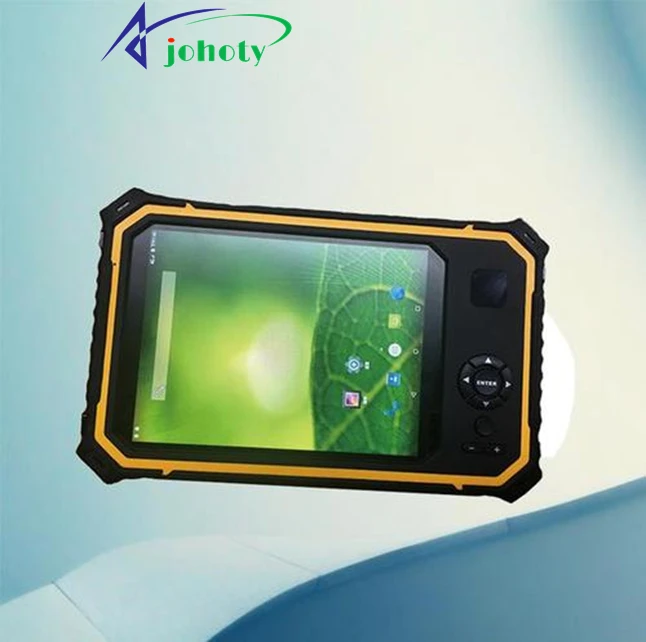
Industrial explosion-proof handheld terminal:
Challenges: Handheld terminals used in the petrochemical industry require connection to external detection probes. Faced with harsh vibration environments and extremely small internal stacking space, the connector height is limited to 2.80mm. The connector is required to be earthquake resistant and able to reliably charge even when immersed in a small amount of salt water.
Solutions: Johoty IP67 low profile pogo pins, using double reed tubes to ensure seismic resistance. Cooperate with sealed outer ring and dual chamber dual spring structure to achieve IP67 waterproof rating. The compact motherboard with a mounting height of 2.50mm has increased contact elasticity to 100gf and will not break instantly under vibration.
Results: Through MIL-STD vibration testing, customer feedback showed that the Johoty lower profile pogo pins connection failure rate decreased by 80% under harsh operating conditions.
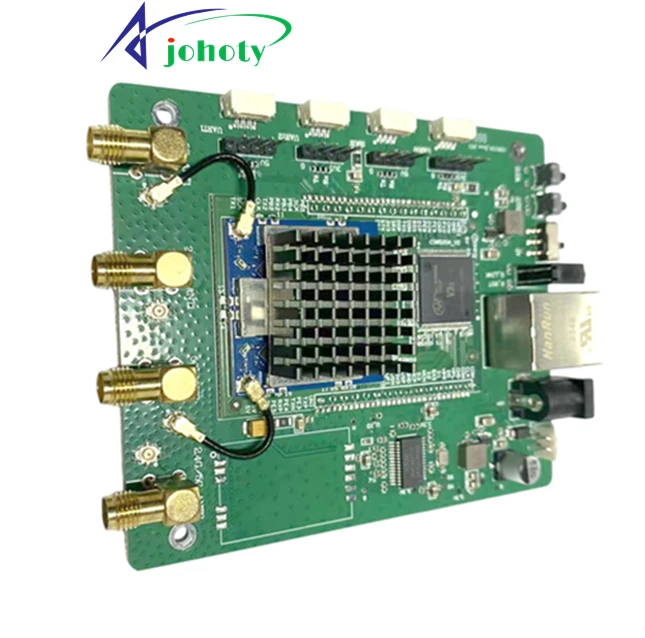
Micro drone image transmission module:
Challenges: The weight of consumer grade drones needs to be precisely controlled, and the distance between the image transmission module and the motherboard needs to be compressed to a maximum of 1.80mm. Ordinary wiring harnesses are heavy and occupy Z-axis space. We need an extremely low altitude connection solution that can provide power and transmit high-speed signals.
Solutions: Johoty high speed low profile pogo pins, height 1.60mm, working stroke 0.25mm. We design 4-point plunger tips and contact surfaces. Support 2A current supply motor to ensure USB 3.0 signal integrity.
Results: The customer saved valuable vertical space of 1.20mm in module design and reduced weight by 3g. After rigorous customer verification, Johoty’s high speed low profile pogo pins have directly improved drone endurance and maneuverability.
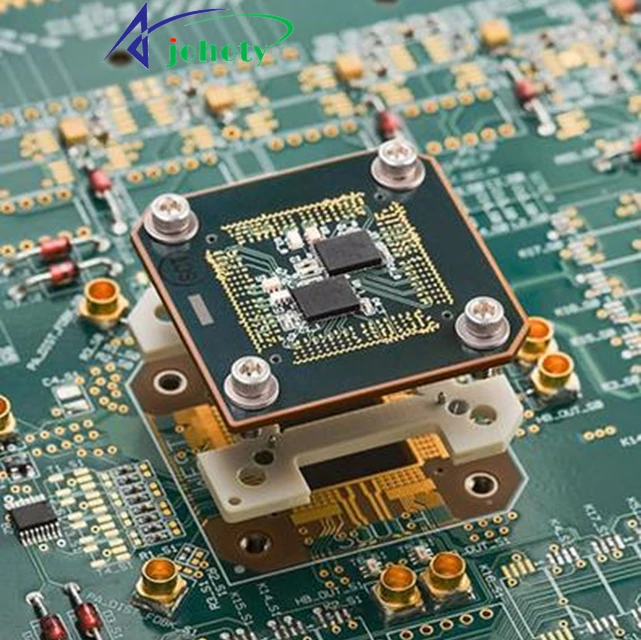
Wafer testing probe card:
Challenges: In semiconductor testing fixtures, the spacing between chip pads keeps shrinking. The test probe needs to achieve high-frequency insertion and removal when the diameter is extremely small and the total length is less than 5.00mm. Simultaneously maintaining an extremely low inductance value to ensure that high-frequency test signals are not distorted.
Solutions: Customize the Johoty low profile pogo pins series of IC test probes. We use special beryllium copper and extremely small SUS631 springs. Within a total length of 4.50mm, a stroke of 1.50mm was achieved with an elastic force of 15gf.
Results: The tested plug-in life exceeds 500,000 times, and the characteristic impedance matching degree at high frequency is as high as 98%. Significantly improve testing yield and probe replacement cycle, reduce NFT rate and customer testing costs.
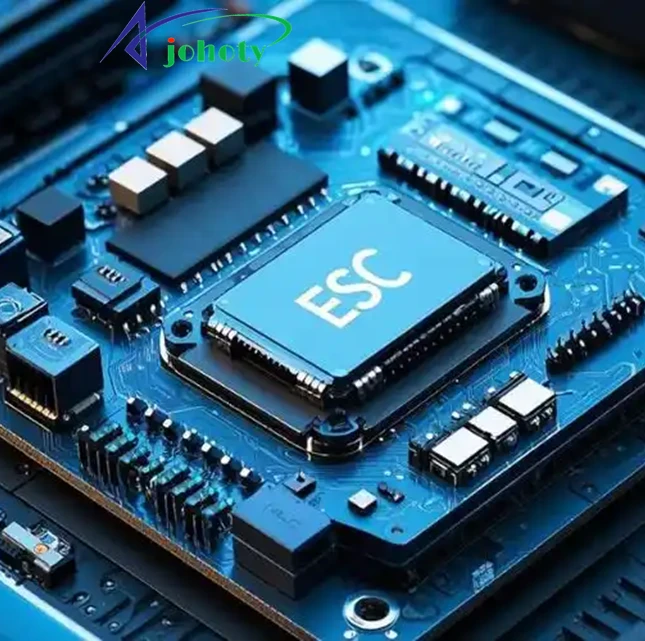
Automotive ESC module:
Challenges: The ESC module installed near the gearbox has extremely limited space. And it needs to withstand extreme temperature cycles from -40℃ to +125℃. Traditional welding harnesses pose a risk of weld cracking and occupy space.
Solutions: Johoty through hole and low profile pogo pins, height 2.00mm, with 80g high elasticity. It can still bite tightly under severe thermal expansion and contraction. All materials comply with RoHS and REACH.
Results: Successfully passed the 1,000 hour high-temperature durability test. In the 125℃ cyclic test, the change rate of contact resistance is <5%. We provide extremely reliable internal and external connections for our customers’ electronic control systems.
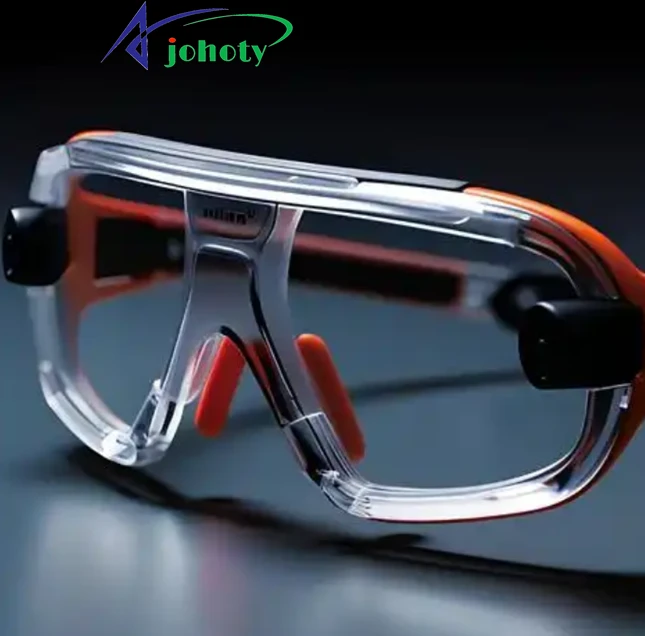
Smart glasses/AR glasses hinge:
Challenges: The conductivity between the legs and frame of smart glasses needs to pass through extremely thin hinges. The axial space left for the connector is only 1.00mm of cylindrical space. It is necessary to maintain continuity when the user opens and closes the mirror legs every day.
Solutions: Johoty develops low profile pogo pins for dedicated micro cylinders. With a diameter of 0.80mm and a length of 2.00mm, it provides precise elasticity of 20Gf within a small 0.15mm stroke.
Results: Successfully supported over 5,000 tests for the lifespan of the temple opening and closing. The enameled wire is no longer easily broken in this space, achieving invisible conductivity.
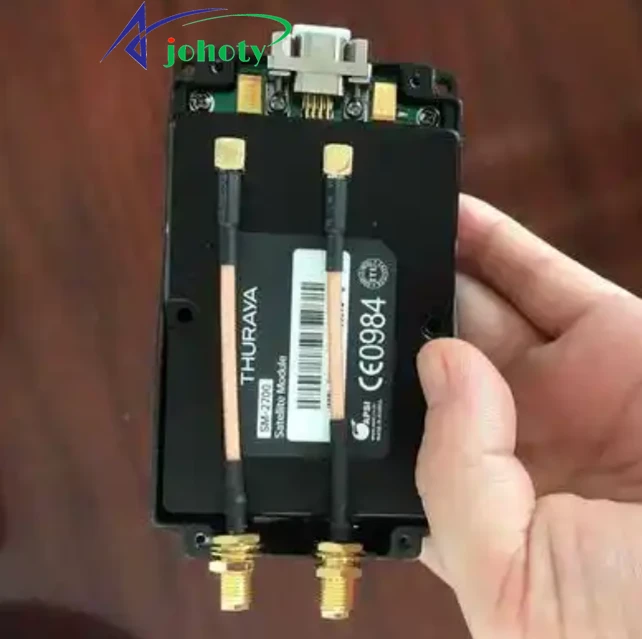
Satellite communication module:
Challenges: In aerospace grade communication modules, multi-layer PCBs need to reserve gaps due to heat dissipation and vibration. Board to board connection needs to be achieved within a 2.20mm space. The connector is required to have a radial floating capacity of ±0.10mm to compensate for assembly tolerances.
Solutions: Use Johoty floating low profile pogo pins with an installation height of 2.00mm. The unique dual head floating can absorb vibrations and tolerances in both directions. Stable transmission of 2A current under 15G vibration conditions.
Results: Passed rigorous random vibration and impact tests. The low profile pogo pins have been evaluated by customers as solving the final challenge of high reliability connections in low and compact spaces.
FAQ
Challenges:
In low profile pogo pins applications, pogo pins will significantly compress their height when the radial size remains unchanged. This can easily cause the internal spring to bend and get stuck, and poor contact between the plunger and the barrel wall can result in the spring burning out. Therefore, Johoty will adopt the following solutions:
Reverse drilling:
This is the core design for dealing with ultra-low heights. Performing secondary precision drilling at the tail of the plunger increases the effective space for the spring to move. This design ensures smooth compression and greatly eliminates the risk of pin jamming. But this design has limited current carrying capacity. The current of a single pogo pin should be strictly controlled within 1A, otherwise it is very easy to burn the spring. Therefore, it is mainly used for signal transmission and is not suitable for high current charging.
Integrated spring and thin-walled technology:
For more space inside, the spring diameter is designed to be only 0.30mm. The barrel wall is also made to be only 0.15mm through precision technology. This ensures structural strength and contact force within a limited space.
Slope contact design:
Cut the end of the contact between the plunger and the spring into a slope. During the compression process, the plunger maintains a large and tight contact with the needle tube. This ensures the stability of the current transmission path and is the foundation for achieving low impedance. Ball/insulator technology: This is a clever solution for low profile pogo pins that require current to pass through. It involves adding balls or insulating beads to the barrel. The current mainly flows through the low impedance metal path of plunger, ball, and barrel, cleverly bypassing the spring. Fundamentally eliminating the risk of springs overheating and burning due to conductivity.
Challenges: Many engineers believe that low altitude inevitably sacrifices electrical performance, which is a misconception. To achieve ≤1.50mm while maintaining stable <15mΩ and earthquake resistance, good design and manufacturing processes are indeed required. Johoty’s solution is as follows:
Structural design:
Using SMT and integrated springs: To meet the ultra-thin requirements, Johoty adopts a flat surface mount process. The overall height can be controlled within 2.50mm, which is >50% lower than traditional direct insertion. At the same time, an integrated spring design is adopted to compress the spring diameter to 0.30mm. The stable 30-80gf and ≥50,000 fatigue life are ensured by a thin middle section and thick ends.
Internal slope design: In order to ensure the stability of the current path, the end of the plunger in contact with the spring should be designed as a slope. This design ensures that the plunger maintains 100% contact with barrel inner wall during operation. Obtain low and stable contact impedance to avoid internal instantaneous disconnection caused by vibration.
Materials and Coatings:
Base material and spring: Barrel and plunger are made of brass or beryllium copper with good conductivity. And the internal spring must use high elasticity beryllium copper, SWP-B, SUS631, also using SUS304. We can ensure that low profile pogo pins can still provide sufficient contact force after long-term compression and vibration.
Plating process: The surface must be treated with gold plating, usually with nickel plating as the base and then hard gold plating. Hard gold coating can effectively reduce contact resistance and stabilize it at <30mΩ. It has excellent resistance on corrosion and wear, and can resist sweat, salt spray, etc. Prevent resistance increase caused by micro motion wear.
Mechanical force properties:
Stable spring force: The larger the force, the better, but it must be stable and have minimal fluctuations, preferably within ≤±10%. When designing, Johoty ensures that the elasticity can also meet the signal pin ≥60gf at the maximum working height. Ensure that there is no interruption time of ≤1μs under vibration.
Multi point contact: To improve reliability, the plunger tip can be designed with 3-4 contact bumps. This multi-point parallel connection ensures that even if a single contact experiences micro motion wear due to vibration, other contacts can still remain conductive. This ensures that the contact resistance is always below the threshold.
Process and validation:
Precision manufacturing and assembly: Barrel adopts a 0.15mm thin-walled molding process and an injection mold with a tolerance of ± 0.005mm. Pogo pin connectors with low profile pogo pins have extremely high structural strength and consistency in confined spaces.
Strict testing standards: Low profile pogo pins must pass targeted vibration and impact testing. For example, vibration testing at 10-2000Hz and 10G acceleration. We all require low profile pogo pins to have no offset and a contact resistance change of ≤10mΩ. Their initial resistance has sufficient margin and can still remain stable below 15mΩ after testing.
Ultra-thin right angle solution:
When the Z-axis space is occupied by batteries or sensors, traditional vertical assembly pogo pins have no place to go. At this point, the right angle scheme must be adopted to convert the vertical connection force into the horizontal direction. In response to this extreme low profile requirement, Johoty offers multiple key solutions:
Our right angle pogo pin is designed specifically for board to board horizontal interconnection. It can compress the Z-axis stack thickness to a module embedding depth of 1.50mm. The built-in oblique plunger can automatically absorb a horizontal docking error of ±0.30mm. The contact impedance remains stable at <30mΩ after 10,000 lateral compressions.
High current:
Don’t be fooled by the low profile pogo pins’ low height. Through the parallel design of multiple pogo pins, the current can be expanded from the standard 3-10A to 50A, meeting the high current requirements of BMS for drones and electric vehicles.
Miniature:
For TWS earphones or smart glasses, Johoty has a miniature pogo pin with a diameter of 0.50mm and a height of 1.40mm. They also support 90° bending to fit the curvature of the mirror legs. At a fine pitch of 1.00mm, it can maintain a contact resistance of ≤15mΩ. It can pass 100,000 high-frequency tests, completely solving the after-sales problem caused by sweat corrosion of smart wearable devices.
Many customers are looking for low profile pogo pins with a working height of 1.10mm. Hope Johoty can help solve the challenges of lateral connections. Some customers also require small-sized low profile pogo pins with a fine spacing of 1.00mm. Johoty can ensure that you meet your space compression needs. Help you achieve ultimate electrical stability and mechanical tolerance capability.