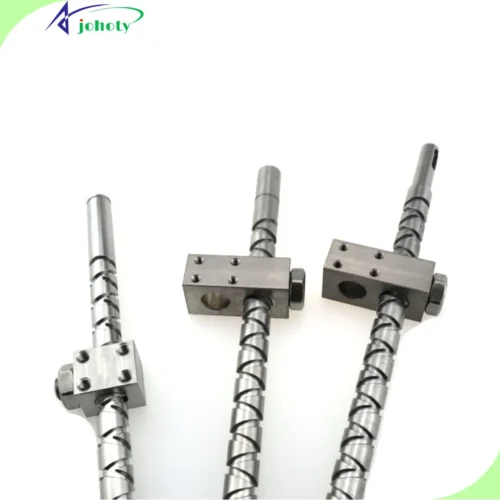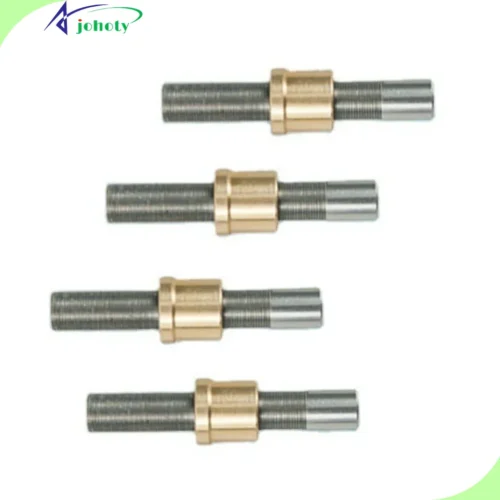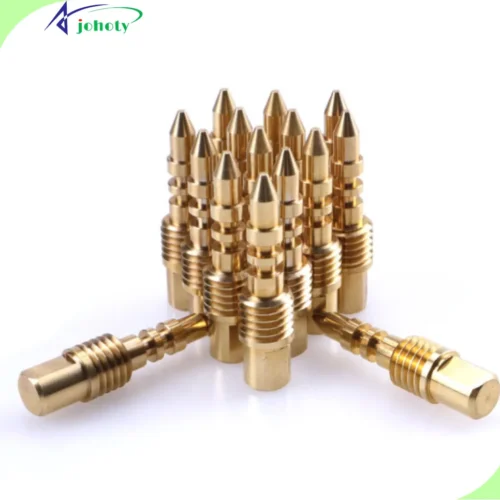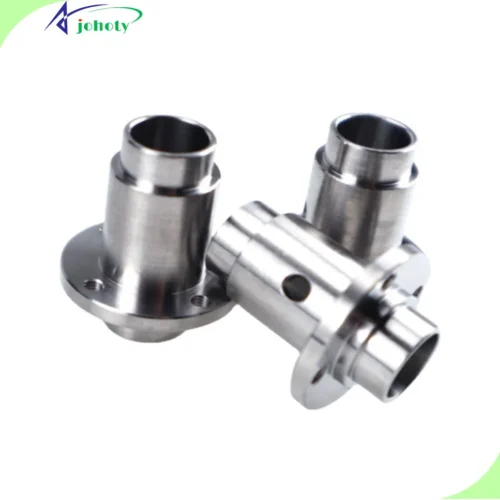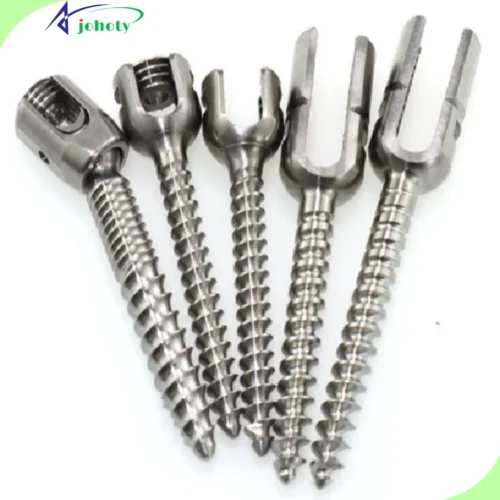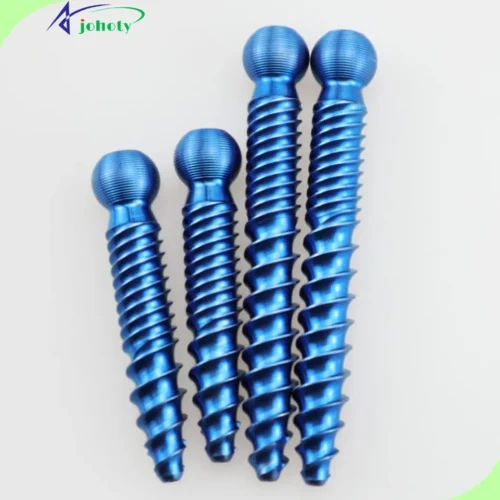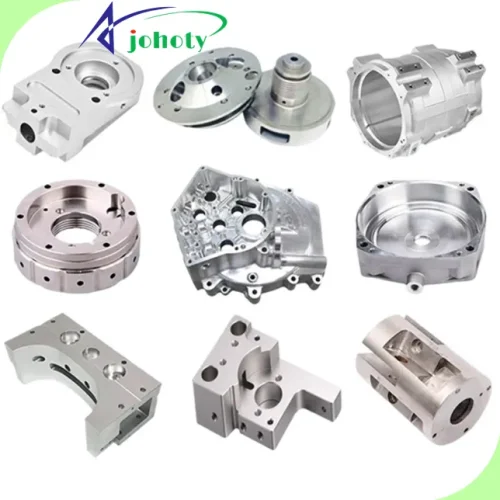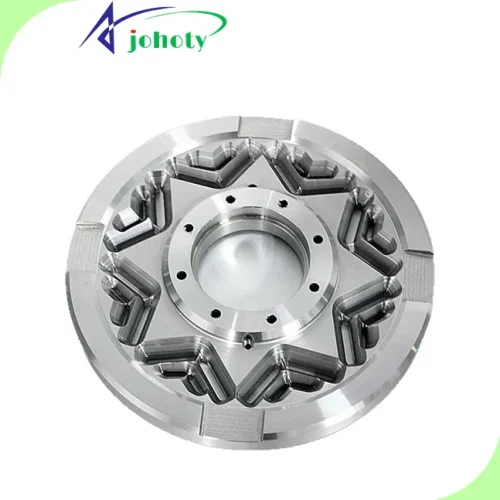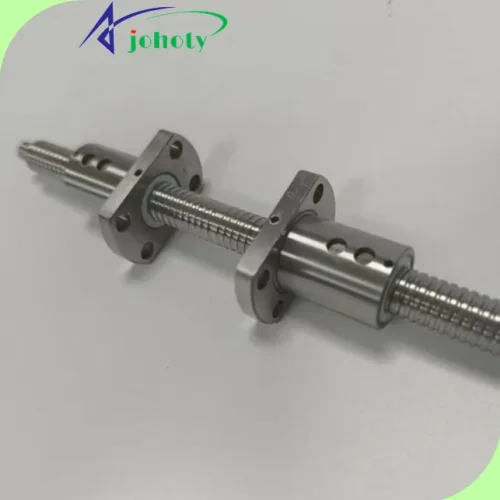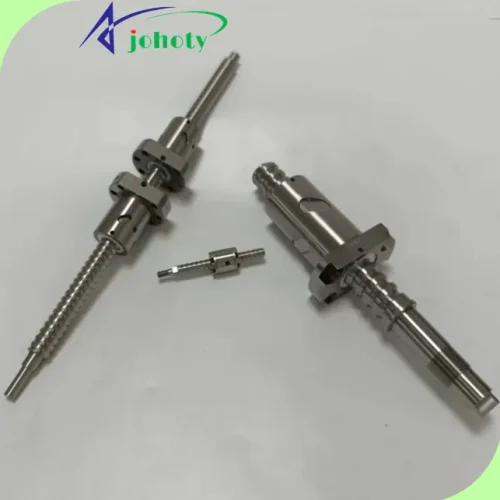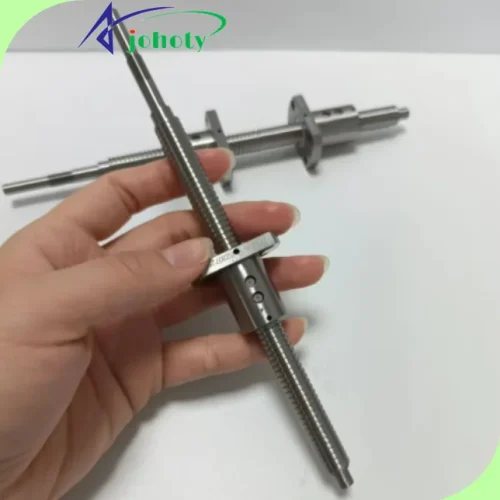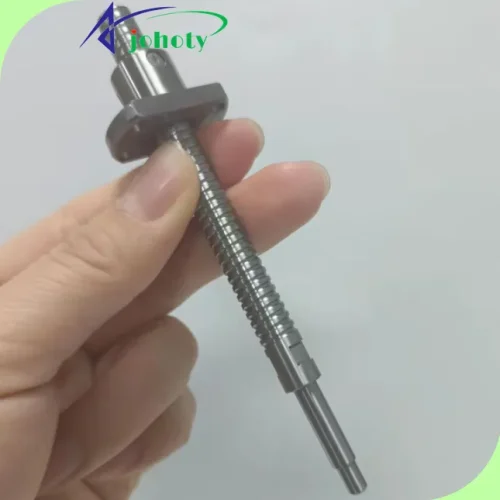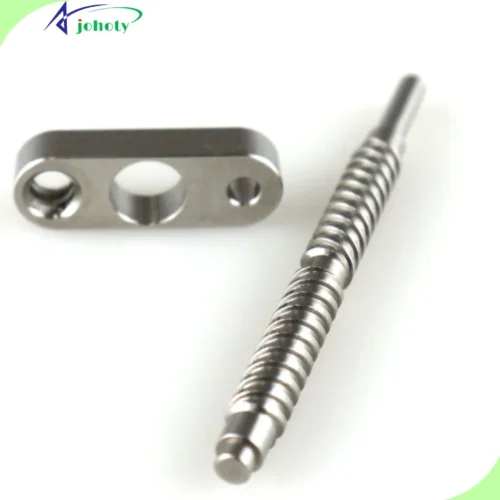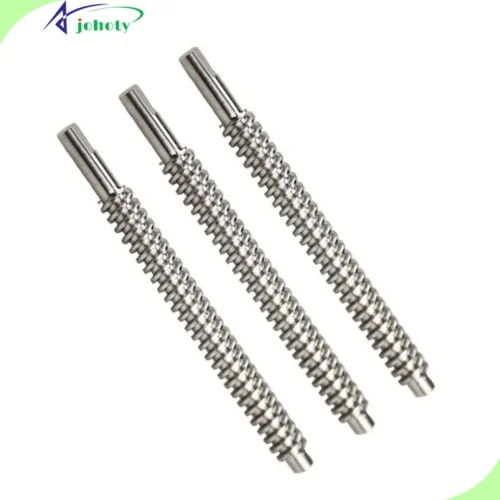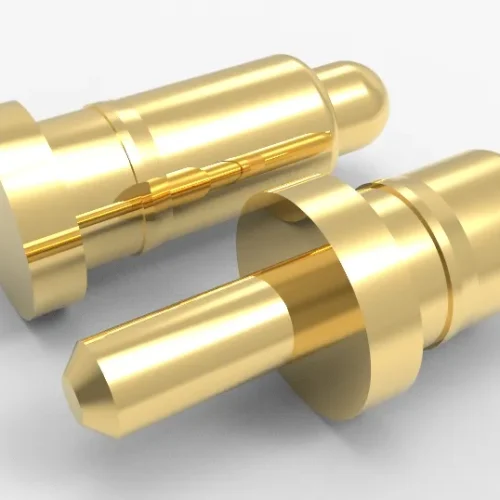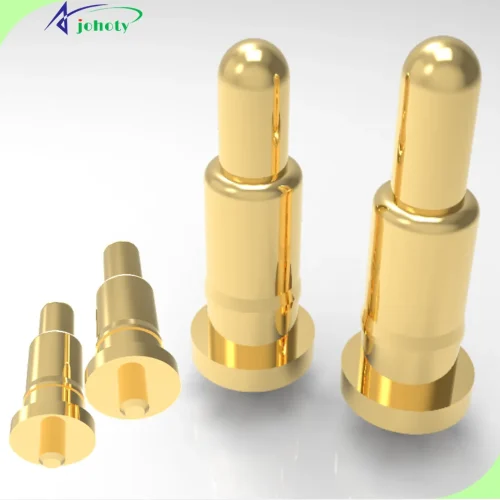


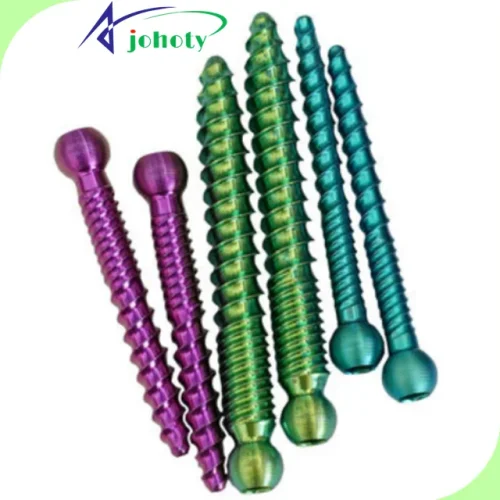
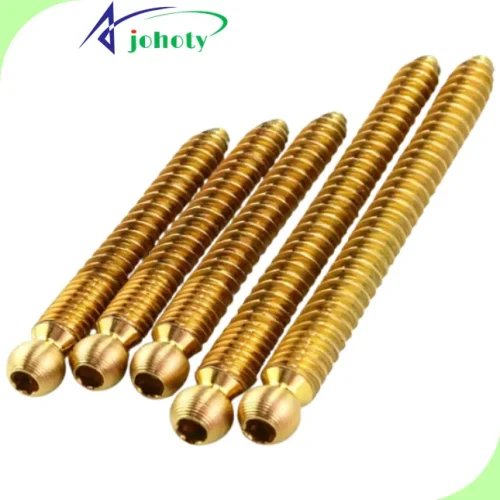
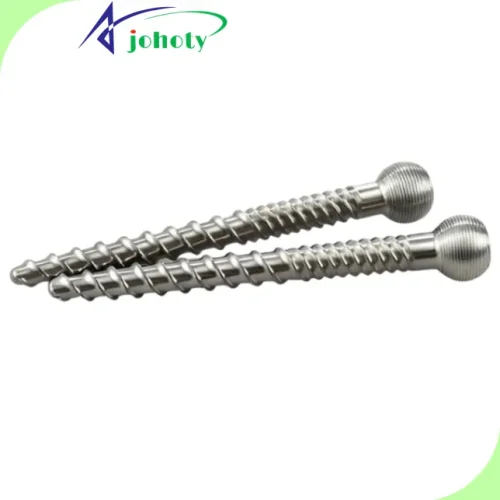
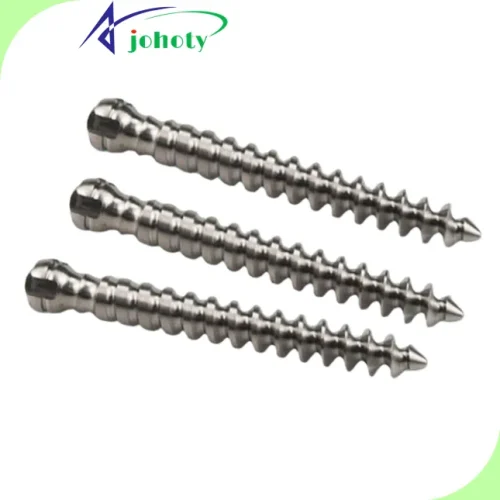
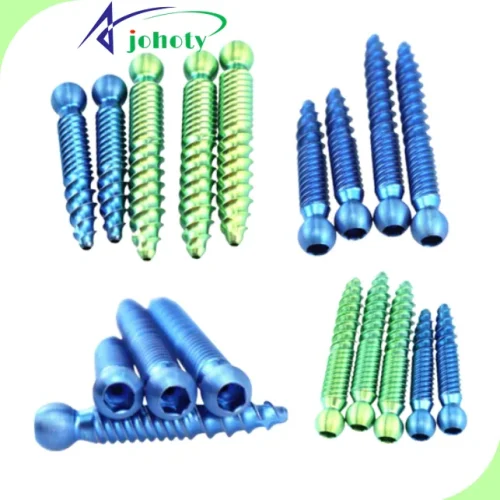
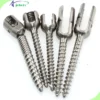
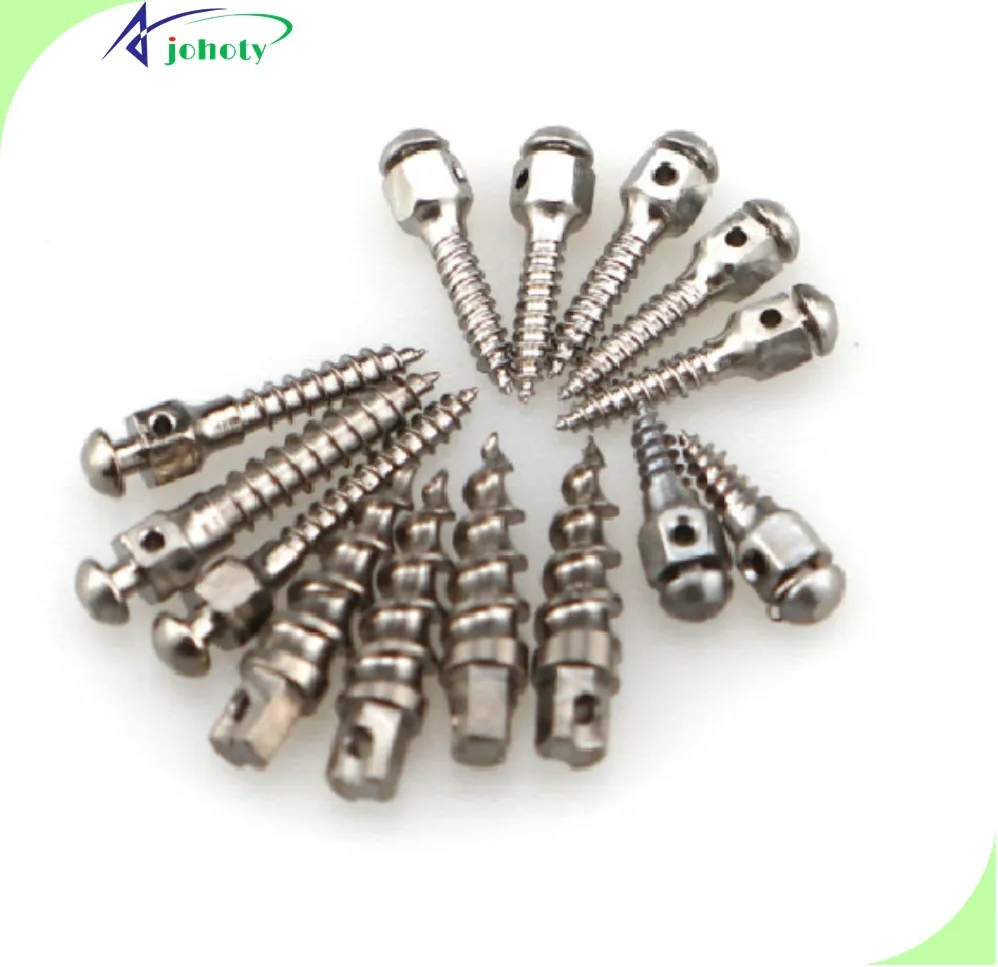
Implant Screw Description:
Mechanical specs and process parameters:
Thread valley bottom/load contact surface roughness: Ra ≤0.2μm, differentially control in designated areas.
Bottom corner/tool radius: ≤0.10 mm for micro tool machining for small-sized and sharp turning structures.
Thread specifications and tolerances: ISO/custom threads, precision according to customer drawings.
Key dimensions SPC: SPC controls diameter, pitch, taper, drive profile, shoulder transition, and can provide Cp/Cpk reports.
Micro texture orientation: Customize texture direction, pitch, depth, and coverage area.
Surface engineering: sandblasting, acid etching, composite process, set up parameters according to the target bone bonding speed.
Material: Ti-6Al-4V ELI, medical stainless steel, heat treated, aging state executed as specified.
Traceability system: Raw material furnace number, bar batch number, CNC machining batch, finishing batch, final inspection batch, full process batch number traceability.
Implant screw feature application + performance + compatibility:
Functional application: Suitable for long-term implantation of bone fixation, implant connection, and modular component locking. Support disposable implant screws, detachable attachment implant screws, and system platform matching implant screws
Key performance: Geometry and valley radius are optimized according to stress paths, reducing local stress concentration and improving high cycle fatigue life. Controllable micro texture + surface activation to enhance initial osseointegration speed and interface stability. The torque displacement curve, pull-out force, and fatigue life can be aligned with ASTM/ISO/customer internal standards.
Compatibility and adaptation: It can be reverse engineered based on existing platforms to achieve complete compatibility of the connection interface, only upgrading materials and surface engineering. Support geometric and surface joint operations based on customer CAD/FEA models to synergistically optimize stress distribution and bone contact area. The tolerance zone, driving form, and connection profile are all defined according to the customer platform, making it easy to directly match with existing instruments and implant systems.
Johoty value:
Deep microfabrication capability: Mature application of Ra ≤0.2μm thread valley and contact surface microfabrication technology. Stable control of tool radius ≤0.10mm under mass production conditions to ensure consistency of small-sized features.
Engineering oriented surface and stress design: Micro texture orientation and texture parameters can be defined according to engineering goals, rather than fixed standard textures. Based on customer FEA data, optimize thread geometry and transition zone stress distribution to reduce fatigue fracture risk.
Manufacturing quality and data transparency: Implement SPC for critical dimensions and provide Cpk data. Traceability from material furnace number to implant screw batch supports medical device regulations and quality system requirements.
Flexible customization and engineering docking: Supports migration from small batch trial production to the same process platform for implant screw mass production, with parameters that can be smoothly scaled up. Engineers can communicate directly with engineers and iterate design around drawings, tolerances, surface call outs, and test indicators.
Catalogs of Implat Screw, Dental Implant Screws:
Challenges and Solutions of Implant Screw
Optimization of microfabrication technology: precise tool radius control:
Challenges: In high-precision medical device or implant screw manufacturing, the controllability of surface fine texture and tool radius are crucial for microfabrication. Any small error may affect the overall quality and fatigue life of the product.
Johoty solutions: Using five-axis and six-axis microfabrication equipment, Johoty precisely controls the bottom of the thread and the contact surface. We can provide surface quality for implant screws with Ra ≤ 0.2μm. The micro texture orientation of surface microstructure can effectively reduce stress concentration. To avoid fatigue fractures caused by surface defects and extend the service life of the implant screw.
Bone Fusion Acceleration and Stress Optimization Design:
Challenges: Implant screw: Surface activation treatment can effectively improve the binding speed of bone tissue during the process of osseointegration. Engineers often require improved osseointegration to ensure optimal stress distribution of the implant screw.
Johoty solutions: Advanced surface activation to improve bone integration speed and reduce postoperative adverse reactions. The optimized stress distribution design makes the implant screw safer. We can avoid fatigue damage during long-term use and ensure the stability and reliability of the implant screw.
Total Quality Control and Traceability Management:
Challenges: Medical devices or implant screws require high material traceability and critical dimension control. Engineers often focus on the traceability of every implant screw. And the dimensional accuracy of each implant screw to meet the strict quality standards of the European and American markets.
Johoty solutions: Strictly implement material batch number traceability management to ensure traceability of raw materials and production processes for each implant screw. Through SPC, Johoty ensures the accuracy of critical dimensions and conducts strict quality inspections on each batch of implant screws. Minimize production errors to ensure that each implant screw has of the highest quality.
Why Choose Johoty’s Implant Screw ?
Choosing Johoty to customize implant screw bottom and contact surface ensures ultra-precision machining with Ra ≤0.2μm. Cooperate with micro-cutting tools to achieve ultimate CNC machining accuracy. Avoiding fatigue fracture, improving bone bonding speed, key dimensions comply with SPC, material batch numbers can be traced, ensuring high-end quality!
Implant Screw Benefits:

Precision machining and micro control:
Challenges: Engineers often face how to ensure the quality and stability of ultra-precision machining in terms of thread valley and contact surface accuracy. When the tool radius is ≤0.10mm, traditional equipment cannot provide such detailed machining capabilities. This leads to substandard machining accuracy, affecting the functionality and reliability of the implant screw.
Solutions: Johoty’s flexible customization, combined with high-precision machining equipment, can achieve thread valley and contact surface treatment with Ra ≤0.2μm. This precision in microfabrication ensures the stability and functionality of the threaded structure.

Surface micro texture control and stress distribution optimization:
Challenges: In the joint implant screw, it is necessary to ensure that the micro texture on the surface of the implant screw can meet the optimal performance requirements. The control of surface texture is directly related to the osseointegration effect and service life of the implant screw. The uniformity of stress distribution is the key to avoiding fatigue fracture.
Solutions: Johoty can provide surface micro texture orientation, optimize stress distribution, and reduce the risk of fatigue fracture. Engineers can adjust the direction and shape of surface microtextures according to actual needs. Help solve the fatigue rupture and poor osseointegration that have long plagued engineers.

Material traceability and batch number management:
Challenges: In the fields of healthcare and biotechnology, batch number traceability of materials cannot be ignored. The traceability of the material and processing of each implant screw can help engineers provide reliable data support. However, existing systems often lack precise traceability and are unable to effectively manage and control the quality of implant screws.
Solutions: Johoty provides material batch number traceability function, which enables accurate traceability of raw materials, production processes, and quality data for each implant screw. This can meet the strict requirements of the high-end market for quality traceability. It also greatly enhances your safety and reliability in the design and production process.

Enhancement of osseointegration speed and surface activation:
Challenges: For joint replacement and dental implantation, the speed and quality of osseointegration directly affect the long-term use of implant screws. Engineers must consider how to improve the speed of osseointegration when selecting materials and designing implants. Reduce patients’ recovery time and complication risks.
Solutions: Johoty has effectively improved the osseointegration speed of the implant screw through surface activation technology. Help the implant screw fuse with bone tissue faster and optimize the patient’s rehabilitation process. This can help engineers improve the performance of implant screws and optimize the clinical experience and treatment outcomes for patients.
Implant Screw Applications:
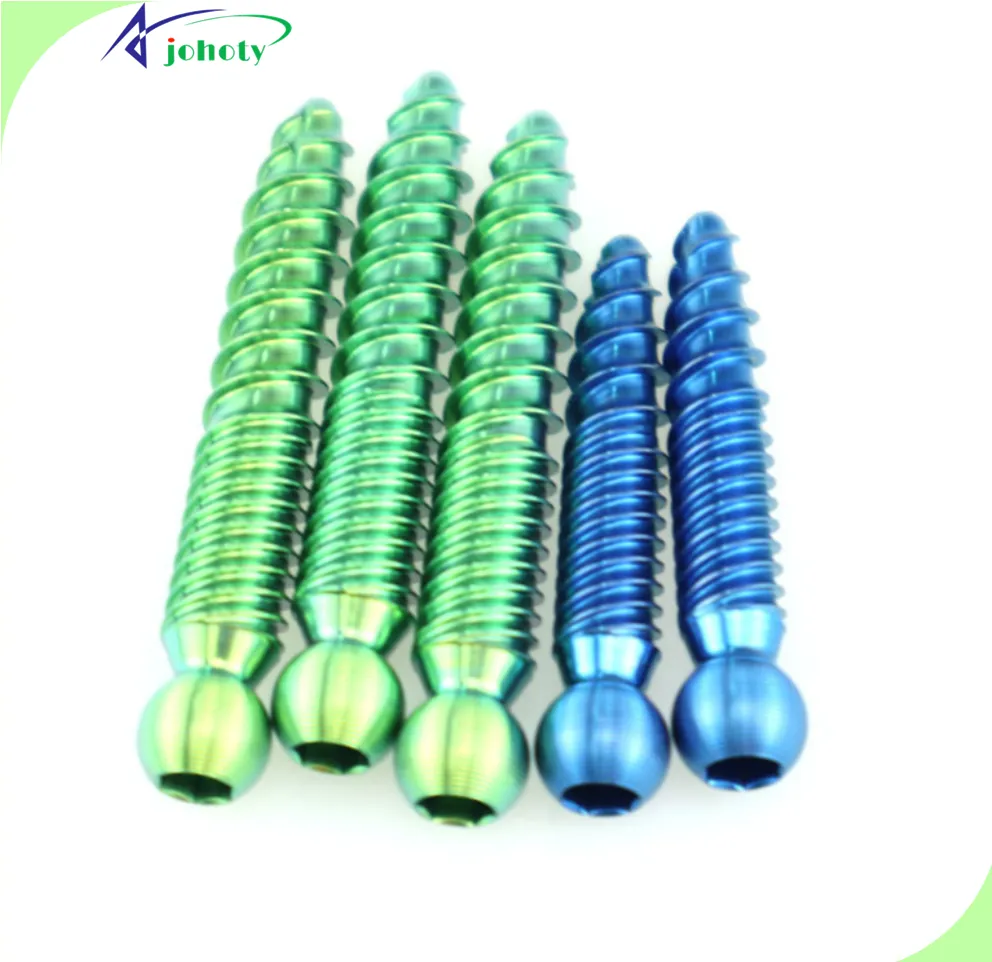
Implant screw for complex infection
Challenges: Poor bone conditions after infection, and traditional implant screw binding surfaces are prone to biofilm growth.
Function: Surface activation technology endows continuous antibacterial activity, and ultrafine cutting tools are used to process complex debridement structures.
Customization: Johoty customizes porous structures and drug loaded surfaces, combined with precise size control.
Solutions: The secondary infection rate decreased by 71%, and bone regeneration increased by 39%.
Efficiency/Costs: Renovation success rate increased by 58%, and subsequent anti-infective treatment costs decreased by 52%.
Advantages: Johoty’s implant screw can combine anti-infective function and structural customization.
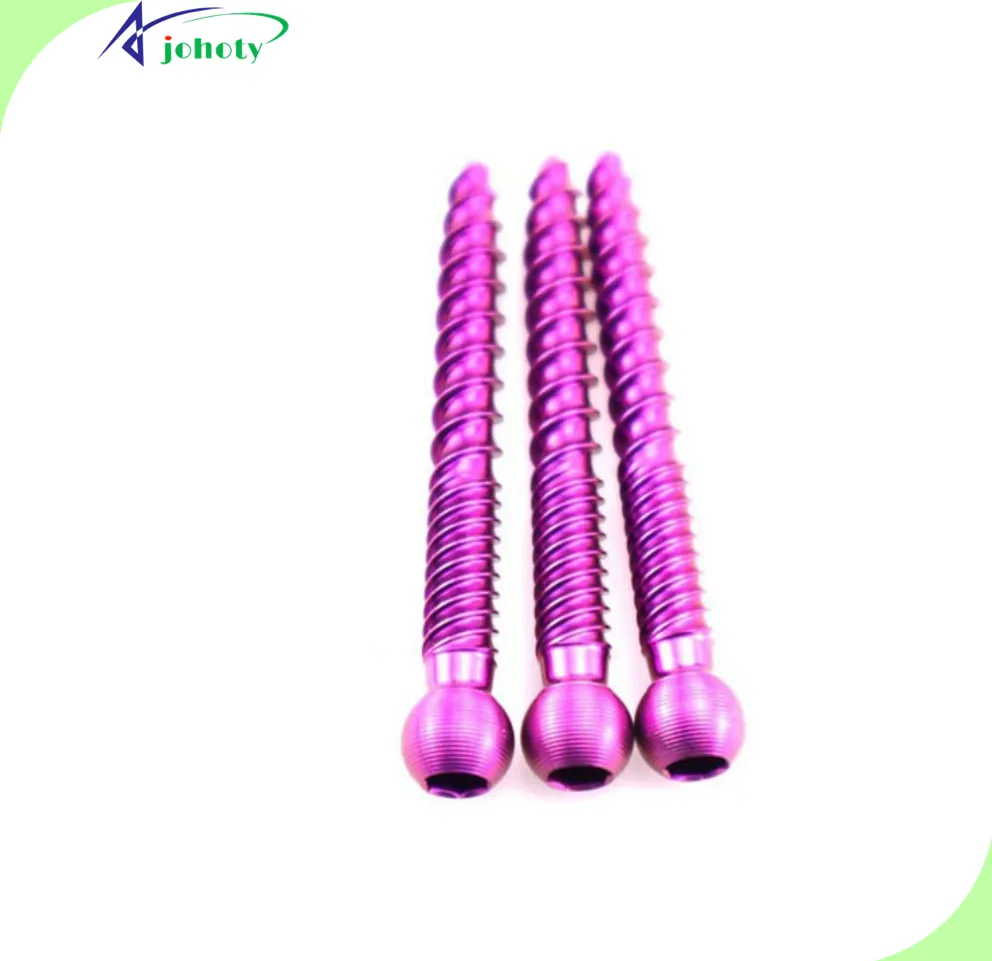
Pediatric growth adjustable implant screw
Challenges: The implant screw that needs to be adjusted as children grow has special requirements for surface durability and biological response.
Function: Material batch number traceability ensures biological safety, controllable surface texture reduces soft tissue adhesion.
Customization: Johoty designs precision threads and low roughness surfaces that can extend the structure.
Solutions: Adjust the surgical time to reduce by 55% and decrease the rate of surrounding tissue damage by 68%.
Efficiency/Costs: The number of surgeries has been reduced by 43%, and the total cost has been reduced by 27%.
Advantages: Johoty’s implant screw has high adjustability and organizational friendliness.
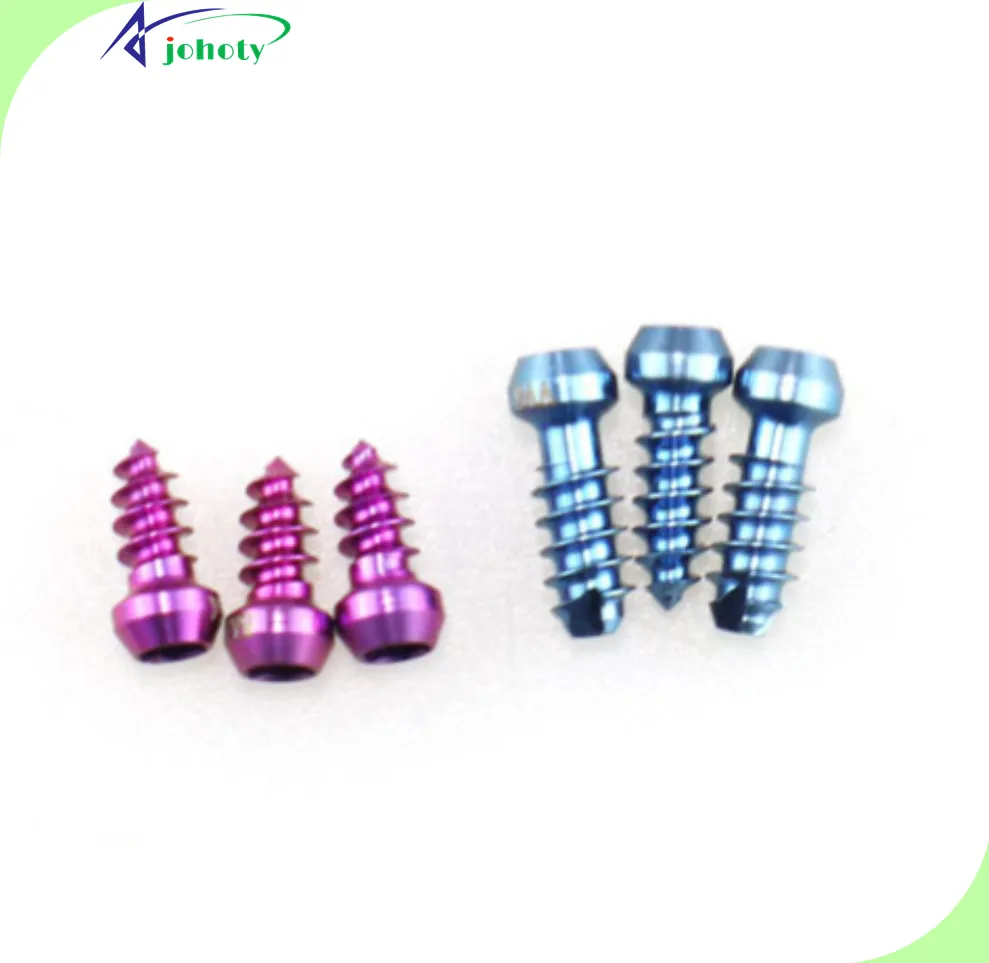
Sports Medicine High Strength Fixed Implant Screw
Challenges: The implant screw used for ligament repair is prone to loosening or breaking under high-speed impact.
Function: Ultra precision machining of threaded contact surfaces ensures uniform distribution of compressive stress. SPC controls thread lead accuracy to enhance grip force.
Customization: Johoty adopts anisotropic surface texture design to optimize the mechanical transfer at the bone implant interface.
Solutions: Under dynamic load, the displacement of the implant screw is reduced by 76%, and the failure cycle is extended by 3.2 times.
Efficiency/Costs: Postoperative rehabilitation time is reduced by 32%, and the rate of secondary surgery is reduced by 29%.
Advantages: Johoty’s implant screw has high dynamic stability and long-term durability.
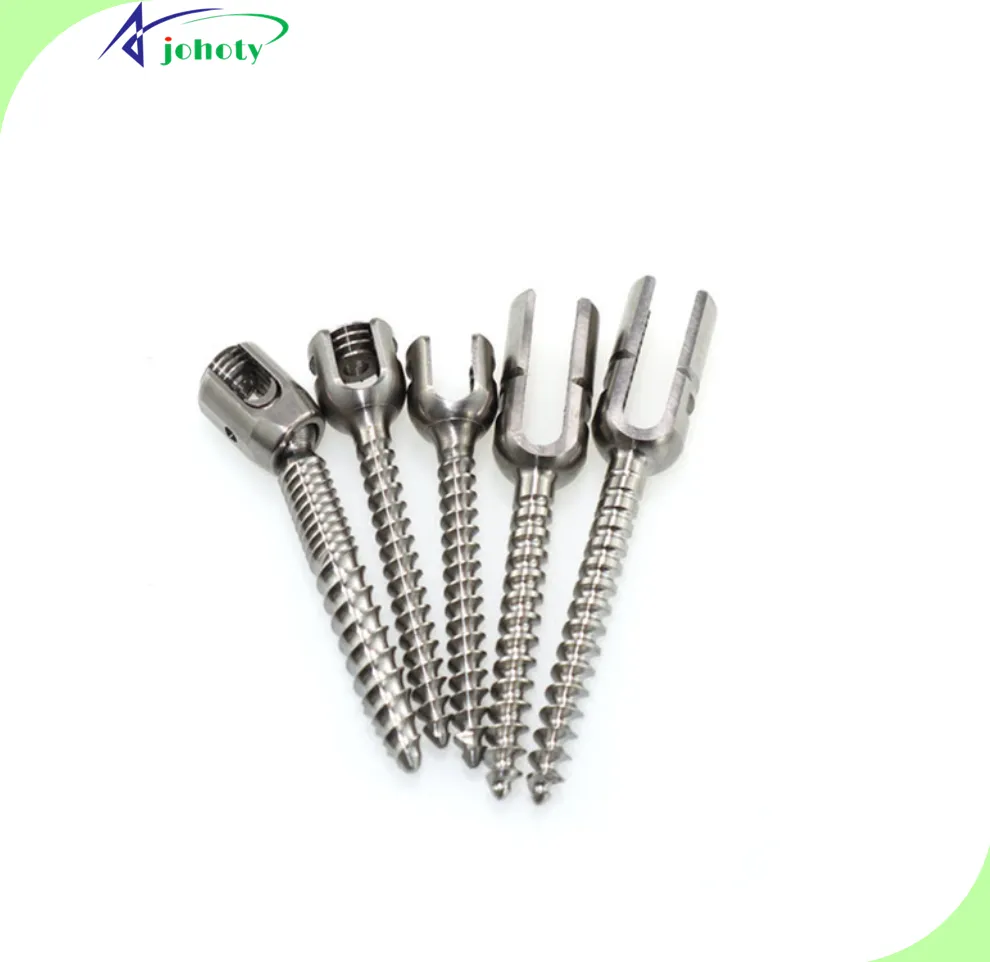
Implant screw for reconstruction after tumor resection
Challenges: The implant screw in the repair of large-span bone defects needs to withstand asymmetric loads and is prone to infection.
Function: The surface activation layer enhances antibacterial and osteoinductive properties. Controllable micro texture orientation guides the direction of bone growth.
Customization: Customize multi-stage thread design and functionally graded surface treatment.
Solutions: Johoty’s implant screw improves bone integration speed by 48% and reduces infection rate by 62%.
Efficiency/Costs: The cost of adjuvant therapy has been reduced by 41%, and hospitalization time has been shortened by 30%.
Advantages: Johoty’s implant screw has a biologically functionalized surface and mechanical adaptability.
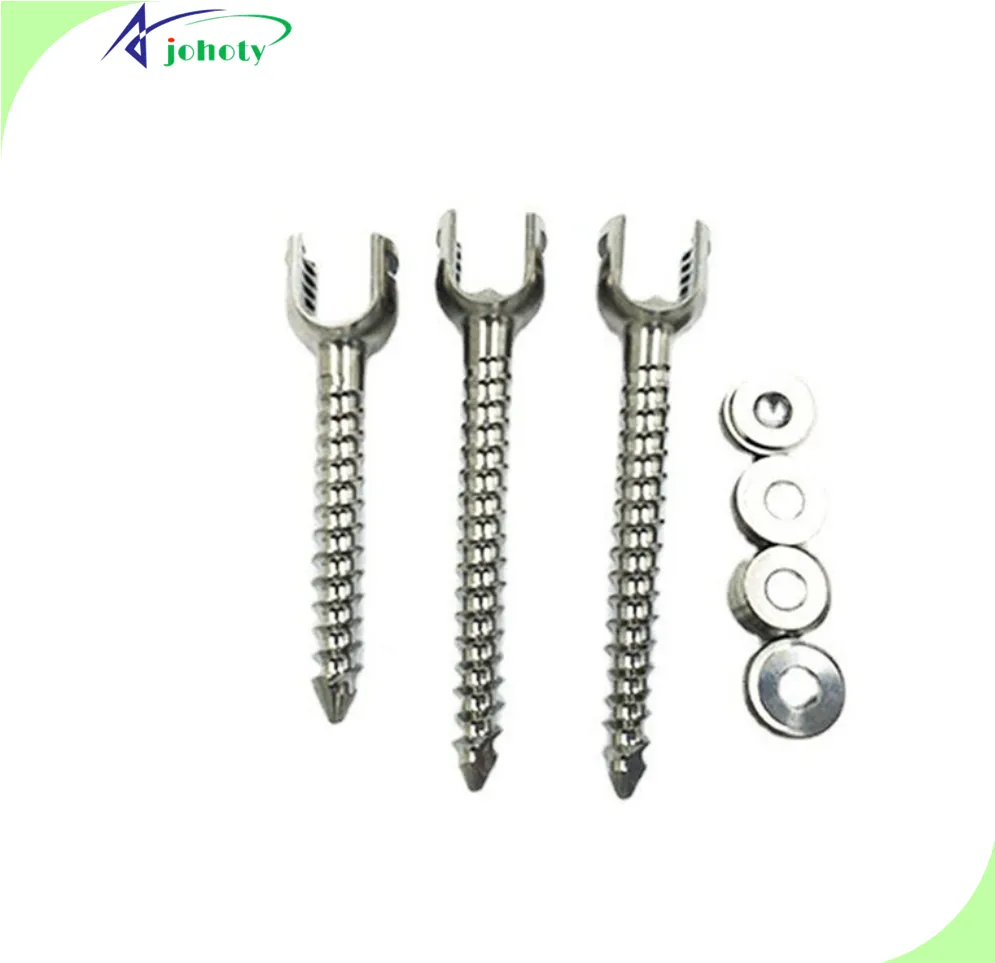
Minimally invasive spinal fixation implant screw
Challenge: It is difficult to balance the torsional strength and fatigue resistance of small-diameter implant screws.
Function: Optimize the valley radius and surface integrity of the thread to improve torsional durability. Optimizing stress distribution to avoid stress shielding.
Customization: Johoty adopts high-strength TC4 alloy and customized heat treatment process, combined with surface processing with Ra ≤ 0.2μm.
Solution: The torsional strength of the 4mm diameter implant screw has been increased by 33%, and the fatigue limit has been increased by 41%.
Efficiency/Cost: Johoty’s implant screw reduces the probability of failure by 44% and saves 35% on renovation related costs.
Advantage: Johoty’s implant screw can achieve a combination of high strength to weight ratio and reliability.
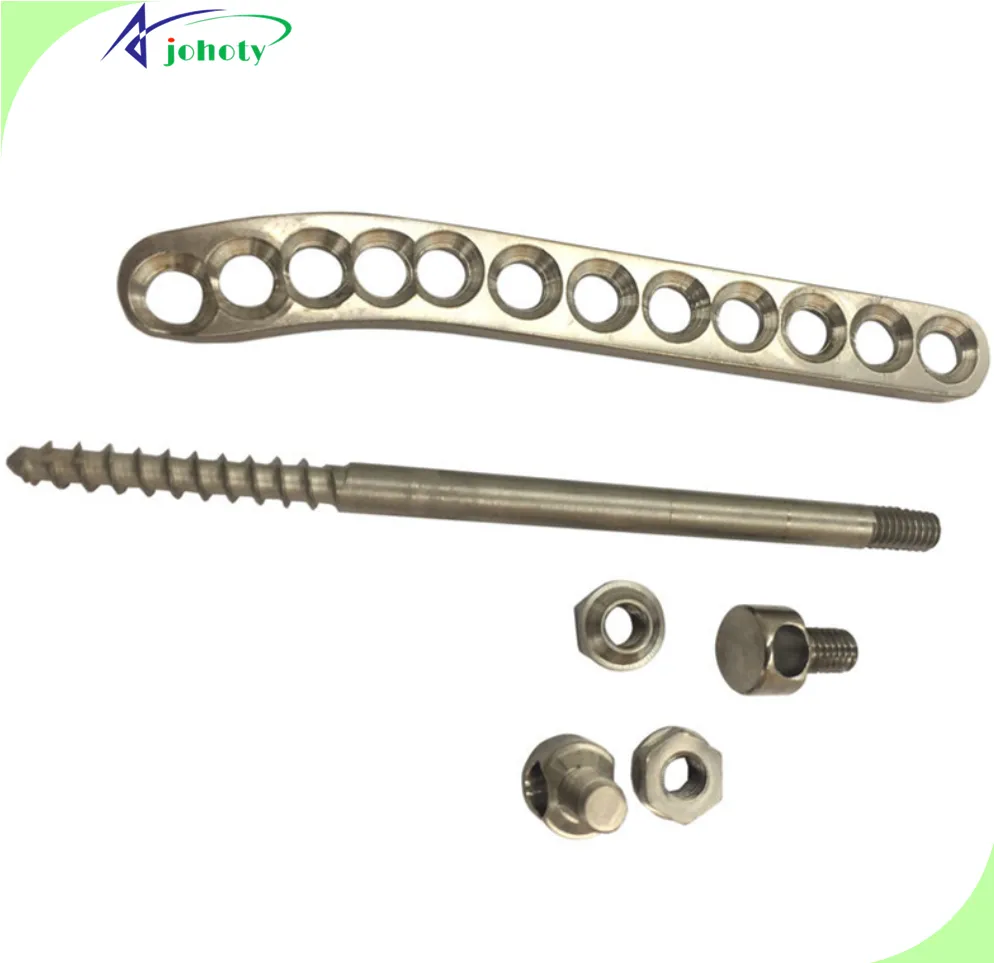
Maxillofacial skull base reconstruction with implant screw
Challenges: Complex anatomical structures require implant screws with irregular geometry and extremely high dimensional accuracy.
Function: SPC system monitors critical dimensional tolerances and enables micro machining equipment to achieve complex contours. Traceability of material batch numbers ensures consistency in biocompatibility.
Customization: Johoty customizes non-standard implant screw thread segments and head structures based on patient imaging data.
Solutions: The matching degree of Johoty’s plan screw reached 99.2%, and the adjustment time during operation was reduced by 70%.
Efficiency/Costs: Customization cycle shortened to 5 days, surgical planning efficiency increased by 60%.
Advantages: Johoty’s implant screw has high anatomical adaptability and traceability.
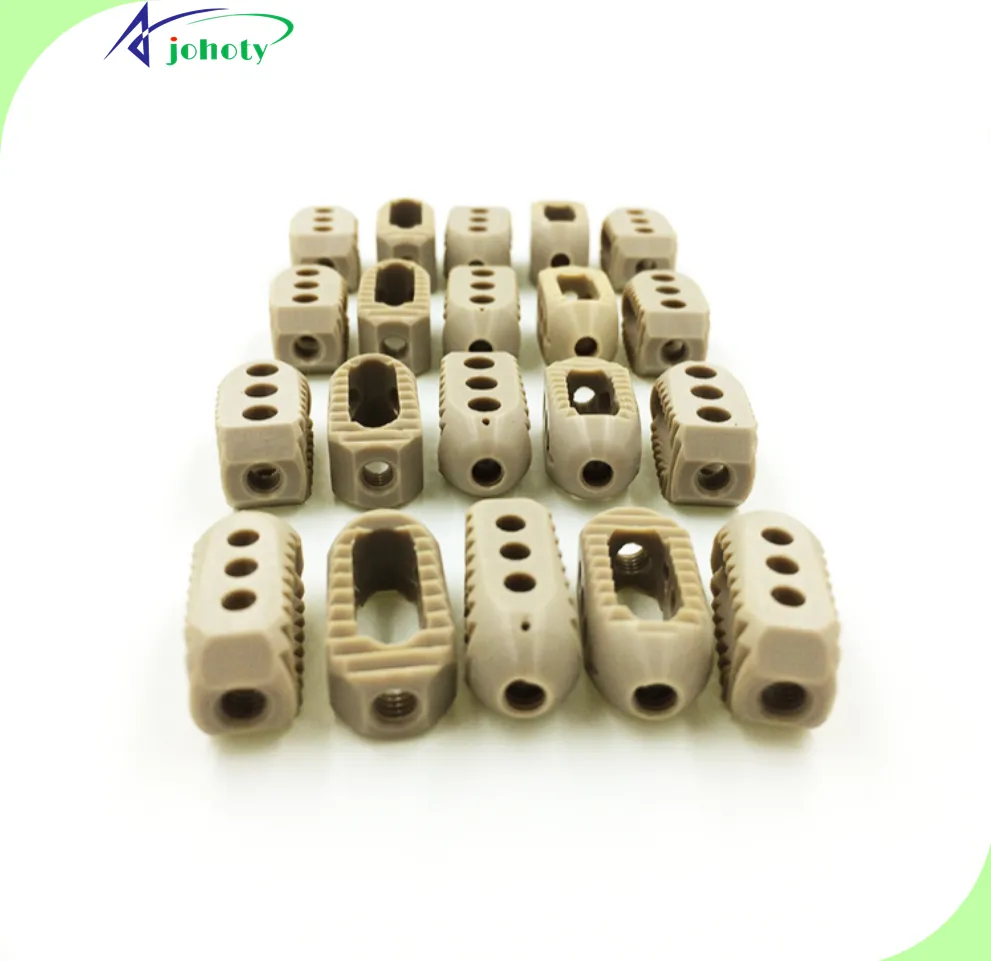
Use an implant screw in areas with osteoporosis
Challenges: Low bone density leads to insufficient initial stability and delayed osseointegration of the implant screw.
Function: Surface activation treatment enhances the adhesion speed of bone cells. Optimize the pressure distribution on the threaded contact surface to avoid local bone resorption.
Customization: Johoty customized surface chemical activation layer combined with controlled micro texture orientation.
Solutions: The patient’s osseointegration time is shortened by 40%, and the initial stability is improved by 52%.
Efficiency/Costs: Surgical time reduced by 25%, and related instrument costs reduced by 18%.
Advantages: Johoty’s implant screw accelerates bone integration and mechanical compatibility.
High dynamic load orthopedic implant screw
Challenges: Stress concentration at the root and mating surface of the implant screw thread under cyclic loading leads to microcracks and premature fatigue fracture.
Function: Reduce stress concentration at the bottom and contact surface of threads with Ra ≤ 0.2μm. Controllable micro texture orientation optimizes load transfer. SPC ensures consistency in key dimensions and improves fit stability.
Customization: Johoty uses micro machining equipment with tool radius ≤0.10mm to accurately form thread profiles. FEA analysis optimizes thread geometry to disperse stress.
Solutions: By controlling surface roughness and texture orientation, the fatigue life is increased to 2.3 times that of traditional implant screws.
Efficiency/Costs: Reduce the revision rate after implantation by 37%, and save about 28% on long-term maintenance costs.
Advantages: Johoty’s implant screw has high predictive fatigue performance and dimensional stability.
Advantages of Johoty’s Implant Screw
Micro geometric controllability of the thread bottom of Implant screw significantly reduces fatigue fracture:
Engineering Challenges:
The long-term failure of spine, trauma, and dental implant screws is almost always related to fatigue cracks at the bottom of the thread or geometric transition. Many designs with nominal stress in FEA are safe. However, the roughness of the valley bottom, the direction of knife marks, and micro notches on the actual implant screw will consume the theoretical safety margin.
Johoty’s solutions and advantages:
The valley bottom and contact surface of the thread with Ra ≤ 0.2μm:
- Lowering the surface notch size to a much smaller scale than the microstructure of the material itself can reduce the impact of surface defects on fatigue strength.
- Under high cycle fatigue, the initiation of cracks shifts from being dominated by surface notches to being dominated by the overall stress state and intrinsic defects of the material. This can greatly reduce early cracking cases.
Micro machining equipment with tool radius ≤ 0.10 mm:
- The valley corner profile, transition radius, and flare transition zone can be precisely defined during the design phase. Design without being constrained by the conventional tool radius in reverse.
- Satisfy the minimum safe fillet and accurately transfer the stress concentration factor Kt assumed by FEA to the implant screw as much as possible. Instead of being magnified by random knife marks and excessive cutting during processing.
Micro texture orientation controllable + stress distribution optimization:
- Control the angle between the tool path and the direction of the maximum principal stress to avoid the formation of guided tool marks in the same direction as the principal stress. Suppress the rapid and stable propagation of cracks in surface grooves from the source.
- Arrange horizontal or intersecting textures in the transition zone of the neck and the smallest cross-sectional threaded ring. Extend the lifespan range of crack initiation and early propagation in fracture mechanics.
Results:
- The dispersion of the S-N curve at the low lifetime end significantly narrows, and the design safety factor does not need to be excessively raised by extreme cases.
- Allowing materials with smaller diameters or higher strength levels under the same safety objectives, leaving space for structural and surgical design.
- The sample size of fatigue testing is controllable, the statistical confidence is improved, and the failure analysis can be more closed.
Functional surface + micro texture orientation, Implant screw for predictable osseointegration:
Engineering Challenges:
- Can the speed of osseointegration be predicted?
- Is the interface micro motion under dynamic load within the design window?
- Can the interface behavior of cortical/cancellous bone and different anatomical sites be designed and replicated, rather than solely relying on the surgeon’s experience and individual differences?
Johoty’s solutions and advantages:
Surface zoning for distinguishing functions:
- Thread valley bottom/mechanical pressure bearing surface Ra ≤ 0.2 μ m, micro texture+surface activation is performed in the bone contact area.
- The high stress valley and mechanical contact area maintain extremely low Ra, prioritizing fatigue strength and contact fatigue.
- The actual area in contact with bone can be treated with controllable micro texture orientation and surface activation. Both achieve spatial decoupling of mechanical and biological functions on the same component.
Micro texture orientation is controllable:
- By adjusting the relationship between texture direction, thread axis, and load path, priority “bite” and anti slip ability can be provided in the interface shear direction.
- In the area of cancellous bone, a combination of radial/helical textures can be designed to increase early micro mechanical interlocking and suppress micro motion; In the cortical bone area, lower height and directional textures can be selected to balance bone stress shielding and interface stiffness.
Surface activation:
- Improve surface free energy and wettability, enabling faster and more uniform initial adsorption of plasma proteins and bone matrix proteins.
- Provide a stable starting point for spreading, subsequent cell adhesion, and matrix deposition. Transforming osseointegration from a random event to a process controlled dynamic process.
Results:
- The dispersion of ISQ, pull-out force, and micro motion level between batches decreases in the early stage after implantation. Engineers can set clearer boundary conditions for early load-bearing.
- Engineers can form modular designs by combining Ra, texture direction, and activation schemes for different bone types and sites. Instead of trial and error for every new model from scratch.
- The sample size of the experimental design is reduced, the interface failure modes are clearer, and the risk assessment is quantifiable.
Contact interface friction can be designed, and the Implant screw reduces the risk of looseness, wear, and corrosion:
Engineering Challenges:
The long-term problems of multi-component nail rod systems, plate screw systems, and adjustable connectors often do not lie in the implant screw body. But the following issues directly affect the torque preload correlation, long-term stability, and corrosion product risk:
- Screw head plate/gasket contact surface fretting.
- The pre tightening force of the screw connecting rod clamping interface attenuates.
- Debris and localized corrosion caused by micro motion wear.
Johoty’s solutions and advantages:
Contact surface Ra ≤0.2μm + controllable micro texture orientation:
- In interfaces that require high stability preload, low Ra+specific directional textures can be used. The friction coefficient remains stable within the design range, rather than being determined by random knife marks.
- Convert the friction coefficients from FEA and analytical calculations into manufacturing constants with minimal differences between batches on a real implant screw. Improve the torque preload model reliability.
Stress distribution optimization to avoid local contact peaks:
- When the tool radius is ≤0.10 mm and the contact surface is microformed, the correspondence between the actual contact area and the nominal contact area is closer to the design value. Weakening the micro fatigue and local plasticity caused by point like peaks.
- Under multiple loading unloading cycles, plastic accumulation in the contact area can be suppressed. Reduce fretting and micro delamination from the perspective of tribalogy.
Indirect inhibition of corrosion and abrasive particle formation:
- Due to the controlled micro motion amplitude and contact peak stress, the amount of abrasive particles formed on the metal metal interface is reduced. The frequency and area of oxide film damage decrease, and the driving force for local corrosion weakens.
- Higher long-term torque retention rate, reduced noise and loosening cases during clinical follow-up, and reduced uncertainty related to corrosion.
Results:
- The dispersion band of assembly torque vs disassembly torque narrows between different batches and LOTs. Can serve as a quantitative basis for DOE and process confirmation.
- The long-term stability of plate screw and nail rod systems has shifted from relying on the operator’s hand feel to relying on validated interface frictional design.
Implant screw critical dimension SPC + material batch number traceability, supporting engineering decision-making and life failure management:
Engineering Challenges:
- Are dimensions, tolerances, and material properties truly valid in batch production?
- Once on-site failure occurs, can it be traced back to batch, process drift, or material issues instead of relying solely on experience attribution?
Johoty’s solutions and advantages:
Key dimension SPC:
- Implement Cpk index driven SPC for thread related outer diameter, root diameter, pitch, flange angle, coaxiality, and head geometry. Ensure that the size distribution remains stable in the middle area of the design tolerance zone for a long time.
- Engineers can obtain a high degree of consistency between the dimensions used in FEA/analytical models and the statistical distribution of real parts. The impact of extreme outliers on fatigue, safety margins, and assembly behavior can be clearly quantified, rather than just scratching the head.
Material batch number traceability:
- Each implant screw can be traced back to a specific material batch number and heat/surface treatment batch. Support targeted metallographic, electrochemical, and mechanical retesting when needed.
- When isolated fracture or abnormal corrosion occurs, the failed part can be compared with samples of the same batch number and process window. No need to blindly investigate within the entire implant screw family.
Closed loop of process performance failure:
- Combining SPC data with material batch information provides the basis for constructing causal diagrams of process parameters geometric deviations fatigue/interface performance.
- Design changes can be based on quantitative evidence to adjust safety factors, tolerance strategies, and test plans.
Results:
- Design validation, process confirmation, and revalidation are supported by reusable data assets to reduce repetitive testing.
- It is easier to demonstrate the consistency and risk control level of the product.
- Not only does it sell an implant screw, but it also provides a verifiable, traceable, and iterative engineering system.
FAQ
1. How to truly convert the thread valley Ra ≤0.2μm and tool radius ≤0.10mm of the implant screw into fatigue life advantages?
Is Johoty achieving Ra ≤ 0.2μm and tool radius ≤0.10mm on the bottom of the thread and the pressure bearing contact surface just a demonstration of machining capability, or will it be implemented in fatigue design and verification?
Johoty transforms machinability into verifiable fatigue performance capabilities, rather than simply pursuing numerical aesthetics. Ra and tool radius are embedded in a complete chain of local stress design, fatigue verification, and SPC control.
Geometry and Tool Control:
- The valley bottom and pressure bearing surface of the thread shall be controlled to Ra ≤ 0.2 μ m according to the drawing requirements. Record the batch and wear status of the corresponding tool radius ≤ 0.10 mm.
- Establish independent cutting paths for the valley bottom and transition corners of the thread to avoid repeated cutting and the introduction of work hardening and microcracks.
Stress distribution and fatigue perspective:
- Establish a correspondence between FEA and empirical fatigue data for valley radius, pitch, and neck transition. Matching the local maximum stress level with the target lifespan is not just about looking at a single Ra value.
- Adjust the radius of the valley bottom and the width of the pressure bearing surface, and conduct comparative fatigue tests on the benchmark sample simultaneously.
Process monitoring:
- Establish SPC control (Cp/Cpk) for the dimensions related to the thread valley bottom, and abnormal deviation will trigger tool replacement and process review.
- Process sampling and cross-sectional observation, regularly confirm the consistency between the measured valley shape and the theoretical tool contour.
2. Can Johoty customize micro texture orientation and surface activation to balance initial stability and long-term osseointegration?
What key variables can Johoty control for customizing the direction, scale, and activation mode of surface microtexture for cortical/cancellous bone or different implantation areas?
Johoty understands surfaces as multi-scale functional structures, not just roughness. We are willing to disclose controllable variables and boundary conditions during the design review phase. Not just reporting a surface name, making surface engineering easier to integrate with your biomechanical and biological validation loop.
Micro texture orientation is controllable:
- On the side, valley bottom, and neck of the thread, the angle between the main direction of the micro texture and the load direction is adjusted by the processing direction and post-processing direction.
- The threaded side emphasizes bone locking and the neck emphasizes fatigue safety in the areas dominated by pull-out force and bending fatigue.
Collaboration between multi-scale structure and Ra:
- Keep the Ra at the bottom of the valley ≤0.2μm, avoid crack initiation, and design a rough layer with higher Ra in non-high stress areas to enhance bone growth.
- Describe the surface based on peak valley morphology and texture period, rather than a single average roughness. In order to interface with engineers’ FEA and biomechanical models.
Surface activation and osseointegration rate:
- Support the combination of sandblasting, chemical etching, electrochemistry, or other activation methods recognized by customers to enhance wettability and early bone contact rate.
- Establish process parameters, surface characteristics, and record test results for each surface state. Facilitate mapping with customers’ in vitro/in vivo evaluation data.
3. What granularity of SPC and material batch number traceability for the key dimensions of the implant screw is sufficient to support failure analysis and regulatory compliance?
To what extent can Johoty provide process and data transparency in the critical dimension SPC and material batch traceability of the implant screw?
Johoty manages the implant screw as an object that can be fully reconstructed in the manufacturing process. Instead of just providing a static qualification conclusion during factory inspection.
SPC control of critical dimensions:
- Johoty’s engineers and customers jointly confirm the thread outer diameter, inner diameter, valley radius, neck diameter, drive groove geometry, etc.
- Use SPC control and control charts for these dimensions, with Cp/Cpk as the process capability indicator. We do not only provide qualified/unqualified inspection results.
- For the critical dimensions specified by the customer, batch measurement raw data can be provided to support independent statistical analysis by the customer.
Material and process batch number traceability:
- The implant screw can be traced back to the material furnace number/batch number, heat treatment batch number, surface treatment batch number, key tool batch number, and program version.
- Introduce UID at the packaging level or individual implant screw, and associate it with the internal traceability system. This can facilitate customers to scan and trace back to process data on site.
Failure analysis support:
- Failure or abnormality can quickly locate the implant screw set of the same batch, tool, and equipment, narrowing down the analysis scope.
- Based on the observation of the implant screw fracture, provide SPC data, equipment status records, and process parameters for the corresponding batch. Assist engineers in determining whether it is a design boundary issue, an application condition issue, or an implant screw manufacturing deviation.
Is Johoty achieving Ra ≤ 0.2μm and tool radius ≤0.10mm on the bottom of the thread and the pressure bearing contact surface just a demonstration of machining capability, or will it be implemented in fatigue design and verification?
Johoty transforms machinability into verifiable fatigue performance capabilities, rather than simply pursuing numerical aesthetics. Ra and tool radius are embedded in a complete chain of local stress design, fatigue verification, and SPC control.
Geometry and Tool Control:
- The valley bottom and pressure bearing surface of the thread shall be controlled to Ra ≤ 0.2 μ m according to the drawing requirements. Record the batch and wear status of the corresponding tool radius ≤ 0.10 mm.
- Establish independent cutting paths for the valley bottom and transition corners of the thread to avoid repeated cutting and the introduction of work hardening and microcracks.
Stress distribution and fatigue perspective:
- Establish a correspondence between FEA and empirical fatigue data for valley radius, pitch, and neck transition. Matching the local maximum stress level with the target lifespan is not just about looking at a single Ra value.
- Adjust the radius of the valley bottom and the width of the pressure bearing surface, and conduct comparative fatigue tests on the benchmark sample simultaneously.
Process monitoring:
- Establish SPC control (Cp/Cpk) for the dimensions related to the thread valley bottom, and abnormal deviation will trigger tool replacement and process review.
- Process sampling and cross-sectional observation, regularly confirm the consistency between the measured valley shape and the theoretical tool contour.
What key variables can Johoty control for customizing the direction, scale, and activation mode of surface microtexture for cortical/cancellous bone or different implantation areas?
Johoty understands surfaces as multi-scale functional structures, not just roughness. We are willing to disclose controllable variables and boundary conditions during the design review phase. Not just reporting a surface name, making surface engineering easier to integrate with your biomechanical and biological validation loop.
Micro texture orientation is controllable:
- On the side, valley bottom, and neck of the thread, the angle between the main direction of the micro texture and the load direction is adjusted by the processing direction and post-processing direction.
- The threaded side emphasizes bone locking and the neck emphasizes fatigue safety in the areas dominated by pull-out force and bending fatigue.
Collaboration between multi-scale structure and Ra:
- Keep the Ra at the bottom of the valley ≤0.2μm, avoid crack initiation, and design a rough layer with higher Ra in non-high stress areas to enhance bone growth.
- Describe the surface based on peak valley morphology and texture period, rather than a single average roughness. In order to interface with engineers’ FEA and biomechanical models.
Surface activation and osseointegration rate:
- Support the combination of sandblasting, chemical etching, electrochemistry, or other activation methods recognized by customers to enhance wettability and early bone contact rate.
- Establish process parameters, surface characteristics, and record test results for each surface state. Facilitate mapping with customers’ in vitro/in vivo evaluation data.
To what extent can Johoty provide process and data transparency in the critical dimension SPC and material batch traceability of the implant screw?
Johoty manages the implant screw as an object that can be fully reconstructed in the manufacturing process. Instead of just providing a static qualification conclusion during factory inspection.
SPC control of critical dimensions:
- Johoty’s engineers and customers jointly confirm the thread outer diameter, inner diameter, valley radius, neck diameter, drive groove geometry, etc.
- Use SPC control and control charts for these dimensions, with Cp/Cpk as the process capability indicator. We do not only provide qualified/unqualified inspection results.
- For the critical dimensions specified by the customer, batch measurement raw data can be provided to support independent statistical analysis by the customer.
Material and process batch number traceability:
- The implant screw can be traced back to the material furnace number/batch number, heat treatment batch number, surface treatment batch number, key tool batch number, and program version.
- Introduce UID at the packaging level or individual implant screw, and associate it with the internal traceability system. This can facilitate customers to scan and trace back to process data on site.
Failure analysis support:
- Failure or abnormality can quickly locate the implant screw set of the same batch, tool, and equipment, narrowing down the analysis scope.
- Based on the observation of the implant screw fracture, provide SPC data, equipment status records, and process parameters for the corresponding batch. Assist engineers in determining whether it is a design boundary issue, an application condition issue, or an implant screw manufacturing deviation.