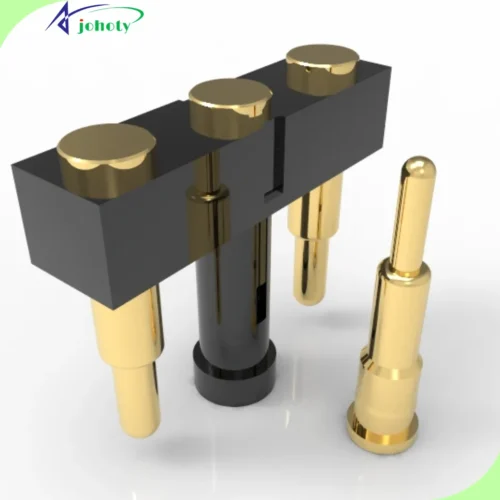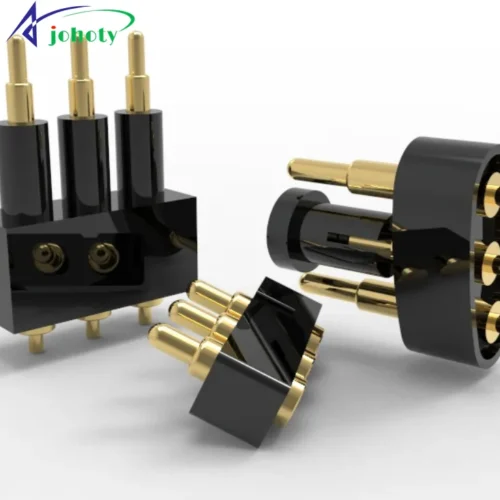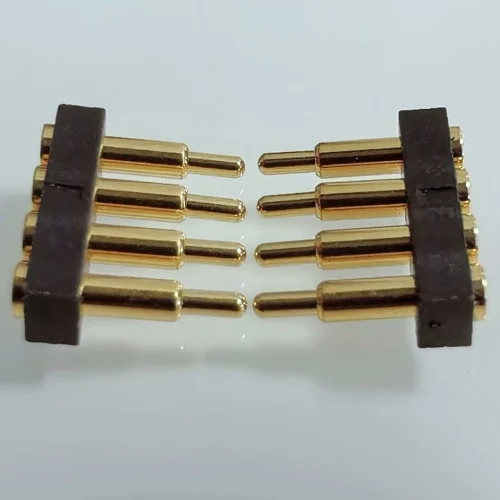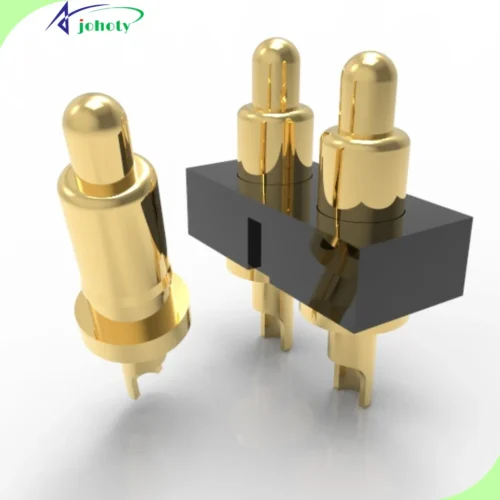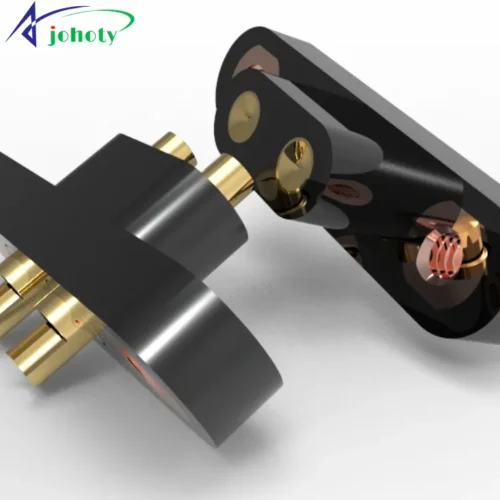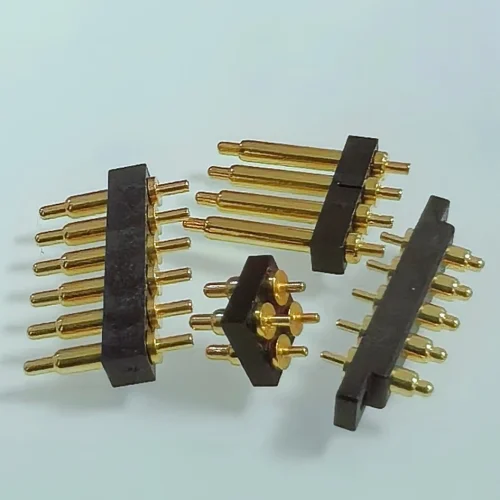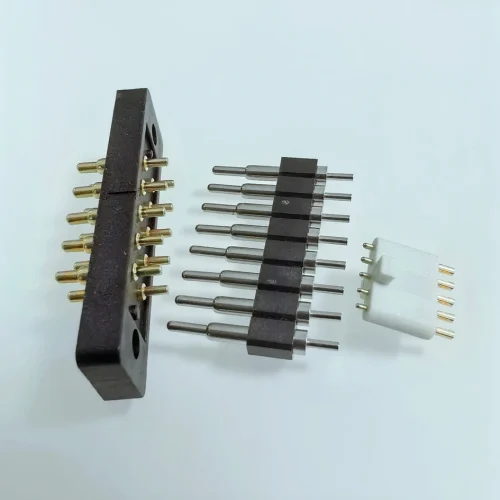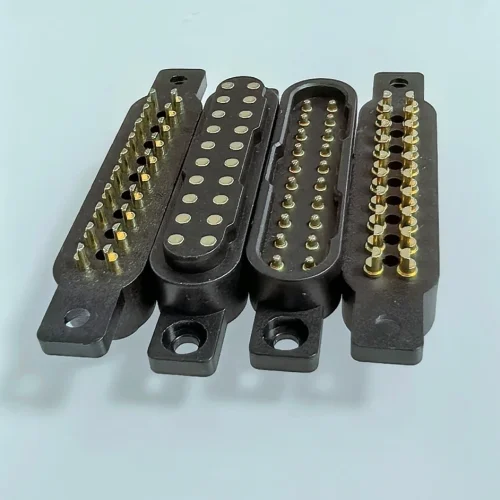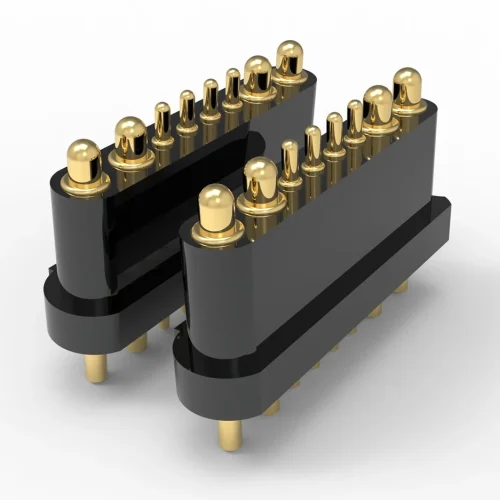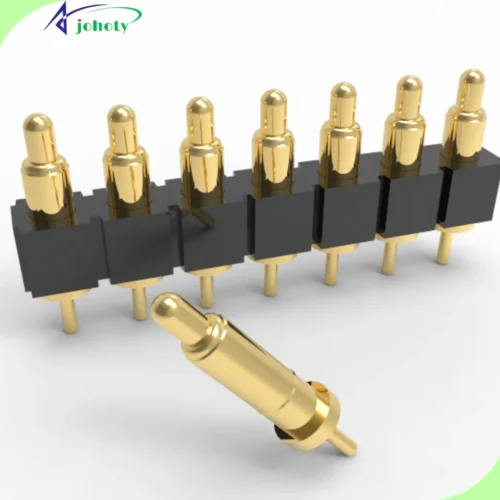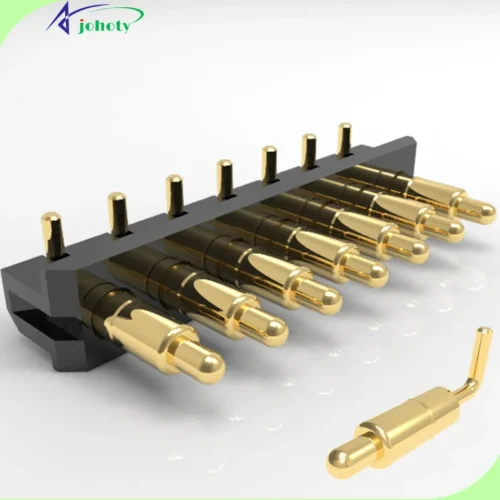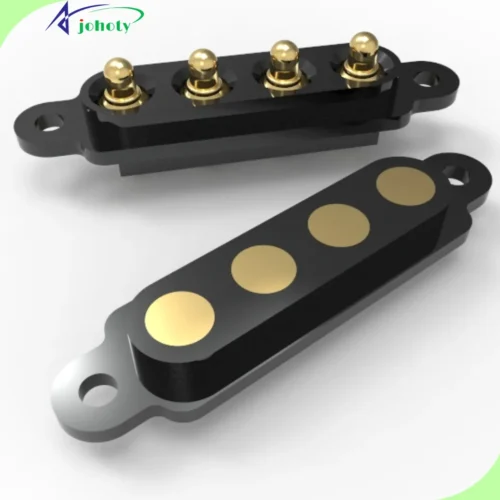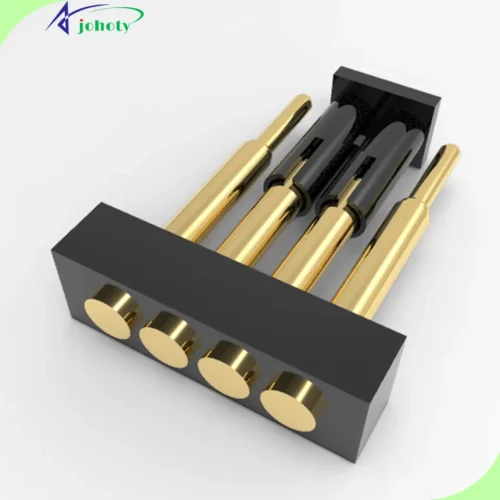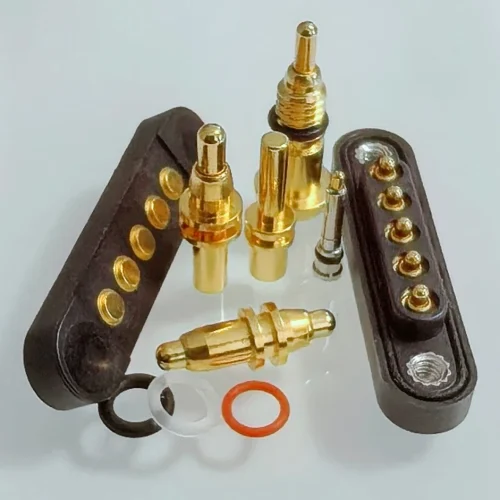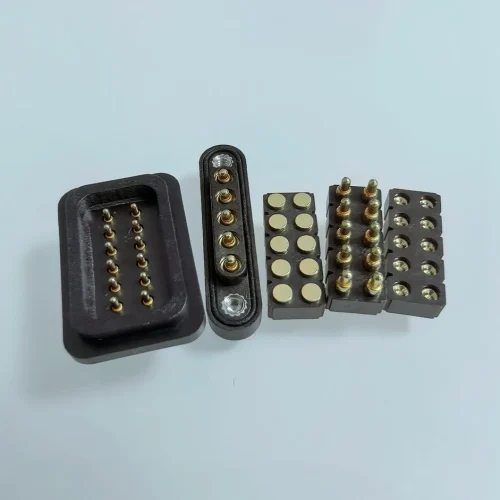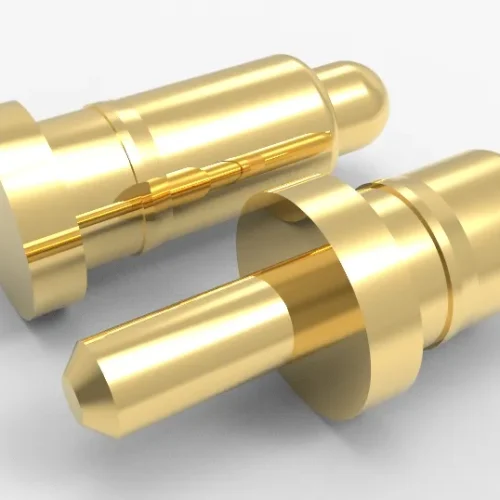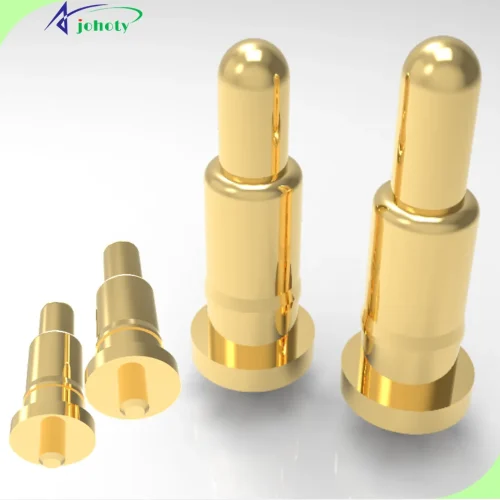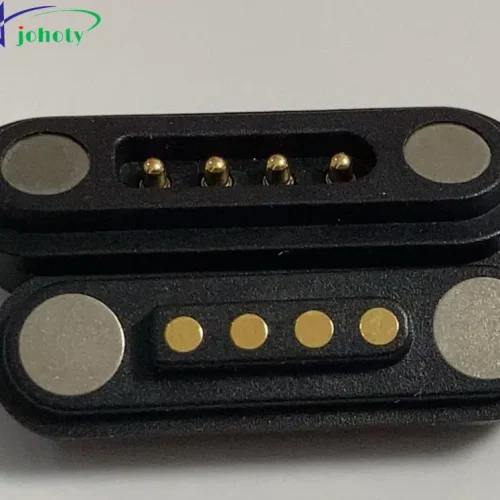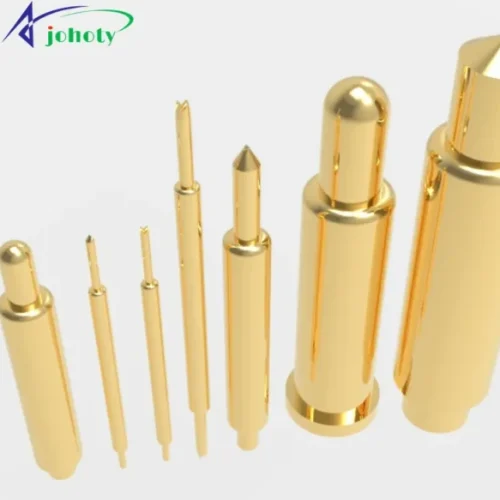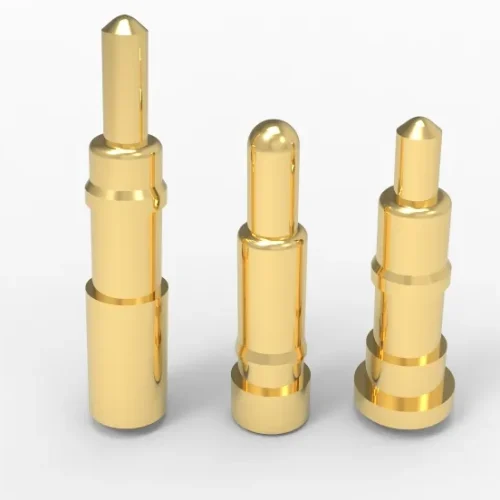

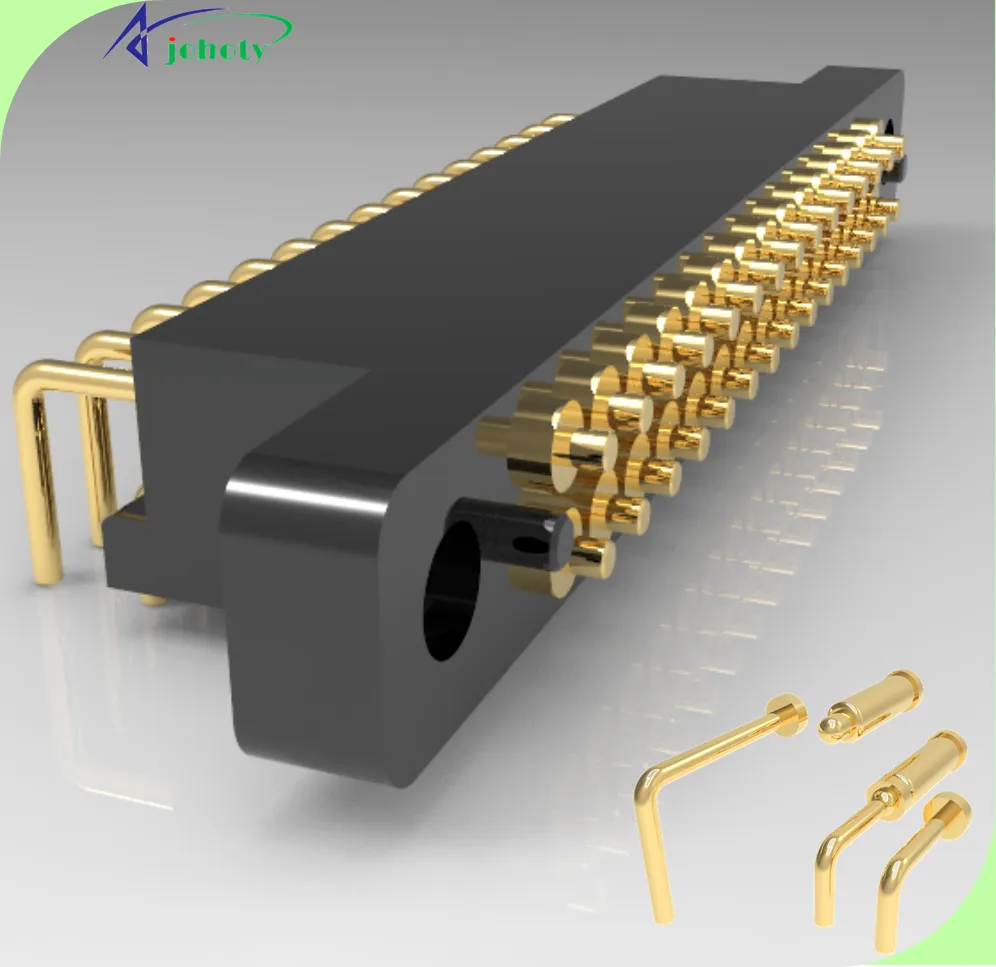
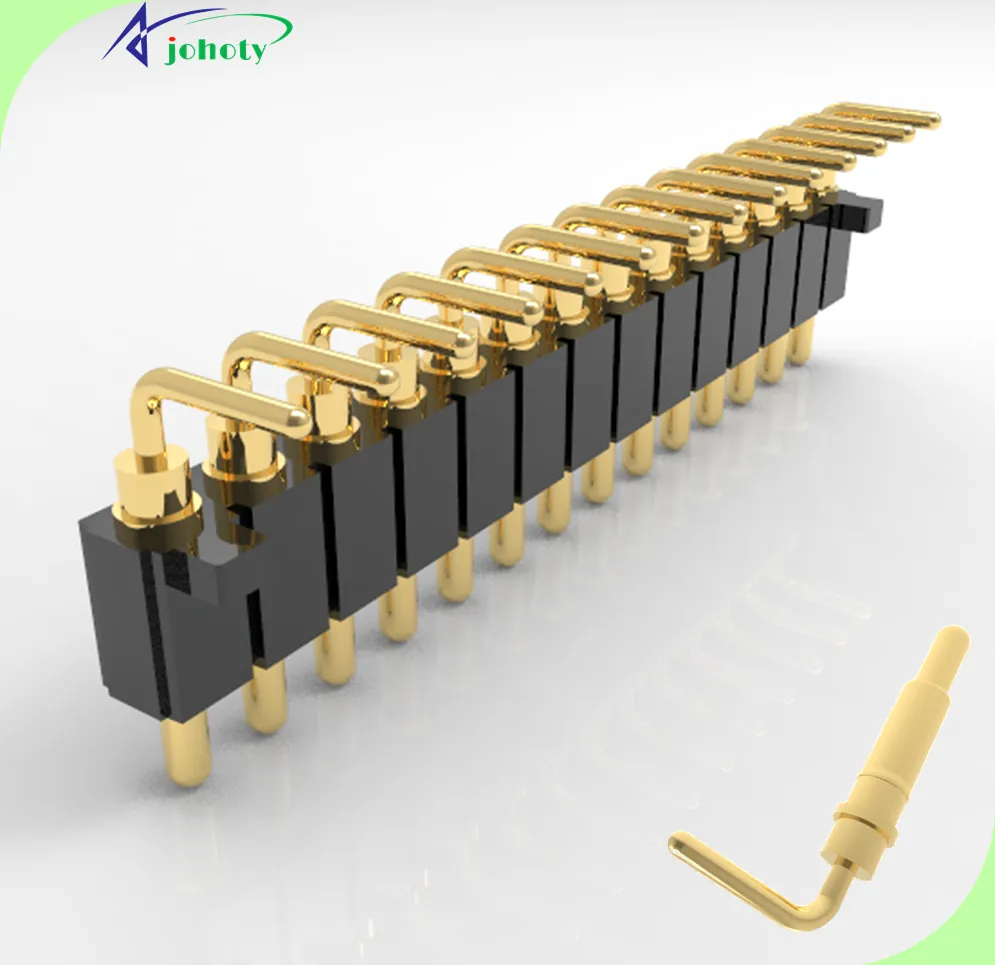
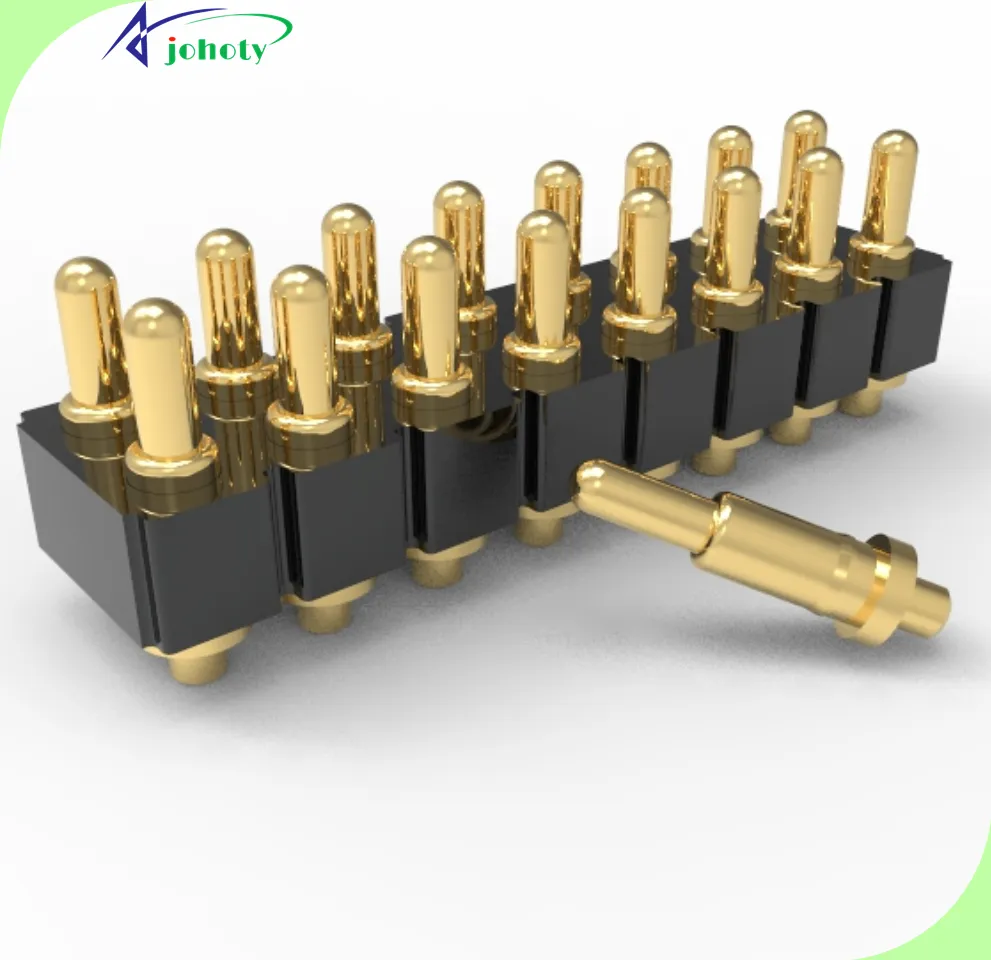
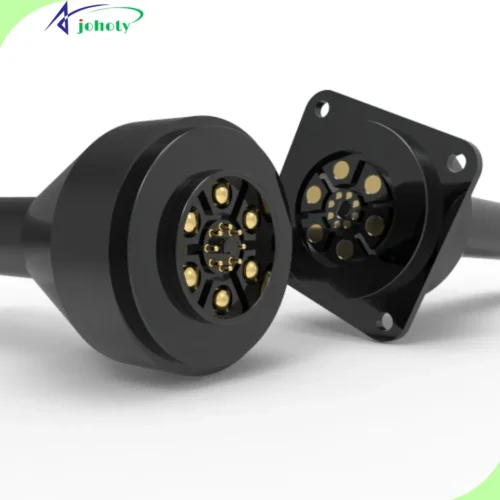
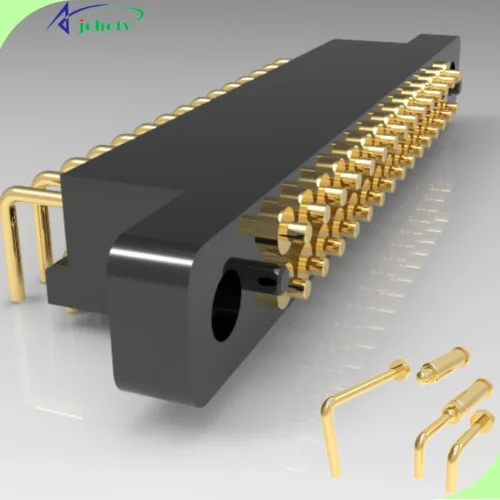
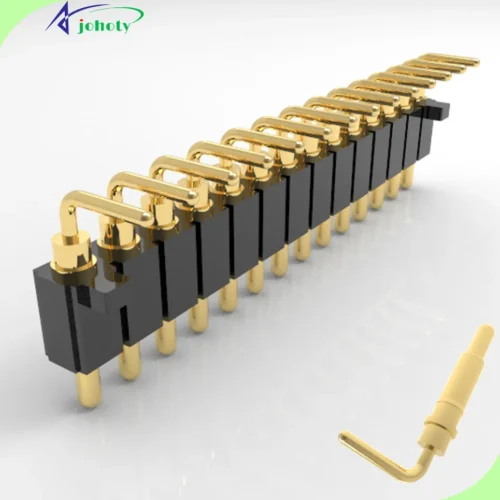
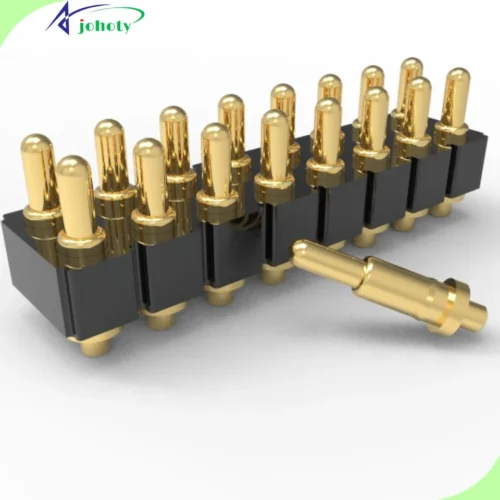
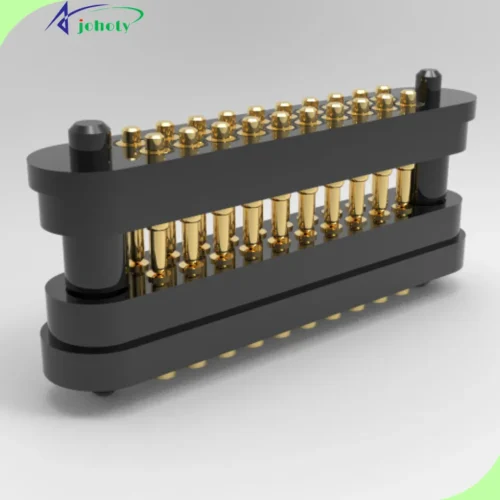
Descriptions of Pogo Pin Connectors
Mechanical specs:
Pogo pin count: 14 to 4,400 pogo pins or contact pins, Johoty supports any custom array layout.
Spacing and tolerance: pitch ≥1.00mm, with a tolerance as low as ±0.02mm, achieving high alignment accuracy for high-density arrays.
Stroke range: standard 0.50mm to 5.00mm, customizable ultra-short stroke of 0.10mm or ultra-long travel >10.00mm.
Alignment tolerance: Excellent radial and axial floating alignment, typical value ± 0.30mm, compensating for PCB assembly tolerance.
Mechanical lifespan: up to 500,000 cycles, requiring customized springs with specific spring force and working stroke.
Housing material: Johoty provides LCP, PEEK, HTN to cope with reflow soldering high temperature and mechanical stress, customized metal shielding housing.
Electrical parameters:
Contact resistance: <30mΩ, stable throughout the entire lifespan.
Rated current: If the size allows, each pogo pin can carry 1A to 50A, supporting mixed power and signal pin designs.
Working voltage: suitable for low voltage up to 550VDC/AC.
Insulation resistance: >100M Ω @ 500VDC.
Voltage resistance: up to 1,500VAC.
Signal integrity: For high-speed PCIe and USB 3.0+, customized impedance matching with 50 Ω/90 Ω/100 Ω differential and low crosstalk design is provided.
Johoty’s Pogo Pin Connectors: Functional Applications and Key Performance:
Functional application:
Simplified device programming/debugging interface: burning and testing points for embedded systems.
Micro modular power and signal connection: provides a compact power supply (+, GND) and single signal channel for detachable daughter boards.
Status detection and triggering: Automatically wake up or switch modes when the device is docked.
Key Performance:
Low power management: providing a solution for ultra-low standby current for battery powered devices.
High current density: Achieve a total current transmission of up to 15A within small footprint.
Blind insertion reliability: In a compact space, pogo pin connectors ensure accuracy of each connection.
Compatibility assessment:
Adaptability Core: Evaluate your PCB layout space, required total current, and guidance accuracy of the docking mechanism. Johoty’s pogo pin connector offers a variety of housing oriented designs. They can adapt to different mechanical environments ranging from precision automation to consumer grade handheld devices.
Johoty’s value in flexibly customizing 14 pin – 4,400 pin pogo pin connectors
Johoty can engineer and systematize flexible customization to solve your core challenges in the most common and complex density range of 14 to 4,400 pogo pins:
Mixed function pogo pin customization: It’s not just about size and shape. Johoty allows mixing high current pogo pins, high-frequency pogo pins, fiber bundles, and even gas/liquid conduits within a single pogo pin connector. Realize true electromechanical integration interface.
Thermal management and signal integrity: In high-density arrays, Johoty optimizes pogo pin layout and GND strategy through advanced simulation. Suppress thermal accumulation and signal crosstalk from the root.
Deep application of materials science: Johoty provides palladium cobalt, gold palladium nickel, and spring materials SUS631/Inconel for high temperature/humidity and strong corrosion. Your contact interface can achieve long-term chemical stability and stable contact resistance.
Transition from prototype to pogo pin connector mass production: Johoty understands engineers’ iteration speeds. Provide rapid prototyping to ensure high consistency in performance between prototypes and mass-produced pogo pin connectors. Avoid the risk of specification drift during mass production.
Challenges and Solutions of Pogo Pin Connectors
Ultra-High Pin Count Reliability of Johoty’s Pogo Pin Connectors
Engineer’s Challenges:
There are tens, hundreds, or thousands of pogo pins (male) or contact pins (female). It is most difficult to ensure the uniformity of compression, consistency of contact impedance, insulation creepage distance, and thermal stability.
High-density arrangement can easily lead to:
- Eccentric compression,
- Multiple points of failure,
- Pin-to-Pin resistance drift,
- Low insertion and removal lifespan,
- Engineers are most concerned about theoretical feasibility but batch instability.
Johoty’s solutions:
- ±0.01 mm CNC + jig fixture positioning, high pin matrix press fit tolerance.
Pin level electrical mapping: Test the contact impedance, force curve, and ±0.05mm stroke consistency of each pogo pin. - Matrix Compression Simulation: Optimize the stress distribution of high pin number arrangements to avoid elliptical deformation and local overpressure.
- Automatic AOI+X-ray ensures the coaxiality and integrity of the solder pad contact area for each batch of multiple pogo pin structures.
Value: Johoty is not just capable of achieving it, but also capable of stable mass production.
High-Current / High-Frequency Mixed-Signal Integrity of Johoty’s Pogo Pin Connectors
Engineer’s Challenges:
Engineers are concerned about EMI/Thermal/Crosstalk issues when high current pogo pins>15A and high-speed signal pogo pins >6GHz coexist.
Many suppliers only specialize in structural design and do not conduct electrical design verification.
Johoty’s solutions:
- High frequency pogo pin gold-plating structure and low loss barrel design ensure stable insertion and return losses when>6GHz.
- The high current pogo pins are designed with a bold plunger and low impedance spring, and are optimized with a Thermal Via structure.
- Internal electrical simulation capability (HFSS/Ansys SIwave):
- Accurate calculation of high-frequency pogo pin pitch,
- Optimization of high-frequency/power/GND pogo pin layout,
- Heat source management and contact impedance drift control,
Actual testing verification includes:
- TDR/S-parameters,
- High frequency impedance curve,
- Thermal rise test @ Full load
Value: Johoty can assist you with electrical design, not just as a pogo pin manufacturer.
Full-Custom Mechanical Adaptation of Johoty’s Pogo Pin Connectors
Engineer’s Challenges:
- Many R&D projects require non-standard structures,
- Special curved surfaces, radius arcs, bottom through holes, and irregular shells,
- The height of the plunger tip is inconsistent, with a blind insertion tolerance of ± 0.50mm for alignment
- Engineers are concerned that suppliers may not be able to provide actual customization, they are only making slight adjustments to the size.
Johoty’s solutions:
- One Stop Customization: From male/female housing, pogo pin pitch, spring force, pogo pin cap, to base/fixture, on-demand development.
- Four types of alignment structures are available: Tapered/Funnel/Floating/Self alignment, optimizing blind insertion compatibility.
- The adjusted spring force from 5gf to 300gf, which can meet the requirements of robotic arms, automation fixtures, high-speed docking, and automotive grade applications.
Johoty can provide:
- Short and long-stroke(≥0.10mm),
- Low-profile,
- Side-contact,
- Shielded barrels,
All non-standard pogo pin connectors can provide:
- 3D STEP,
- Stress simulation report,
- Reliability testing curve, with a lifespan of 10,000-200,000 cycles,
Value: No matter how unique your structure is, Johoty can make true full customization.
Why Choose Johoty’s Pogo Pin Connectors?
Pogo pin connectors has flexible customized shapes, sizes, durability, waterproof, and EMI performance. Johoty is trustworthy!
Benefits of Johoty’s Pogo Pin Connectors

Expected electrical performance and signal integrity of pogo pin connectors
Engineer’s Challenges:
1. Contact resistance is opaque with changes in stroke and lifespan, resulting in unpredictable voltage drop and heating of the power supply.
2. High frequency/high-speed signals are reflected and crosstalk increases after passing through pogo pin connectors, but the supplier cannot provide available data support.
3. We need to do worst case design, which can only be overly redundant, sacrificing space and cost.
Benefits brought by Johoty:
1. Provide test data on contact resistance vs stroke, current carrying capacity vs temperature rise based on diameter, spring force, and coating. Facilitating engineers to make power/thermal design budgets, rather than relying on experience estimation.
2. For mixed signals or high frequencies, the pitch, GND layout, shielding structure, and pogo pin grouping can be adjusted as needed. Cooperate with basic impedance, crosstalk testing, or suggested layout to reduce uncertainty in high-speed segments.
3. For multiple pins pogo pin connectors, they can be divided into power area/ground area/high-speed area/low-speed area. Clearly specifying the allowable working conditions for each partition in the specification book makes pogo pin connectors more easily accepted by system simulation and review.

Structural integration and tolerance management of pogo pin connectors under mechanical constraints:
Engineer’s Challenges:
1. The Z-direction height is limited by the thickness of the entire machine, shielding cover, and radiator.
2. The assembly direction is limited and requires blind insertion/side insertion, which is sensitive to guidance, tolerance superposition, and eccentric force.
3. The ready-made standard parts have a slight difference in pin number, layout, and installation method, and can only rely on mechanical structure to make complex compromises.
Benefits brought by Johoty:
1. Within the range of 14-4,400 pogo pins, customization of pin count, multi row matrix, coaxial ring, non-equidistant distribution, and total height is allowed. And the working stroke, preloading stroke, as well as plunger tips of rounded, conical, convex, and flat heads. Fit the actual Z-direction space and contact surface shape.
2. Alignment columns, floating or guiding ramps can be added to the male/female connector. Help tolerate assembly deviations and thermal expansion and contraction in actual machines. Reduce the probability of local overload and contact failure.
3. Recommend 3D numerical models and technical drawings for installation benchmarks, allowable offsets, and critical dimensional tolerances. Facilitating engineers to conduct tolerance overlay analysis, rather than relying on verbal guarantees from suppliers that there are probably no issues.

Reliability and environmental adaptability of Johoty’s pogo pin connectors based on lifespan:
Engineer’s Challenges:
1. We requiry 200,000 cycles of lifespan or long-term vibration. and the lifespan of ordinary pogo pins is often missing or deviates greatly from actual working conditions.
2. Need to face temperature cycling, humidity, salt spray, and dust, but unsure if the material and coating are suitable for these environments?
3. Quality consistency and traceability between multiple batches and projects are difficult to grasp.
Benefits brought by Johoty:
1. Barrel,high strength copper alloy/stainless steel, LCP/PEEK insulator, and other materials can be used for springs and plunger. Match lifespan based on expected lifespan, maximum offset, and vibration level. We won’t just give a vague high lifespan.
2, Nickel bottom layer + gold plating of different thicknesses will provide multiple solutions for corrosion, current carrying, and cost constraints. Collaborate with salt spray testing, temperature cycling, humidity and heat data to assist engineers in making decisions.
3. Multiple-pin pogo pin connectors and long-term mass production projects are our strengths. Provide batch consistency control, key dimension and electrical parameter sampling reports. If necessary, a data package can be established to improve the traceability of quality and failure analysis.

Johoty’s collaborative design and sustainable supply capability for non-standard pogo pin connectors
Engineer’s Challenges:
1. Need some special installation methods, coding structures, foolproof designs, integrated sensing or shielding structures that are not in the directory.
2. Many suppliers have a huge gap between being able to do and being able to do it long-term, stably, and traceable. Lack of clear engineering communication process and version management.
3. The first batch of samples is good, but it is difficult to perceive and control parameter drift and material replacement in a timely manner during subsequent iterations and multi project reuse.
Benefits brought by Johoty:
1. Conduct requirement collection forms, technical clarifications, and 3D solution reviews in the early stage. Solidify key information such as pin number, stroke, material, coating, electrical indicators, assembly method, etc. in the specification sheet. Instead of relying solely on email descriptions, reduce misunderstandings.
2. Provide samples and test records with clearly labeled version numbers during the EVT/DVT phase. The subsequent ECR/ECO changes in stroke, elasticity, and coating can be carried out through a controlled process without any tacit material changes during mass production.
3. For pogo pin connectors with 14-4,400 pins, Johoty will consider production processes, fixture design, measurability, and maintainability. Provide DFM/DFT suggestions in advance to enable you to evaluate the manufacturability and maintenance strategy of the entire machine as early as possible.
Applications of Pogo Pin Connectors
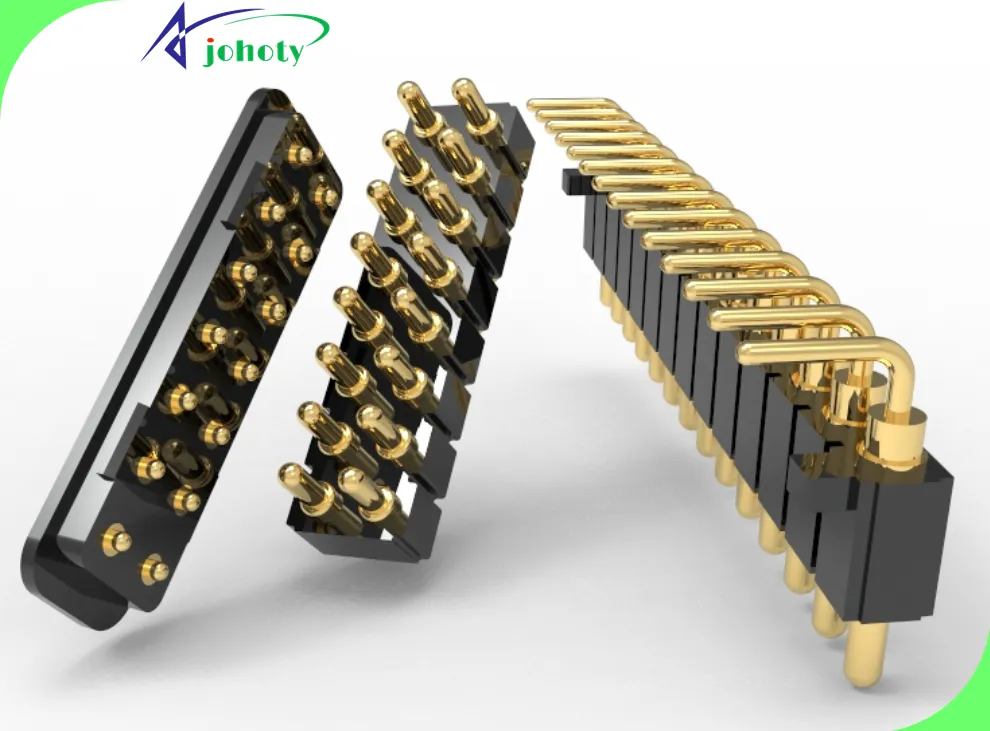
Pluggable modules for medical imaging/monitoring equipment:
Challenges: The module space is extremely small and requires blind insertion to prevent accidental insertion. The patient’s movement causes vibration, and cleaning and disinfection bring corrosion and condensation.
Johoty’s pogo pin connectors function as an elastic contact array for module docking, allowing blind insertion and short stroke compensation for deviations. Compatible with signal, power, grounding, and recognition pogo pins.
Customization: Pogo pin connectors with low contact force reduce insertion force, and the hard gold and anti-corrosion bottom layer effectively respond to cleaning solutions. Asymmetric arrangement avoids reverse insertion, with needle numbers ranging from 14 micro needles to hundreds of needles for imaging backboards.
How to solve: By customizing the pin height difference and plastic guidance, the tolerance for blind insertion and docking can be relaxed. Contact resistance drift is controlled, frequent replacement of probes or monitoring modules, and pogo pin connectors still maintain stable contact.
Efficiency/Costs: The replacement time of nurse/technician modules can be reduced by about 30-40%. During maintenance, only the pogo pin connectors module needs to be replaced instead of the entire PCB, which can reduce spare parts costs by about 20%.
Advantages: Medical grade corrosion-resistant coating, low particle shedding, and support for high cycle times. The structure is simple and convenient for verifying fatigue and stroke margin through mechanism simulation.
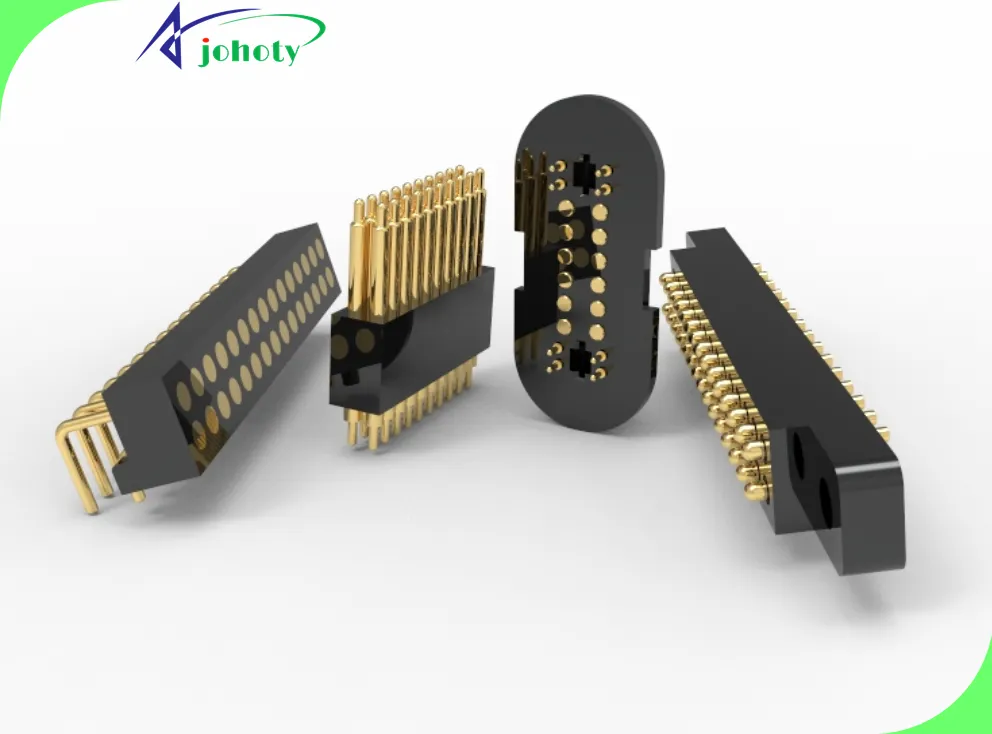
Aerospace/satellite module docking:
Challenges: High vibration, large temperature difference, limited space, limited mass.
Role: Johoty’s highly reliable pogo pin connectors enable elastic electrical connections and thermal expansion compensation between modules.
Customization: The spring material is Inconel, SUS631, Elgiloy with elasticity attenuation<1%. The Pogo pin structure has anti-lock guidance and limit, and the number of Pogo pins ranges from 14 pin control signals to 4,400 pin compartment backboards. Low inductance electrical specifications, capable of differential pair shielding layout
Solution: The axial stroke of pogo pin connectors absorbs structural deformation and thermal expansion. Multi point GND pogo pins are arranged to reduce circuit impedance and EMI, and a locked housing prevents relative sliding of the contact surface under vibration.
Efficiency/cost-effectiveness: Reduce wiring harness customization and assembly time by approximately 25-35%. In long-term maintenance, modular replacement of pogo pin connectors reduces the complexity of in orbit maintenance tasks.
Advantages: Mechanical decoupling, electrical stability, and the number and layout of pogo pins can be freely designed according to the cable structure inside the cabin. Avoid stress concentration caused by traditional rigid plates on plate connections.
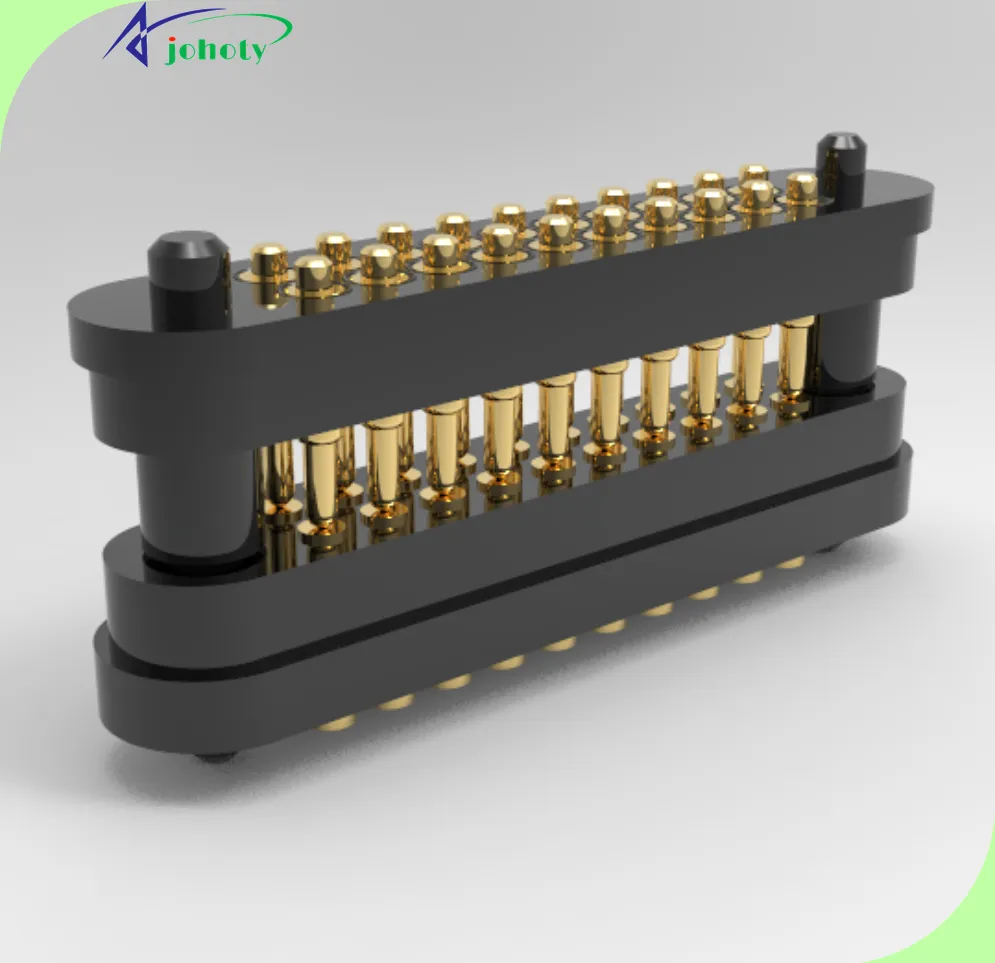
Industrial automation/testing fixtures and quick change stations:
Challenges: Frequent replacement of fixtures at workstations, switching between different product models, slow insertion and removal of traditional wiring harnesses, frequent misconnection, and complete repair of worn fixtures.
Function: Arrange Johoty’s pogo pin connectors female seats uniformly on the workstation base, and arrange corresponding male seats at the bottom of each fixture. The fixture only needs to be inserted into the positioning hole to complete electrical docking, and the pogo pin connectors absorb the machining errors of the fixture.
Johoty’s customization: The pin count ranges from 14 pin simple I/O to over a thousand pin complex sensor/cylinder/motor hybrid interfaces.
How to solve: Multiple pogo pin connectors submodules can be split by workstation area for easy partition maintenance.
Results: The tooling replacement time has been reduced from minutes to seconds, and the overall TAKT has increased by about 10-20%. When repairing the tooling, only partial pogo pin connectors modules need to be replaced, and the total tooling ownership cost can be reduced by about 15%.
Advantages: The mechanical positioning and electrical interface are separated, and on-site engineers can independently optimize both. Pogo pin connectors support increasing the number of pins or reconfiguring pin functionality in the later stage, without the need for complete rewiring.
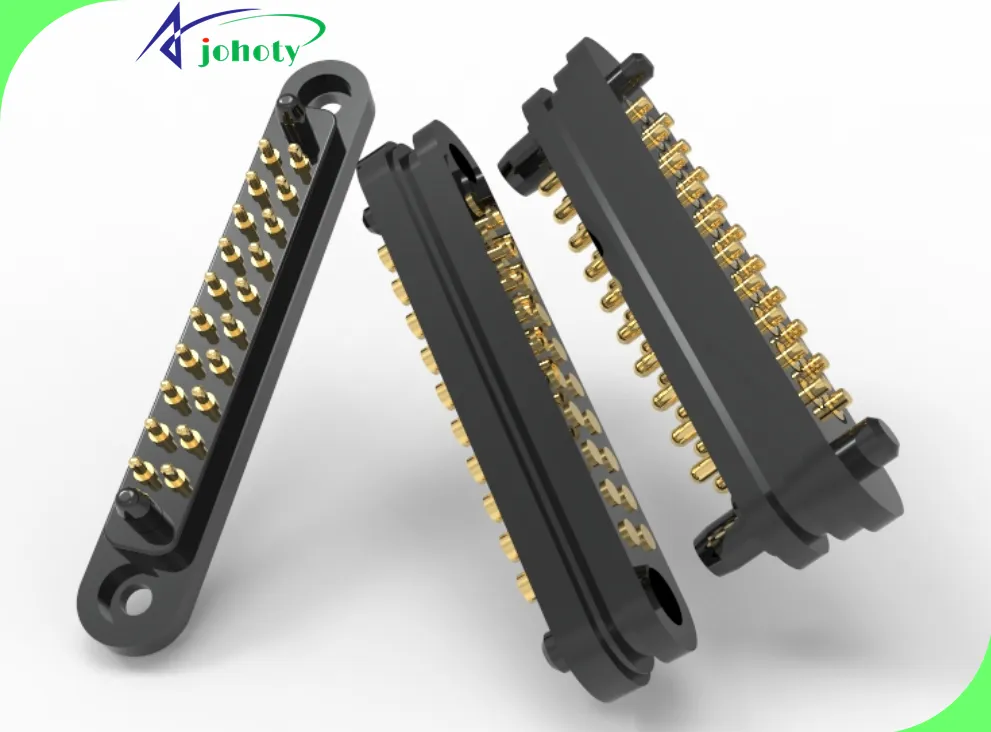
Electric vehicle battery module/battery swapping and high current low voltage interface:
Challenges: High current and low voltage, high current impact, high insertion and removal frequency, environment with dust and condensation water. Traditional rigid terminals are prone to local overheating.
Function: Johoty’s high current pogo pin connectors serve as compressible contact points for battery modules BMS、 The auxiliary power supply provides elastic conductivity.
Customized solution: Multi pin parallel pogo pin connectors share the current, and the geometry of the special plunger tip increases the contact area. The spring parameters are designed for surge, and the housing can be matched with sealed IP67 and IP68 structures.
How to solve: Johoty designs multi-point contacts to reduce single point contact resistance and heat generation, while stroke design balances guidance and seismic resistance. Contact with materials and coatings that match low voltage and high current.
Efficiency/Cost Results: The probability of downtime and repairs caused by overheating of pogo pin connectors can be significantly reduced, dropping to half of the original. The efficiency of module disassembly and assembly is improved, which is conducive to maintenance and hierarchical utilization.
Advantages: High current pins and signal pins can be mixed within the same pogo pin connectors. Pin count can be expanded to >1,000, meeting the requirements of complex battery modules.
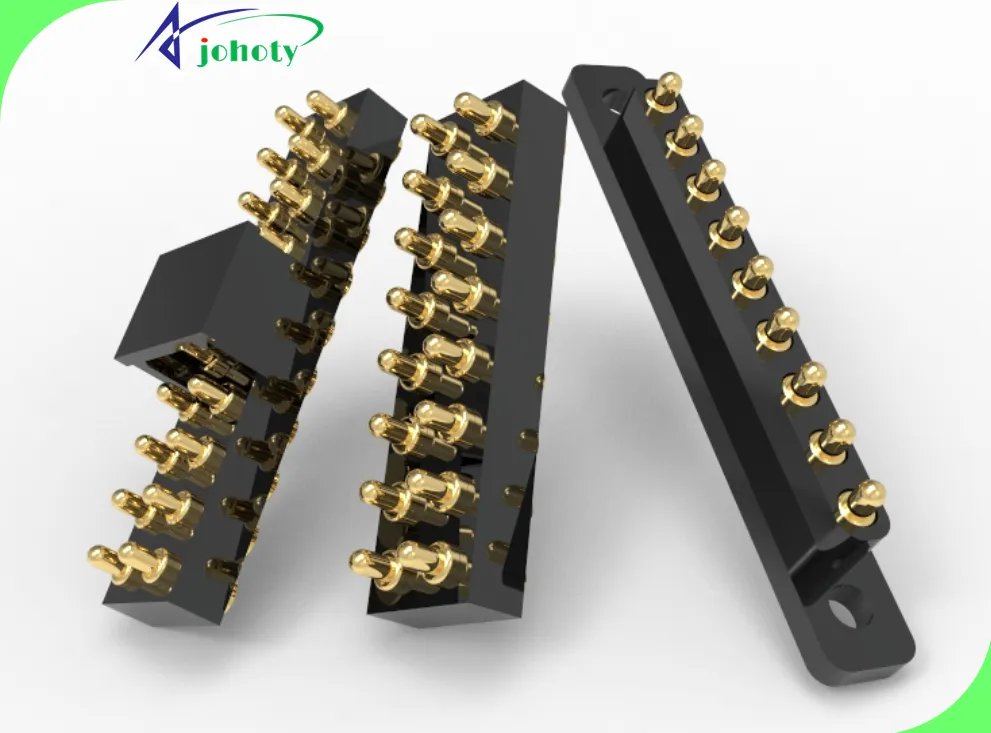
Wearable/Waterproof Consumer Electronics Charging and Data Connection:
Challenges: Extremely small size, high appearance requirements, must be waterproof and sweat proof, unstable user insertion and removal actions.
Function: Johoty low exposed height pogo pin connectors are embedded in the housing to achieve magnetic or mechanical guidance docking.
Customization: Miniature 14 pin to dozens of pin pogo connectors, with waterproof ring matching. Low height cap shaped plunger, specially designed with a coating for salt spray/sweat.
Solutions: Short stroke + magnetic attraction, users do not need precise alignment, pogo pin connectors compensate for housing fit errors during stroke. The coating and sealing design support IP67 and IP68 waterproof.
Efficiency/Costs: Assembly unlocking is a combination of flat mounting and shell guidance. Reducing manual plugins and wiring harnesses can reduce assembly time by approximately 15-25%.
Advantages: The interface appearance can be integrated with the overall machine ID, and similar pogo pin connector structures can still be used when adding temperature/heart rate electrodes.
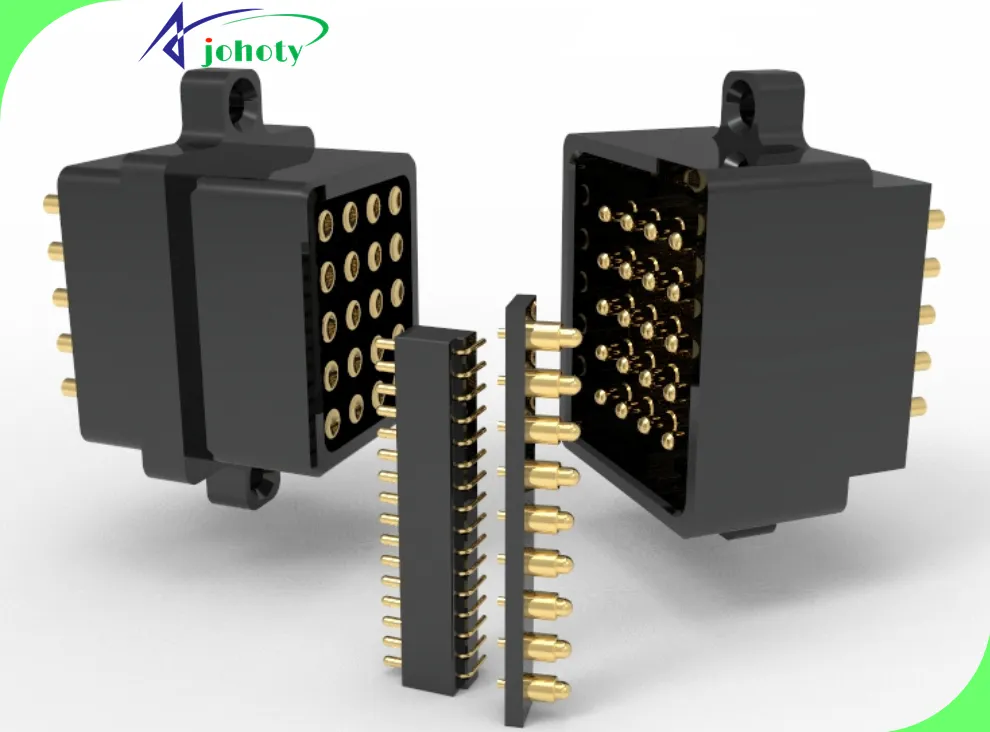
Semiconductor ATE/Load Board high pin count testing interface:
Challenges: Ultra high pin count, mixed signal and power supply, coexistence of high current and low signal. The warping of the board leads to uneven contact and frequent insertion and removal of the testing fixture, resulting in wear and tear.
Function: Johoty’s high-density pogo pin connectors serve as elastic contacts that can compensate for tolerances, ensuring stable transmission of high-speed signals and power supply.
Customization: stroke, elasticity curve, needle shape, coating system, rated current/voltage. The guiding structure, 14-4,400 pin matrix, and partitioned grounding/shielding can all be customized according to the project.
Solutions: By customizing the stroke and elasticity to match the warpage of the tested board, pogo pin connectors automatically balance the contact pressure. Reduce contact resistance fluctuations and false faults.
Efficiency/Cost: ATE fixture debugging time can be reduced by about 20-30%. Due to the replaceable array, the cost of long-term fixture maintenance and rework can be reduced by approximately 15-25%.
Advantages: High needle count, good scalability, resistance to insertion and removal cycles, and modular needle array. Engineers can plan the pogo pin connectors area without being limited by standard connector pins.
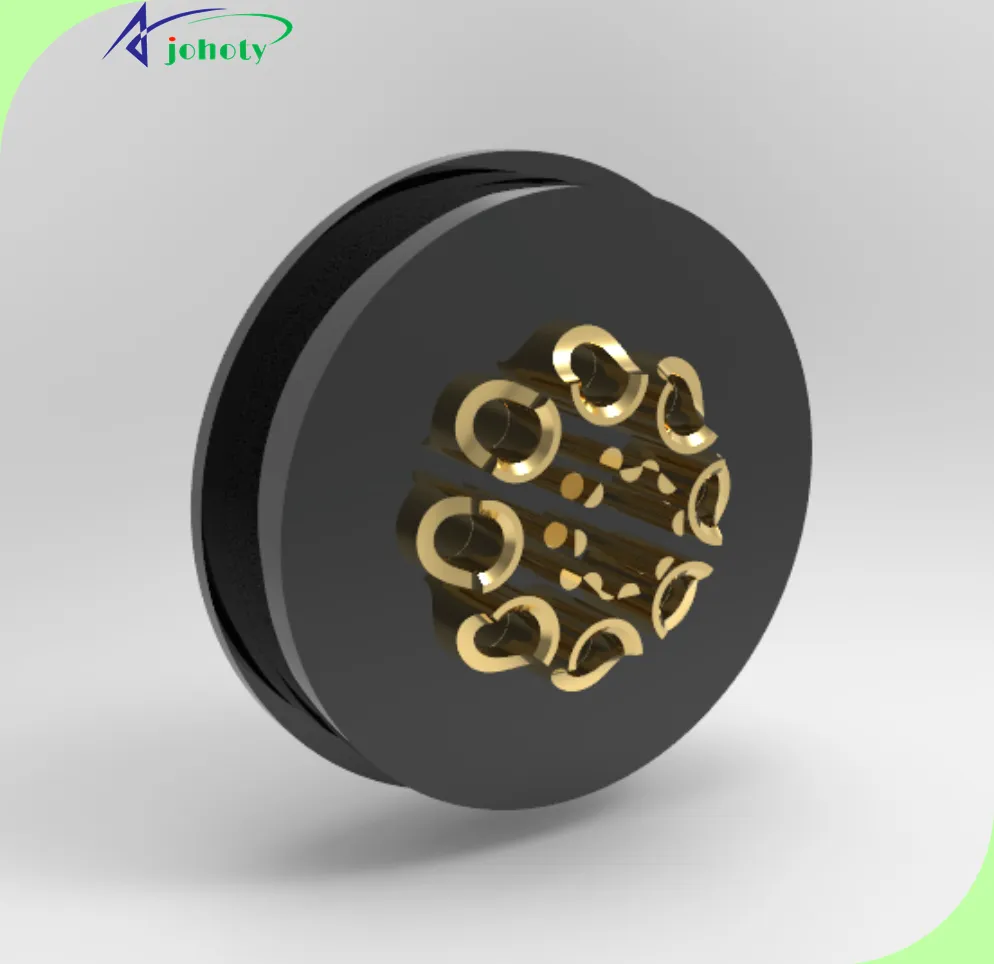
Communication base station/high-density backplane and blade server:
Challenges: The backplane signal density is high, differential pair wiring is complex, hot swappable is required, and there are temperature gradients and micro vibrations in the environment.
Function: Johoty high pin count pogo pin connectors serve as a compressible array between the backplate and blade, replacing some traditional long pin connectors.
Customization: The number of pins can be expanded to thousands, and pogo pin connectors can be arranged in pairs through differential pairing. Form a reference plane through a specialized GND/shielding pin layout.
Solutions: Utilize the axial elasticity and guiding structure of pogo pin connectors to buffer the impact force and relative displacement between boards during insertion and removal. Reduce stress concentration between solder joints and copper foil.
Efficiency/costs: Due to the reduction of long solder pins and manual pins at the back panel end, the welding failure rate can be reduced. The reliability of hot swappable contacts is improved, and on-site maintenance time is reduced.
Advantages: The backplane layout is more flexible, and engineers can arrange pogo pin connectors blocks according to signal integrity requirements. Not limited by fixed needle pitch.
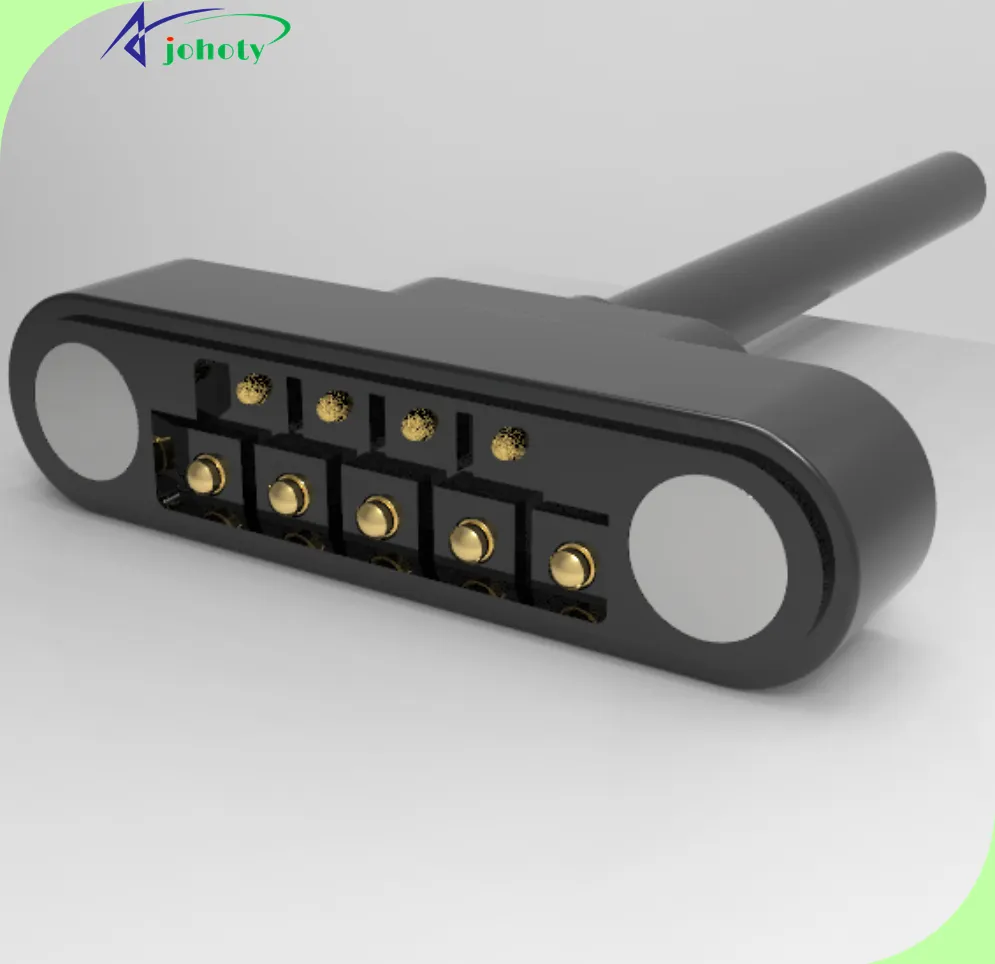
Laboratory instruments/reconfigurable measurement and signal routing platform
Challenges: In reconfigurable testing, engineers need to frequently change signal routing and module combinations. Traditional wiring harnesses quickly become difficult to manage, with multiple contact points and a high probability of misconnection.
Function: Johoty offers a wide range of customizable pogo pin connectors from 14 to 4,400 pins.
Customization: Summarize all measurement and control channels onto a regular pogo pin array. By fixing different module boards to these pogo pin connectors, routing changes can be completed.
Solutions: Pogo pins with different voltage/current levels, color and silk screen coding, needle array block detachable structure, etc.
Efficiency/costs: Engineers can organize experiments with fewer cables, fewer welding points, and more visible needle arrays. The module switching time has been compressed from hours to minutes, and the wiring error rate has decreased. Long term maintenance only requires replacing the local pogo pin connector subarray.
Advantages: The logical topology is defined by engineers, while the physical implementation is undertaken by a reconfigurable pogo pin connector array. The trial and error costs of hardware experiments are diluted.
Advantages of Pogo Pin Connectors
Johoty’s pogo pin connectors provide ultimate mechanical adaptability to the challenges of alien spaces and system integration:
Challenges addressed: In compact or endoscopic robots, wearable medical devices, and multi degree of freedom robotic arm joints, engineers sacrifice valuable space or modify core structural designs for connectors. Because traditional rectangular connectors often become bottlenecks in industrial design due to shape and size limitations.
Johoty’s advantages:
Space optimization: Pogo pin connectors can be perfectly embedded in the structural dead corners of devices, achieving almost 100% space utilization. Johoty can customize circular, polygonal, L-shaped, or irregular surface fitting shapes and pin arrangements. You will free up more space for batteries, sensors, or heat dissipation modules.
Integrated structure and function: pogo pin connectors can become a part of the mechanical structure of the device. Circular pogo pin connectors can simultaneously achieve 360 degree electrical connections and optical/liquid path passage in hollow areas.
Simplified assembly: The customized shape itself is a mistake proof design. In complex assembly processes, only the only correct way to connect can improve production yield and reliability.
Johoty’s pogo pin connectors achieve synergistic design of electrical and mechanical performance for high reliability connections:
Core challenges faced by multiple-pin connectors is to ensure that each pogo pin has stable contact resistance at tiny contact points. Simultaneously capable of withstanding vibrations, impacts, and thermal cycles, avoiding signal integrity degradation or instantaneous power outages.
Johoty’s advantages:
Accurate customization of current carrying and impedance matching: Johoty can customize the spring force, stroke, barrel diameter, and coating of pogo pins for different power sources, high-speed signals, and RF signals. The power pogo pin can adopt a low resistance thick gold coating and a large diameter design to carry 10A current. The adjacent high-speed differential pair pogo pins can be controlled with small diameter, short stroke, and precise coplanarity. This ensures resistance matching and minimal various signal reflection.
Material for contact stability: SUS631/Inconel/Ti Cu alloy/SWP-B spring material and heat treatment process are used. Can maintain stable contact force and resist stress relaxation after 100,000 lifetimes. The optimized Pd-Ni bottom layer and hard gold surface layer can effectively suppress fretting corrosion. This is the main mechanism of pogo pin connector failure in vibration environments.
Self-cleaning effect: Precise pogo pins produce a small lateral sliding during insertion and removal, which can scratch the oxide film. The contact between metals is high and stable, and this self-cleaning can enhance the reliability of long-term connections.
Empowering the rapid iteration of pogo pin connectors prototypes and the design and manufacturing agility of Johoty’s supply chain resilience:
Challenges solved: Tight R&D cycle of high-end projects, the long delivery time of traditional customized connectors, and the expensive mold opening costs seriously slow down the iteration speed. In addition, a single supply source also brings supply chain risks.
Johoty’s engineering response advantages:
Rapid prototyping response: Johoty has standardized multiple specifications of barrels, springs, insulated housing, and advanced fast CNC/3D printing for housing. We can provide fully functional engineering samples within 2 weeks. Engineers can quickly validate design concepts and conduct system level testing.
Mold-free or low-cost mold solutions: For small and medium-sized batches or prototype stages, Johoty can provide manufacturing solutions that do not require expensive hard molds. Significantly reduced the initial engineering investment cost and decision-making threshold.
Scalable Manufacturing Capability: From prototyping to mass production, Johoty’s manufacturing process is scalable. We can flexibly adjust production capacity based on high consistency in design, and enhance the supply chain resilience.
The product features of Johoty’s pogo pin connectors are designed to handle extreme applications:
Challenges solved: In aerospace, deep-sea exploration, and high-precision testing and measurement, connectors need to go beyond conventional electrical connection functions. Undertake additional tasks such as environmental sealing, high-voltage isolation, or high-frequency signal transmission.
Johoty’s advantages:
Environmental sealing: Johoty can integrate customized sealing silicone and fluororubber during the assembly of pogo pin connectors. Provides IP67 and IP68 protection, capable of handling liquid immersion, high-pressure spraying, or extreme humidity.
Hybrid transmission: Supports integrating pogo pins for electrical signals and coaxial interfaces for high-frequency/RF within the Hosing of pogo pin connectors. This hybrid transmission simplifies system interfaces, minimizes connection channels while improving overall system reliability.
Magnetic assisted docking and locking: It can integrate precisely defined neodymium iron boron magnets N52 or N54, providing smooth docking guidance and holding force. Blind insertion operations or automated testing fixtures that require quick connection/disconnection, as well as robot battery replacement, are crucial. Johoty’s pogo pin connector can be designed in conjunction with mechanical locking mechanisms, making it very stable under vibration.
FAQ
Challenges: High needle count means that small deviations in mechanical stress distribution, CTE matching, and single contact forward force design will be rapidly amplified. This can easily lead to unstable contact resistance, abnormal temperature rise, or early failure of some pogo pins.
Johoty’s solutions:
Multi point contact and ultra-low resistance coating: Johoty’s pogo pin’s plunger tip uses precise 4-point to 9-point contact instead of simple single point contact. This creates multiple parallel current paths, reduces overall contact resistance, and provides redundant backup. The coating adopts palladium cobalt gold or hard gold over nickel, which can ensure ultra-low and stable contact resistance. Enhance wear/corrosion resistance for small current signals or 10A power transmission.
Precision spring mechanics and CTE compensation design: Johoty customizes spring force curves for each pogo pin/pinch. At working temperature, the spring force is sufficient to overcome the deformation caused by the CTE difference between LCP and PPS, and maintain a stable positive contact force. We simulate the insertion and extraction process and thermal cycling through FEA to optimize the geometric shapes of barrel and plunger, in order to eliminate stress concentration points.
Current thermal simulation drive layout: In designs with >1,000 pins, Johoty provides optimized layouts for power and signal pins. Through current thermal coupling simulation, distribute high current pins reasonably to avoid local heat concentration. By embedding thermal conductive silicone pads inside pogo pin connectors, heat is directed towards the PCB or casing. All pogo pins have controllable temperature rise ΔT<20℃ at rated current.
Challenges: Connectors with circular, elliptical, or irregular contours are much more difficult to align and guide than standard rectangular connectors. Micro scale misalignment may cause pin shear damage, and poor insertion and removal feel can damage the product texture.
Johoty’s solutions:
Integrated secondary guidance system: Johoty relies not only on housing for primary alignment. Inside the pogo pin connectors, we design precision guide pins+guide sleeves or inclined self guides. At the initial stage of the insertion process, it contacts the pogo pin and gradually converges the tolerance to the sub millimeter level. You can achieve smooth zero misalignment insertion and removal when connecting.
Customized anti spoofing and polarization key: Anti spoofing design is not just about preventing reverse insertion, Johoty regards anti spoofing as a mechanical key. We offer a variety of asymmetric positioning columns, magnetic assisted alignment, or mechanical encoding keys. In complex systems, only the correct modules can be connected, fundamentally eliminating human errors. The strength and location of these keys have been simulated and can withstand expected misoperation forces.
Force displacement curve engineering: Johoty models and tests the insertion and extraction forces of the entire pogo pin connectors. Provide clear click confirmation or linear smooth insertion sensation. Adjust the friction coefficient, spring preload, and magnetic attraction of the guiding structure. We provide precise and consistent mechanical feedback for the user experience of your product.
Challenges: The physical structure of Pogo pin connectors naturally introduces parasitic inductance and capacitance. Under high-speed signals, impedance discontinuity, signal reflection, and loss are caused, severely limiting bandwidth.
Johoty’s solutions:
Coplanar waveguide grounding structure and shielding scheme: Johoty no longer considers pogo pins as independent components, but designs them as part of the entire transmission line. Arrange dense GND pogo pins around each high-speed signal pogo pin to form a coplanar waveguide structure. To provide the shortest path for returning current, strictly control the impedance of Pogo pin connectors. For extremely high frequency applications, Johoty provides built-in grounding fences or regional shielding covers to suppress crosstalk below -50dB.
Optimized pogo pin geometry and materials: Johoty will redesign the internal structure of high-speed dedicated pogo pins. Using low dielectric constant materials as insulation support to shorten signal length. The shapes of barrel and plunger have been optimized through electromagnetic simulation to reduce equivalent series inductance and ground capacitance. The impedance within the 10GHz range required by pogo pin connectors is stable at 90 Ω± 10% differential or 50 Ω± 5% single ended.
3D electromagnetic simulation and testing verification: Johoty assists clients in using HFSS or CST for full wave 3D electromagnetic field simulation during the design phase. Accurately extract the insertion loss, return loss, and crosstalk of pogo pin connectors. We can provide simulation reports and comparison of measured data based on VNA. Prove the bandwidth and signal integrity performance of Johoty’s pogo pin connectors using engineering data.