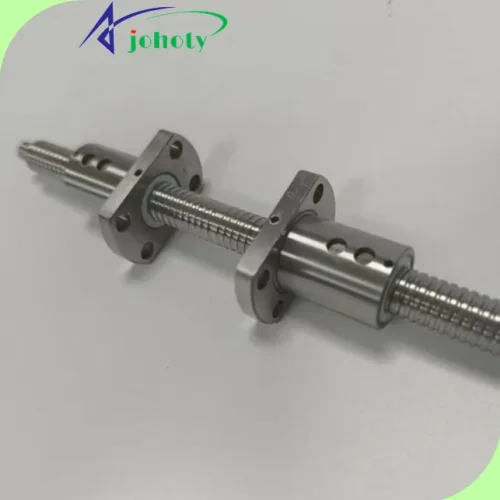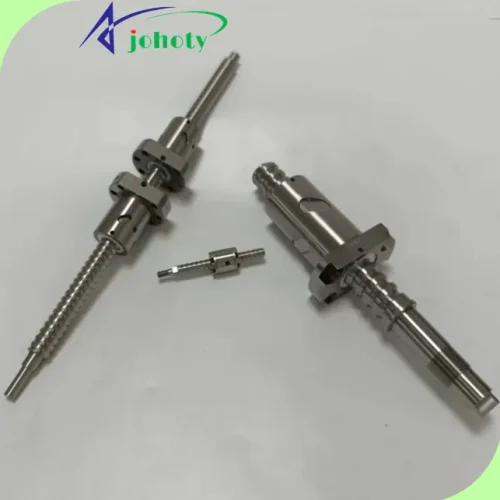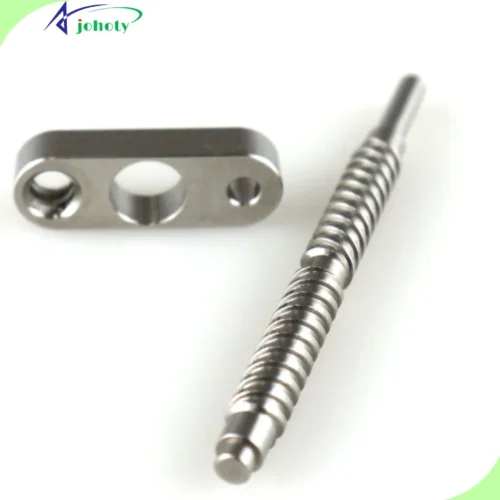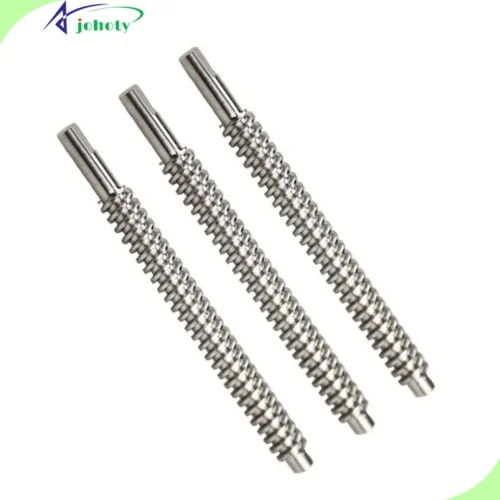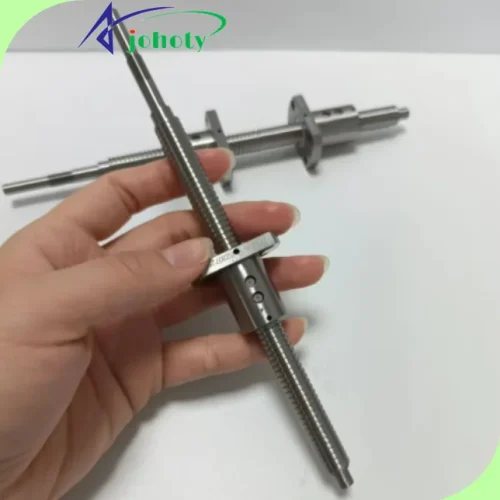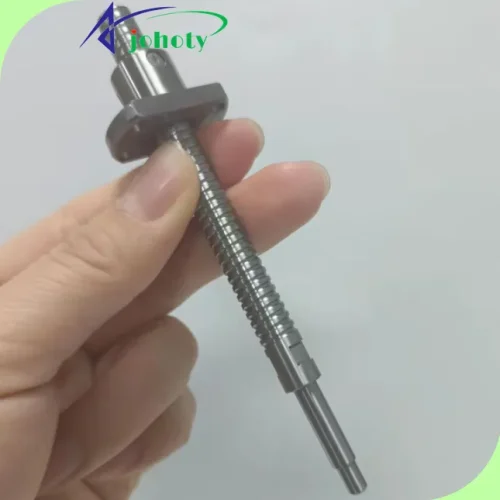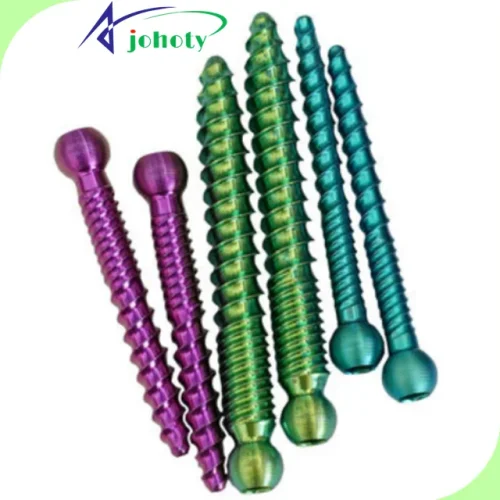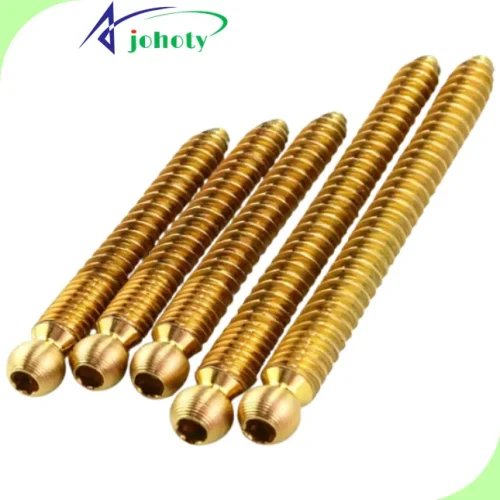
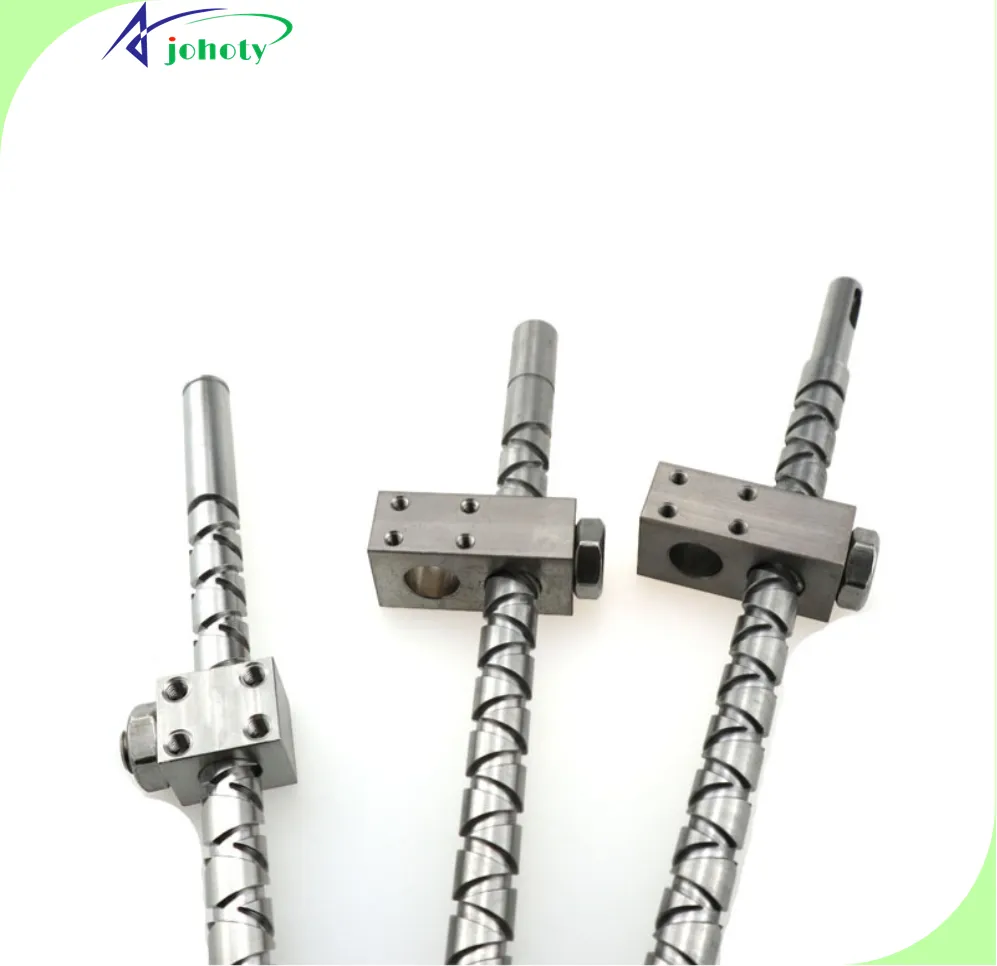
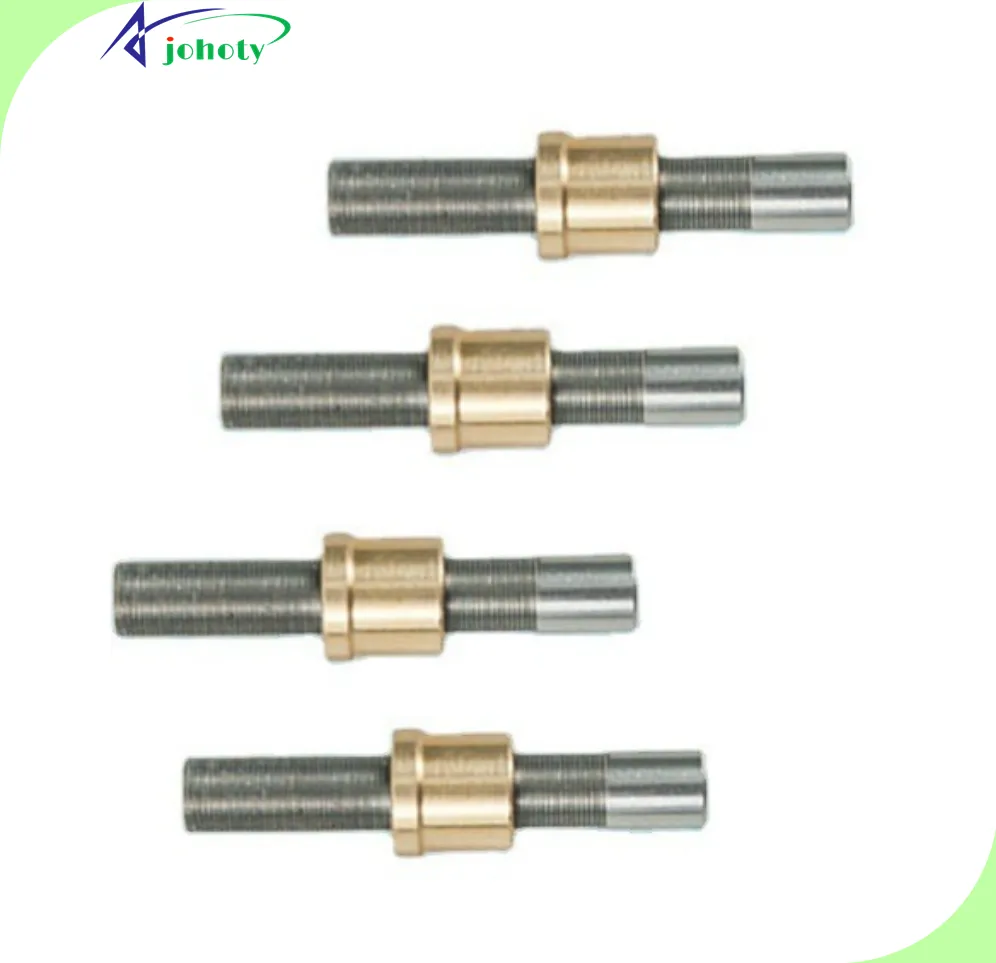

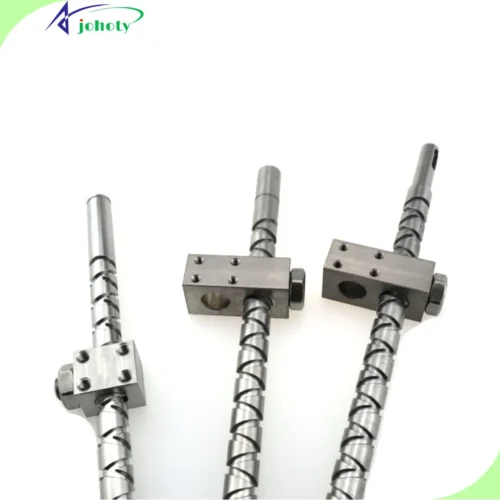
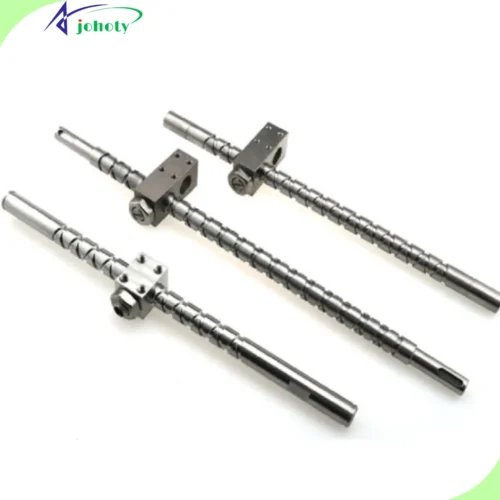
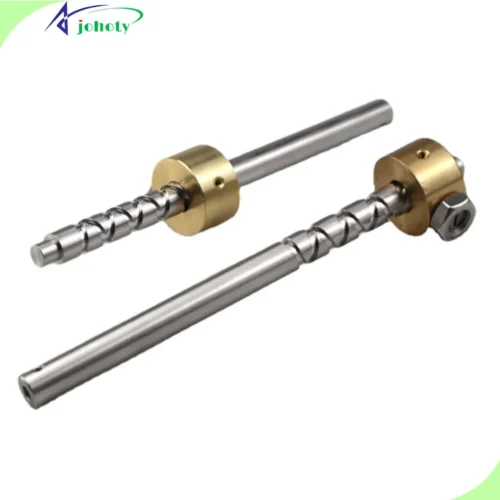
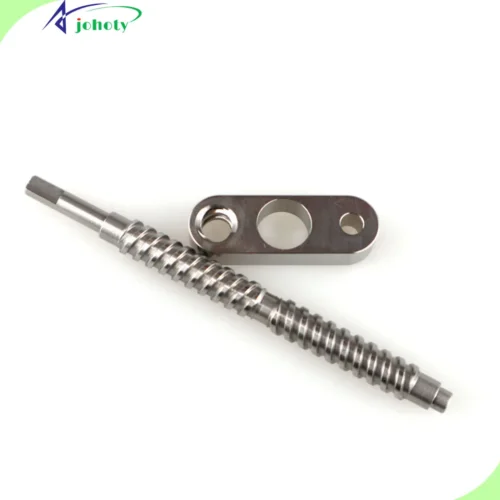
Description of lead screw
Lead screw mechanical specs:
Material: 304/316 stainless steel, carbon steel C45, alloy steel 40Cr. Can be nitrided, plated with hard chromium, and carbonitrided.
Accuracy: Lead accuracy ±0.20-0.25 mm/300 mm. Coaxiality ≤0.05 mm. Straightness ≤0.10 mm/300 mm.
Thread: Tr/ACME (Tr8~Tr36, 1-12mm lead) for left/right rotation and dual lead.
Screw: diameter 6.00-40.00 mm, effective length ≤2,000 mm (customized longer).
Surface roughness: Ra 0.8-1.6μm (up to Ra0.4μm for quiet or low friction).
Supporting nut materials: POM, PA66, PTFE, bronze, PEEK (wear-resistant and high-temperature solution).
Load: Calculated based on material and pitch, lead screw can support smooth transmission under medium and light loads. Johoty provides torque/thrust calculations.
Speed: Linear speed of 10.00-150.00 mm/s (adjusted according to lead and material).
Temperature: -20°C~120°C (PEEK nuts can reach up to 250°C).
Key performance and lead screw functional applications:
Functional Roles:
- Convert motor rotation into linear motion.
- Suitable for medium low speed, low noise, long stroke, economical linear transmission.
- The most commonly used for mechanisms that don’t require ball screw level rigidity and accuracy.
Performance Highlights:
- High anti backlash ability (in combination with self-lubricating engineering plastic nuts).
- Low noise operation (suitable for medical/experimental instruments).
- Low maintenance requirements, optional dry operation.
- Anti-vibration stability (wide thread cross-section, suitable for repeated start stop).
- Strong anti-corrosion solution (all stainless steel or surface treatment optional)
Compatibility:
- Suitable for medium to low load, long travel, and cost-effective linear transmission. Lightweight and low-noise priority, no need for ball screw level μm precision.
- Medical equipment and experimental instruments (low noise, light load). 3D printers, automation equipment, dispensing machines, optical platforms.
- The positioning and adjustment mechanism on the factory production line.
- Furniture, lifting structures, and linear drives for household appliances.
- Industrial robot auxiliary mechanism (non-spindle type).
Johoty‘s value:
Truly flexible non-standard customization capability (also supported for small batches):
- Any lead, pitch, length, surface treatment.
- Can be used for composite leads, double headed threads, special thread angles, and rare specifications.
- Single piece trial production, small batch of lead screw, batch continuous production.
- Unrestricted MOQ is a key advantage for European and American engineers during the prototype stage.
Stable and controllable lead accuracy:
- Can maintain batch consistency of ± 0.20-0.25 mm/300 mm stably.
- It can also achieve straightness control for long axes (>1m) without common bending problems.
High grade materials + strong surface engineering capabilities:
- Materials can be recommended based on the final working conditions (corrosion resistance, wear resistance, noise reduction, high temperature).
- Surface engineering can meet European and American medical equipment standards (Ra, hardness, uniformity).
Self-lubricating nut scheme has adjustable depth:
- Provide customized nuts (POM/PTFE/PEEK/bronze) according to different friction coefficients and temperature resistance requirements.
- Can be used as a preloading structure, low back gap group, and silent solution.
Engineering level communication skills:
- Thrust/torque calculation.
- Load life assessment.
- Suggestions for anti-vibration structures.
- Nut material selection and wear analysis.
Short delivery time can still maintain processing consistency:
- Sample 7-10 days.
- Batch production takes 15-25 days.
- Full inspection of key dimensions to ensure that replacement parts do not deviate.
Challenges and Solutions of Johoty’s Lead screw
Unstable consistency of lead accuracy:
Challenges: Engineers are most afraid not of the tolerance values themselves, but of the unpredictability between batches and within length intervals. Affects positioning accuracy, repeatability, and long-term reliability.
Johoty solutions:
- Independent tool path compensation: Establish a tool path error database for different pitches/leads, and automatically compensate for slight deviations.
- Section mapping: Establish linear and spiral error curves every 300 mm to visualize the error distribution.
- Batch stability: Conduct 3D thread shape sampling for each batch of materials to ensure that the error peak does not shift.
Fluctuation of friction coefficient is large, which affects lead screw service life and noise:
Challenges:
- The friction coefficient of the lead screw without surface engineering treatment fluctuates with temperature/load/lubrication conditions.
- Engineers encounter abnormal noise, stuttering, and decreased acceleration, can’t conduct a retrospective.
Johoty solutions:
- Establish a friction curve database for Material Matrix: 45 #, SUS304, SUS316, SPCC, etc., and recommend the optimal ratio based on the application.
- Customized Spiral Lubrication grooves: Maintain the continuity of the lubricating oil film and reduce temperature rise.
- Surface engineering pack: Roll strengthening, nitriding treatment, MoS ₂ dry film. After precision boring and ultra precision polishing, the friction coefficient tends to be constant, significantly reducing wear and noise.
Long non-standard customization cycle, low communication efficiency, and high design risk:
Challenges: Can you make it according to my drawing? Will this lead modification affect the lifespan? When can you give me the sample? Do we have to recalculate the delivery date after making a design change once?
Johoty solutions:
- Complete DFM manufacturability inspection within 48 hours, including lead, torque, lifespan, and assembly compatibility.
- Parameterized lead screw design model: lead, tooth profile, pitch, angle, and length can quickly generate manufacturing data.
- One-on-one tech support: able to communicate with engineers at the same technical language level.
- Continuous process validation for trial production/small batch/large batch: reduce lead screw and batch production differences during trial production.
Why Choose Johoty’s Lead Screw ?
Johoty’s lead screw has a ±0.02 precision, save >15% costs, ship in 2~3 weeks, flexible custom. Today Contact Johoty!
Benefits of Johoty’s Lead Screw

Accuracy consistency and system performance guarantee:
Benefits and value: Johoty ensures that the cumulative lead error of the lead screw is strictly controlled throughout the entire journey. Not only to meet the local sample accuracy of 300mm. In long-distance travel, the positioning accuracy of the entire machine has predictability and consistency. Johoty precision manufactures thread profiles, pitch diameters, and fillets. Ensuring the stability of pre tightening force and smooth movement in conjunction with the nut.
Challenges solved: Solve the positioning accuracy drift and unpredictable wear faced by engineers in long trips and high loads. The local accuracy of ordinary lead screws meets the standard, but accumulated errors may cause the system to exceed the limit at the end of the effective travel. Johoty’s full process consistency control allows you to make reliable system accuracy budgets. Over design isn’t helpful to compensate for unknown errors, improving the certainty and reliability of the entire machine design.

Professional customization of materials and heat treatment:
Benefits and value: Johoty provides deep customization of materials and heat treatment based on applications. Beyond simple surface quenching, specific alloy steels are recommended based on load spectrum, speed, working cycle, and environment. And matched with precisely controlled carburizing quenching, induction hardening or tempering processes. Accurately control the depth of the hardened layer, the gradient of core hardness, and the residual austenite content. Achieve optimal balance for you between anti-wear performance and fatigue strength.
Challenges solved: Overcoming the durability and impact resistance challenges that engineers expect from core transmission components. Improper heat treatment is the main cause of lead screw pitting, peeling, or brittle fracture. Johoty’s customization eliminates this hidden danger from materials science and extends the lifespan under harsh dynamic conditions. Avoid equipment shutdown due to unexpected lead screw failure.

Targeted optimization of dynamic performance and NVH:
Benefits and value: Johoty can optimize the dynamic characteristics of lead screw. Precise dynamic balance correction lead screw to suppress centrifugal force disturbance during high-speed rotation. Specially designed preloading nuts can eliminate clearances, and the internal thread contacts and preload distribution. Johoty provides you with the best vibration damping effect.
Challenges solved: Solve the vibration and noise bottlenecks that equipment inevitably encounters when developing towards high speed and high acceleration. The lead screw without dynamic optimization will become the excitation source of the system. This will lead to increased tracking error, decreased processing quality, and unacceptable noise. With Johoty’s solution, you can surpass the speed limit of your device. At the same time, it meets increasingly stringent industrial noise standards to ensure the accuracy and stability of equipment at high speeds.

Deep adaptation of system integration and special working conditions:
Benefits and value: Johoty regards lead screw as the core of the transmission subsystem for overall design and adaptation. This provides a support unit with an integrated design, ensuring the concentricity and perpendicularity of the installation reference. Provide special coatings or passivation treatments for medical and food applications in corrosive environments. Johoty customizes materials and fit tolerances for wide temperature range operating conditions.
Challenges solved: Addressing common interface mismatches and insufficient environmental robustness when integrating standard lead screws with hosts. Minor misalignment of the mounting seat can significantly shorten the lifespan of the bearings and screws due to the leverage effect. Ordinary lead screws may rust due to disinfectant corrosion in clean environments. Johoty’s system level perspective and adaptability to special operating conditions seamlessly match the transmission subsystem with the host. Capable of stable operation in specific environments throughout the entire device lifecycle.
Applications of Johoty’s Lead Screw
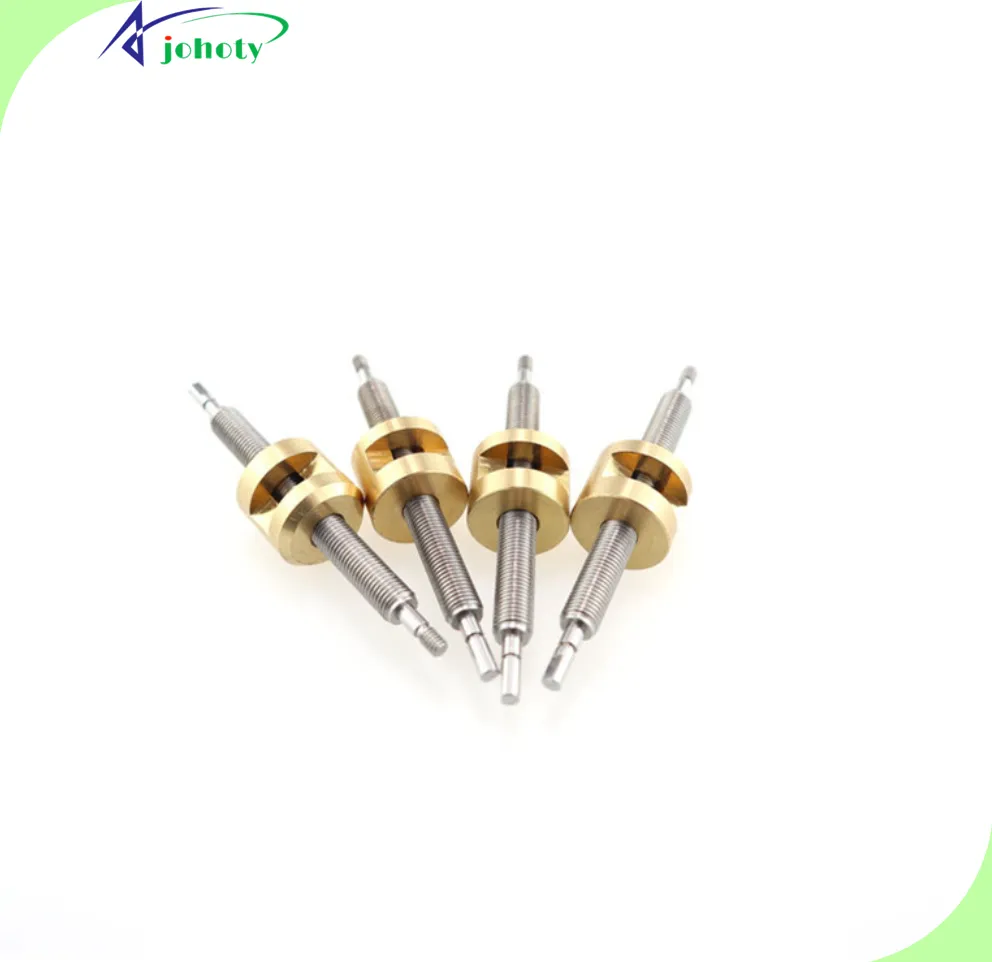
Medical imaging & operating table/C-arm lifting:
Challenges: Requires a long stroke, quiet, self-locking lifting mechanism with high load but low speed. The allowable positioning error is in the millimeter range, but it must ensure repeatability and no crawling. Need to meet the cleanliness and lifespan requirements of the medical environment.
Function: The ordinary drive lead screw has self-locking characteristics and can maintain the bed in case of power failure. The lead accuracy is ± 0.20-0.25mm/300mm, which is sufficient for a lifting stroke of 400-600mm. Johoty can optimize thread types and nut materials, reduce noise and micro vibrations, and avoid imaging shake.
Johoty’s customization: stainless steel or electroplated steel lead screw, matched with POM/PTFE composite nuts. Customize thread lead and diameter to match thrust and speed with existing motors/reducers. Customize dust seals and pre lubrication processes to reduce maintenance frequency in hospital environments.
How to solve: You provide parameters based on the target travel, load, and allowable positioning error. Johoty adjusts the lead, support method, and nut clearance on the lead screw platform. Realize a balance between self-locking, safety, and low noise within the same institution.
Efficiency/Costs: Compared to using ball screws, the number of parts in the complete actuator can be reduced by about 10-20%, and no additional brake is required at the drive end. The overall system BOM cost can be reduced by about 5-15%.
Advantages: By using Johoty’s lead screw, the required precision for medical beds can be achieved without excessive specifications. Simple structure, reliable self-locking, and more intuitive safety analysis. Customization focuses on materials, nuts, and leads, making the design easier to verify and reuse.
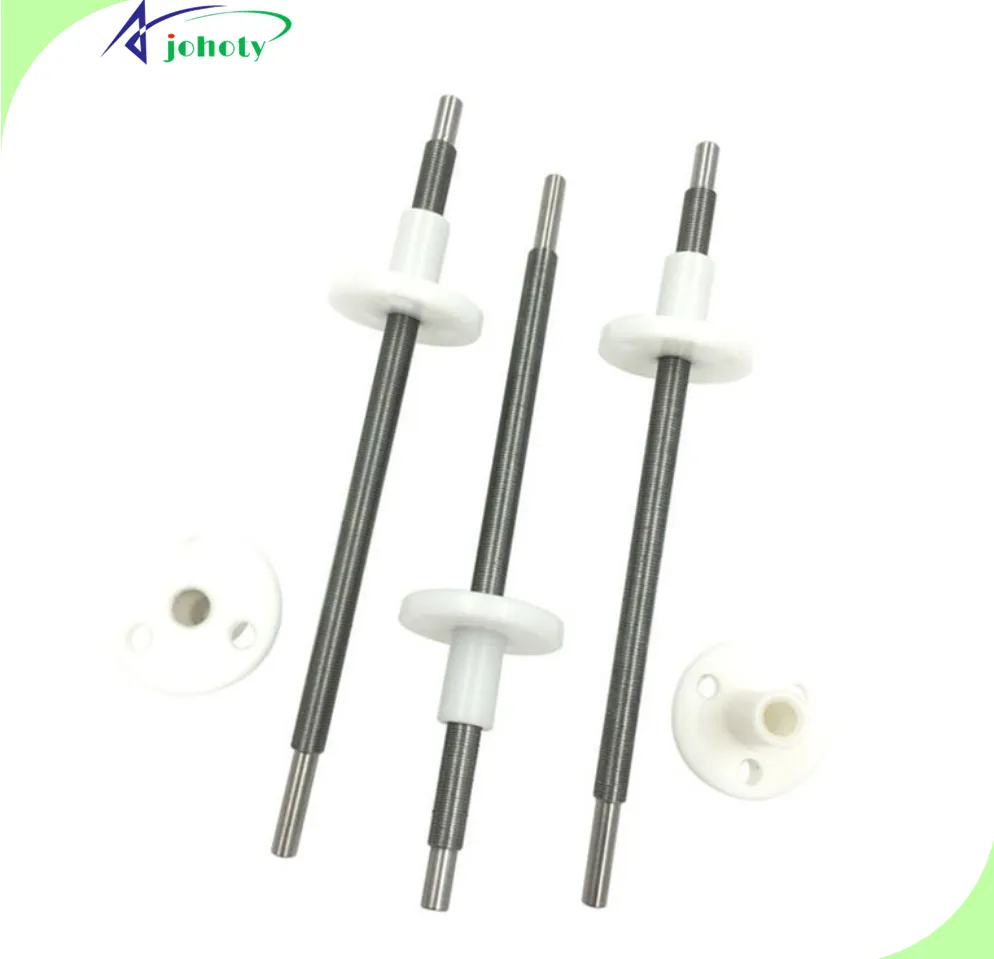
Laboratory automation platform (XYZ modules for pipetting and sample processing):
Challenges: Small load, multi axis, high repetition round trip. Require the lead screw to maintain a predictable cumulative error within a stroke of 200-400 mm. And there isn’t low noise and not introduce any deviation in pipetting accuracy.
Function: Johoty’s lead screw, combined with low backlash nuts, can provide sufficient Z-axis positioning accuracy. The cumulative distribution of guidance error and pitch can concentrate local errors in non-working areas. Customize surface roughness and coating to ensure long-term operation of the lead screw in clean rooms and low lubrication environments.
Johoty customization: Configure lead screws with different leads for different axes (X/Y/Z) to balance speed and resolution. Adjust the lead error distribution range based on the target workspace. Choose corrosion-resistant materials and lubrication solutions for detergent and disinfectant environments.
Problem solving: Engineers are concerned with the overall pipetting error budget rather than the accuracy of individual parts. By allocating the overall machine error, Johoty reverse matches the lead screw lead accuracy, nut clearance, and axial preload. Control the lead screw error within the budget.
Efficiency/Costs: The lead screw solution can reduce the cost of linear modules by approximately 15-30%. By unifying the multi axis lead screw specifications, spare parts inventory and management costs have been further reduced.
Advantages: Achieving sufficient accuracy levels, transparent error allocation, and easy compensation with upper level control algorithms. Materials and lubricants can be tailored to the laboratory chemical environment.
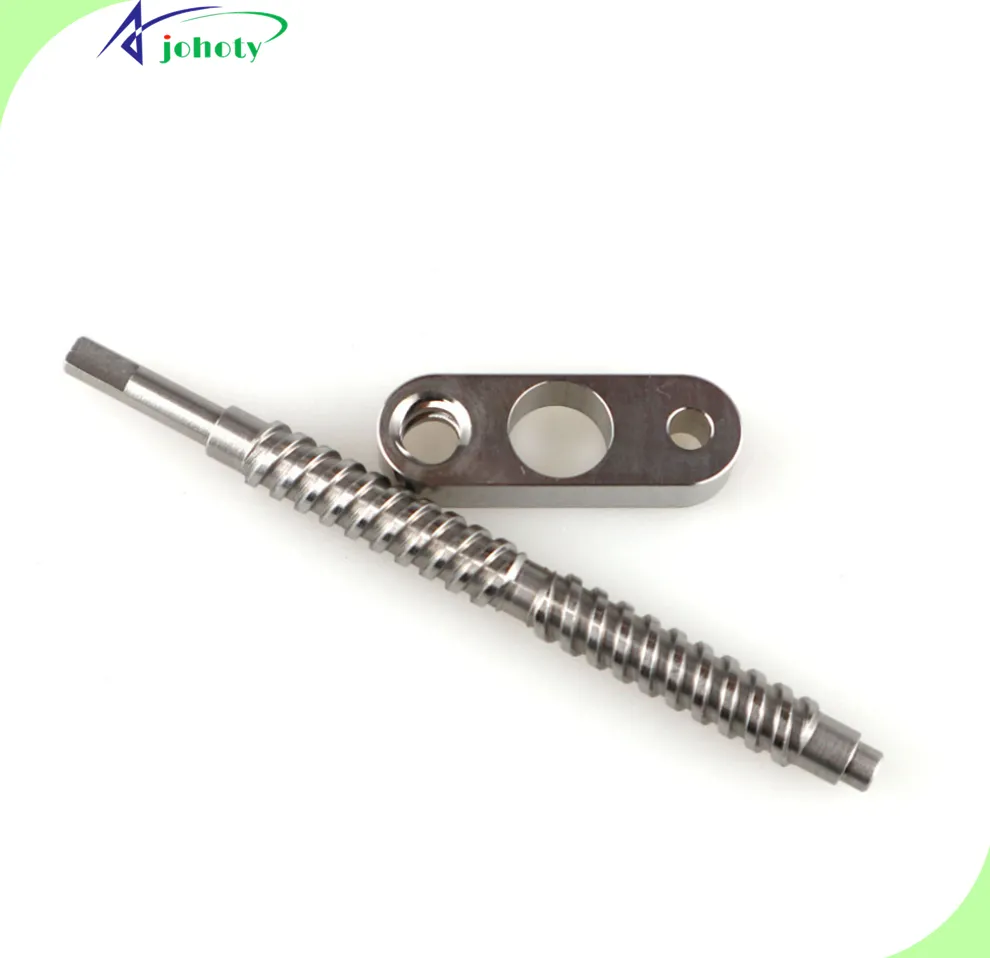
Collaborative robot end effector:
Challenges: Extremely small space, weight sensitive, requiring adjustable travel and stable force retention. Require the lead screw to have good repeatability and self-locking within a short stroke to prevent the gripper from loosening when the robot is powered off.
Role: Lead screw with lead accuracy of ± 0.20-0.25mm/300mm, equivalent local travel error in the tens of micrometers range. Satisfy the control of the opening and closing position of the gripper. Self-locking eliminates additional braking.
How to customize? Customize small diameter, high lead, or multi head lead screws based on gripper thrust and speed. Make lightweight hollow, stepped, and flat positions, directly connected to servo or reducer. Provide self-lubricating and low wear nuts for end effectors, suitable for frequent start stop operations.
Help for engineers: Mechanical engineers can simplify the structure into three core components: motor, lead screw, and nut slider. Reduce coupling and locking structures. Electrical engineers focus on force control algorithms without the need for complex braking designs.
Efficiency/Costs: In a typical end effector project, the number of parts can be reduced by 20-30%. Aluminum alloy casing can simplify processing, reducing the overall processing time by 10-25%.
Advantages: Under short stroke, the lead screw’s lead accuracy is sufficient. Self-locking and simplified structure are beneficial for the safety certification of collaborative robots. Small batch customization is easy and suitable for rapid iteration of multiple types of grippers.
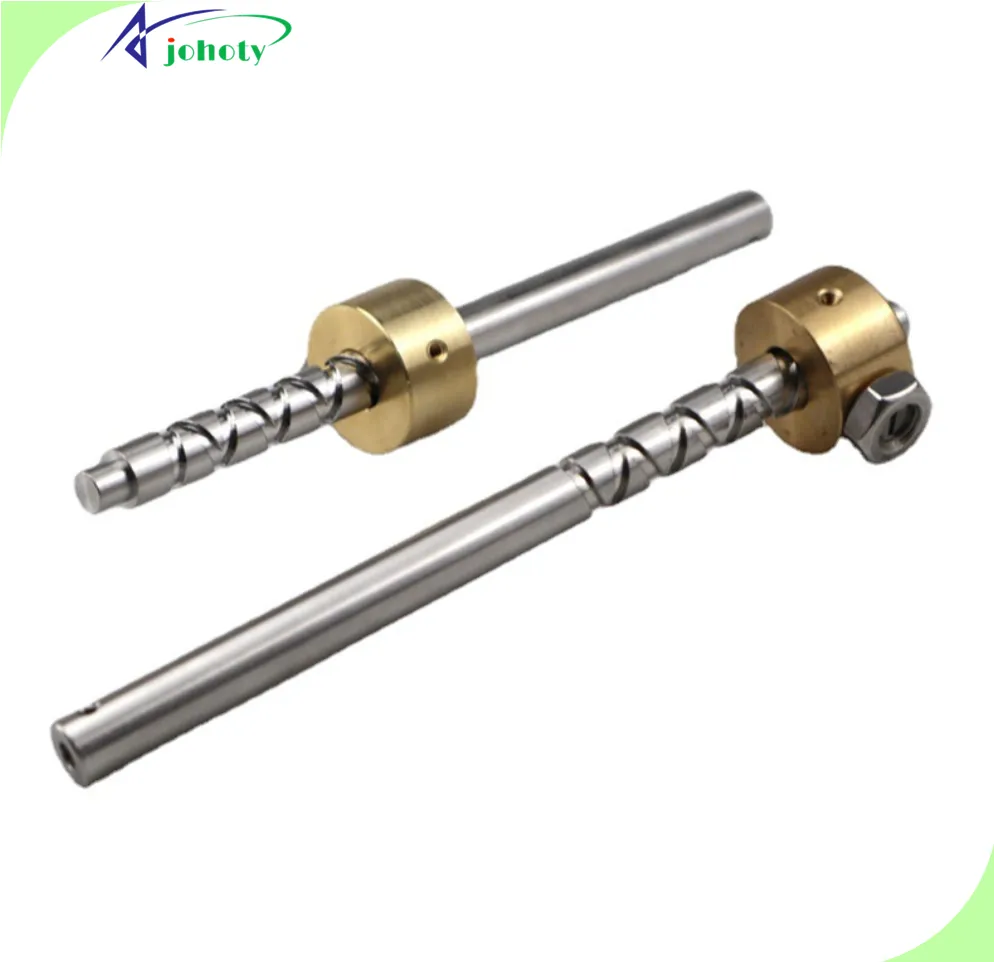
Industrial valves, electric baffles, and throttling:
Challenges: Need to use an electric actuator to control valve opening or baffle position. The absolute travel error is not overly strict, but long-term repeatability, dust resistance, and temperature difference resistance are required.
Function: Provides linear displacement, directly converts motor angle into valve stem stroke, self-locking prevents medium pressure from pushing the valve back. The lead accuracy is ± 0.20-0.25mm/300mm, which is sufficient for 50-100mm opening and can work at high temperatures or outdoors.
Customization: High temperature steel lead screw + heat-resistant lubricating grease, combined with metal protective cover and dust ring design. Lead screw shaft end machining integrated with potentiometer and encoder for position feedback.
Solutions: Leave the precision work to the position sensor and control algorithm. Johoty achieves lead error within the compensable range of the control system, sufficient mechanism stiffness, and controllable return clearance. You can use software compensation to achieve higher control accuracy.
Efficiency/Costs: Compared to hydraulic or pneumatic actuators, electric lead screw actuators reduce external piping and maintenance costs. Compared to ball screws, lead screws typically have lower costs at the same level of protection. Self-locking reduces the cost of external brakes.
Advantages: Simple structure, easy protection, meeting the precision and lifespan of valve control. Clear division of labor between software and hardware facilitates cross platform migration design.
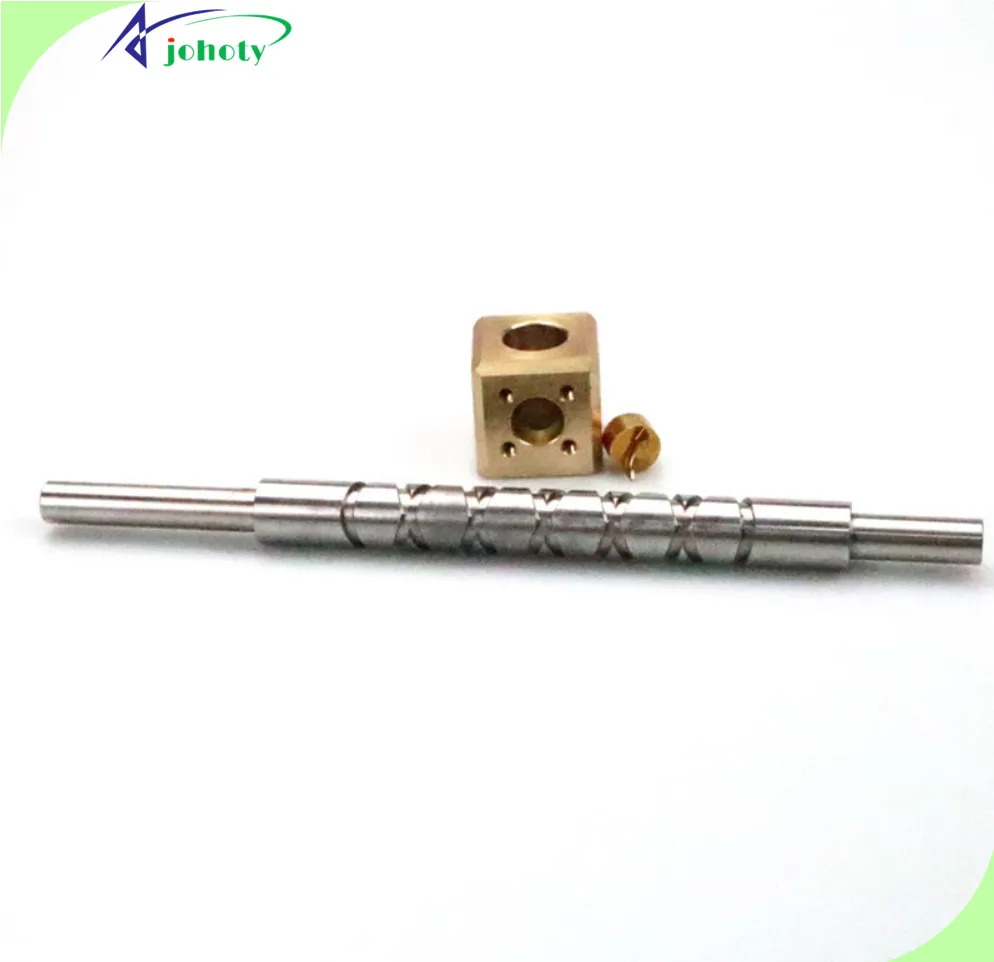
Desktop devices&3D printers Z-axis/industrial small platforms:
Challenges: The Z-axis needs to ensure layer thickness and platform flatness, but the overall cost is sensitive. The precision of a regular lead screw must be coordinated with the subdivision and control algorithm of the stepper motor.
Function: The lead screw is the Z-axis main drive and self-locking to prevent layer dropping during printing. Lead accuracy of ± 0.20-0.25mm/300mm is sufficient for printing heights of 200-300mm.
Customization: Multi head or single head lead screw, matching different lead lengths with different layer thicknesses and printing speeds. Customized anti return nuts can be used to reduce layering and Z-banding.
Solutions: By providing the target layer thickness and stroke, Johoty proposes a suitable combination of lead and step distance to ensure that the motor can achieve controllable Z displacement in one step.
Efficiency/Costs: Compared to linear modules and all screws, regular lead screws make the overall structure more compact and reduce the number of parts and machining.
Advantages: High design openness, engineers can develop different printing heights/platform sizes.
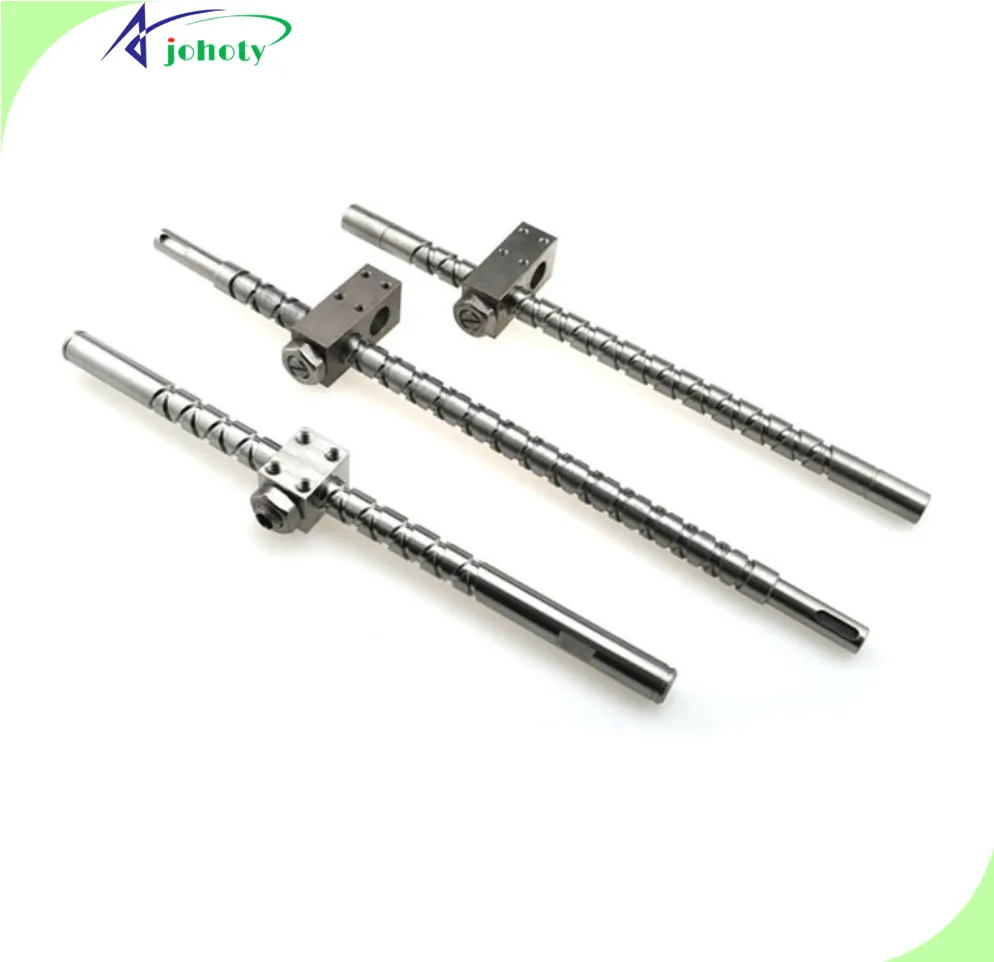
Focusing and optical path fine-tuning of precision optical/laser equipment:
Challenges: The optical system requires repeatable small stroke adjustment, but the internal space of the entire machine is limited. Temperature drift and structural vibration directly affect the position and focus of the light spot.
Role: Within a short distance, the lead screw’s lead error is actually very small. Choosing a reasonable lead can achieve small displacements in a limited space. By adding nut pre tightening, sufficient axial stiffness can be obtained to resist vibration.
Johoty’s customization: a small diameter lead screw that can be directly integrated into an optical slide table. Nuts can be made of low creep materials to reduce time-dependent drift. Temperature compensation structures or redundant supports can be implemented at both ends.
Value to engineers: Optical engineers can clearly provide the focusing stroke and allowable error. Johoty is able to control mechanical errors within the acceptable range of optical error budget.
Efficiency/Costs: Compared to using high-precision ball screws or piezoelectric platforms, lead screws can significantly reduce single axis costs. The same design can expand focus, tilt angle, and aperture, with a unified testing and calibration process.
Advantages: Under short stroke, the accuracy of the ordinary lead screw is highly matched with the actual requirements of the optical system. Structural stiffness and self-locking characteristics are beneficial for maintaining long-term stability
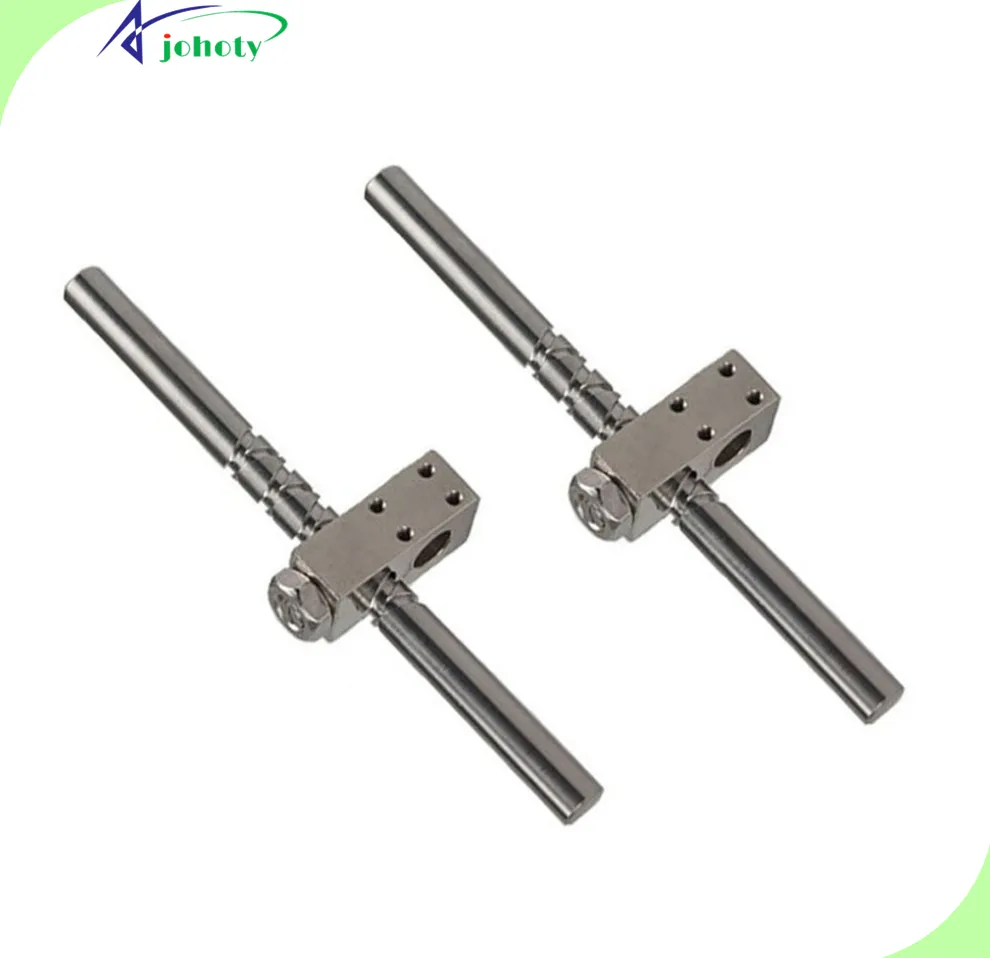
Car/commercial vehicle seats, electric pedals, and sunshade mechanisms:
Challenges: In vehicles, seat slippage, electric pedals, and sunshade mechanisms face high vibration, wide temperature difference range, limited power supply, and strict noise restrictions. Long term reliable, self-locking, and easy to assemble linear drives are needed, rather than extreme high precision.
Function: The lead screw can provide medium precision linear displacement and maintain the seat position or pedal extension position through thread self-locking. When directly coupled with the motor, the structure is compact and the anti-vibration is reliable.
Johoty’s customization: Choose corrosion-resistant steel or special coated lead screws for vehicle platforms. The nut is made of low-noise plastic and has a lubrication storage tank structure. Integrate splines or flats at the end of the lead screw for easy integration with the existing transmission architecture of the car manufacturer.
Solutions: Deduce the material and lubrication selection of the lead screw through temperature cycling and vibration spectrum analysis. Based on the seat/pedal travel design, the lead screw maintains predictable wear and tear for 10-15 years.
Efficiency/Costs: Lower the number of components required for lead screw, and simplify the assembly process. Helps to control the cost of bicycles while reducing the complexity of after-sales maintenance.
Advantages: Set the accuracy at the level truly required for vehicle comfort and safety. Utilize lead screw self-locking to reduce additional mechanical lock structures. Convenient for small batch customization based on vehicle platform, without the need for a completely new platform.
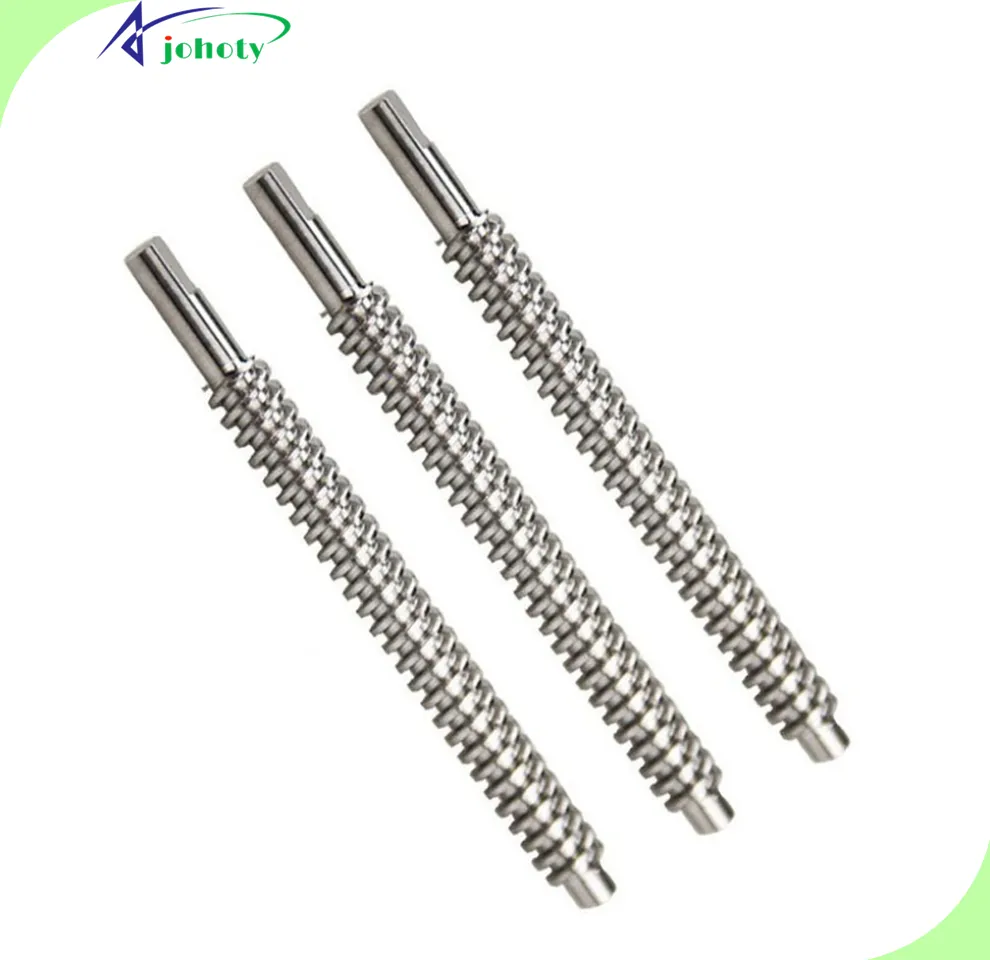
Adjustment of knife holder height and guide plate width for packaging/food machinery:
Challenges: Frequently changing specifications, hoping to quickly adjust the position of the tool or guide plate through a handwheel or small motor. There is dust, moisture or cleaning solution in the environment, which requires cleaning and maintenance of the lead screw.
Professional positioning: Used for key dimension adjustment, with a lead accuracy of ± 0.20-0.25mm/300mm, sufficient for formula/packaging size switching adjustment. Self-locking prevents device vibration from causing set value drift.
Johoty’s customization: stainless steel or corrosion-resistant coating lead screw, combined with open or semi closed protection. Disassembling and washing a nut/support structure design. Customize the lead according to the common packaging specifications of the enterprise.
Solutions: Define the changeover time and acceptable setting error, and Johoty adjusts the lead, axial clearance, and protective structure. The changeover process is repeatable and easy for operators to understand.
Efficiency and Costs: Reduce changeover time from 30 minutes to 10-15 minutes, improving OEE. By using the regular lead screw instead of high-end linear modules, keep the cost of the adjustment mechanism controllable.
Advantages: The lead screw structure is intuitive, making it easy for workshop personnel to operate and maintain. Meet the requirements of packaging machinery for repeatable and easy-to-clean positions. Customize leads according to operating habits to reduce errors during changeover.
Advantages of Johoty’s lead screw
Optimization of system level matching and lead screw to enhance overall reliability:
Problem solved: Engineers are often forced to modify the design or add adapter components when designing the entire machine. Because the shaft end form and installation diameter of the standard lead screw do not match the existing structure. This increases BOM costs and assembly complexity, introduces additional tolerance accumulation points and potential misalignment risks. Affects system rigidity and long-term operational stability.
Johoty’s advantage: Johoty can customize according to the installation space and load requirements you provide. Provide non-standard specific flange, keyway, thread, preload adjustment, and nut installation structures. Our lead screw is already a highly compatible subsystem with the target system when it leaves the factory. You can optimize the force transmission path from the driver end to the load end. Minimize vibration, noise, and early wear caused by poor adaptation to the greatest extent possible. In this way, you can effectively enhance system reliability and transmission lifespan.
Accurate adaptation of materials and heat treatment processes, lead screw to cope with harsh use:
Problem solved: In food, packaging, or medical settings, equipment requires frequent cleaning and is exposed to corrosive environments. Carbon steel lead screws are prone to corrosion, while stainless steel lead screws are expensive, have low hardness, and lack wear resistance. Engineers often have to flexibly balance corrosion resistance, wear resistance, and cost.
Johoty’s Advantages: Johoty can provide surface treatments such as galvanizing and electroless nickel plating to achieve good corrosion resistance on an economical carbon steel substrate. For higher requirements, specific grades of stainless steel materials can be provided. Optimize surface hardness and core toughness through controllable heat treatment. Ensure corrosion resistance and compensate for potential shortcomings in wear resistance. This material process application matching enables engineers to solve durability issues with more cost-effective solutions.
Lead screw for implicit tolerance control and balancing of dynamic performance:
Problems solved: Lead accuracy is only one of the indicators of lead screw positioning accuracy. Accumulated errors in pitch, straightness, and circular runout directly affect the stability, vibration level, and noise level of the system during high-speed operation. Many standard lead screws only meet lead accuracy, but the implicit tolerance band is wide. Poor performance in fast pick and place and scanning movements with high dynamic performance requirements.
Johoty’s Advantages: Our customized leas screw has collaborative control over the comprehensive tolerance. Our thread rolling, straightening, and inspection standards are finely controlled to achieve better straightness and runout tolerances within a given lead accuracy. Johoty’s lead screw can effectively suppress forced vibrations caused by form and position errors during high-speed operation. Meet the deep needs of engineers for equipment dynamic stability and low noise.
Lead screw accelerates R&D iteration and Johoty’s rapid response to supply chain resilience:
Problems solved: During prototype R&D or small-scale trial production, engineers often slow down project progress due to the inability to quickly obtain non-standard lead screws. Ordering non-standard lead screws from large standard component suppliers often involves long lead times and high tooling costs.
Johoty’s Advantages: Johoty has established a flexible production system that can efficiently handle small batch, multi specification customized orders. We can respond quickly and deliver with short lead times. Engineers can quickly obtain lead screw samples that perfectly match the final design. Being able to conduct system testing and validation greatly accelerates the R&D iteration process. Johoty’s supply chain resilience also reduces the risk of upfront investment in your project. And it provides a stable and reliable supply source for subsequent production, enhancing the resilience of the supply chain.
FAQ
Challenges: In frequent start stop or micrometer level displacement, accumulated errors in the back gap lead to positioning drift.
Johoty’s solutions:
- Asymmetric tooth shaping technology: pressure angle optimization design is adopted on the contact surface of the threaded pair to converge the backlash to within ± 0.03mm.
- Multi contact damping structure: The nut integrates an elastic damping ring inside, which eliminates the critical vibration frequency through a phase difference layout. This lead screw is suitable for high-frequency micro motion applications of stepper motors.
Challenges: Long lead screws are prone to jamming and abnormal wear due to installation surface flatness errors.
Johoty’s solutions:
- Flexible flange coupling design: The nut flange surface adopts a 3D of freedom floating structure, with an adaptive installation base surface parallelism deviation of ± 0.50mm/m.
- Thread pitch diameter gradient compensation: Adjust the lead screw pitch diameter tolerance according to the stroke segmentation. Compensate for uneven thread load caused by self-weight sagging.
Challenges: Traditional lead screws may experience actual lead errors exceeding their nominal values due to thermal expansion and changes in friction coefficient during continuous operation or large temperature differences.
Johoty’s solutions:
- Material pairing and heat treatment process: Johoty’s lead screw is made of nitriding alloy steel, and the nut is matched with specialized polymer composite materials. Segmented temperature compensation process controls the thermal deformation of the lead screw.
- Dynamic calibration of preload force: Adjust the preload force of the lead screw based on the axial load spectrum during the assembly phase. Provide a measured data table to correlate the load temperature accuracy correction factor.