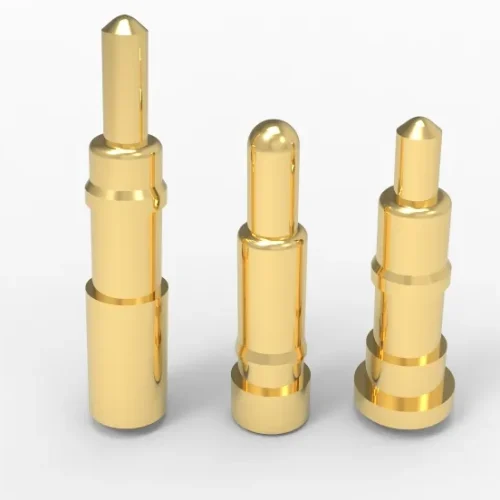
Through Hole Pogo Pins Offer Robust Reliability for Custom OEM and EMS Solutions. Improve Connection Quality and Precision. Get a Quote Now!
Introduction: Every small contact is the starting point of a grand system
Through hole pogo pins, it can work in any high reliability electronic system. It is the lifeline of stable performance and system security. Global OEM, ODM, and EMS customization is accelerating the evolution towards high-density, long-life, and high-frequency directions. Through hole pogo pins are a traditional but irreplaceable solution. It is once again becoming the preferred choice in high-end engineering projects.
It is not as dazzling as high-speed chips, but it often undertakes the first kilometer of electrical transmission. Once it fails, it not only leads to signal disconnection, but also may cause the entire machine to shut down. And truly understanding its engineering significance is not about looking at marketing jargon. Need to consider the system architecture for connection reliability and mechanical tolerance.
Johoty will show you in-depth through hole pogo pins here. Including their structural advantages, process boundaries, failure modes, PCB compatibility, and cross application solutions. Fully expand the system level understanding that you cannot obtain from the supplier brochure. What Johoty CFT team insists on is precisely such an uncompromising professional spirit.
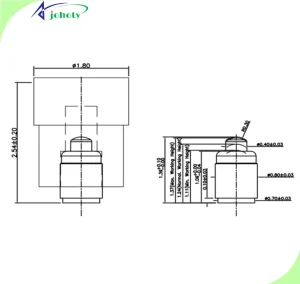
Is through hole pogo pins a mechanical electrical integrated component?
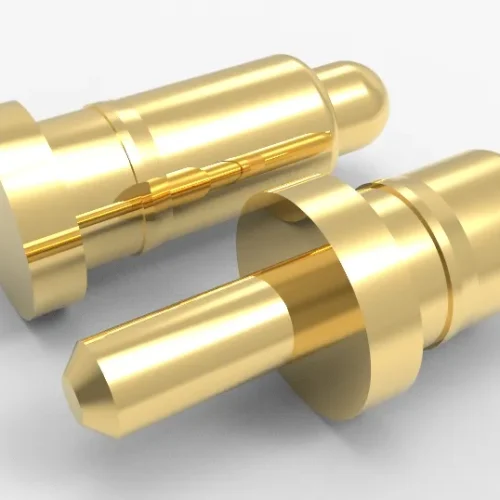
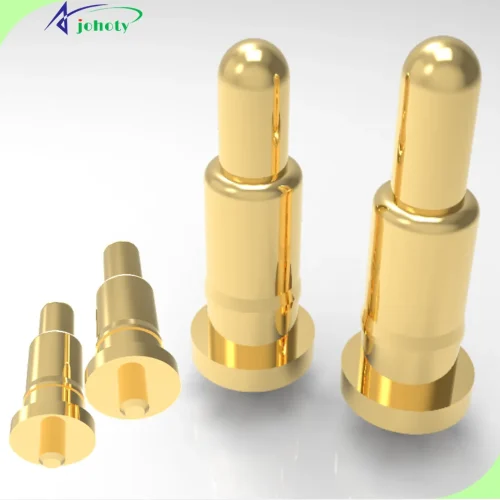
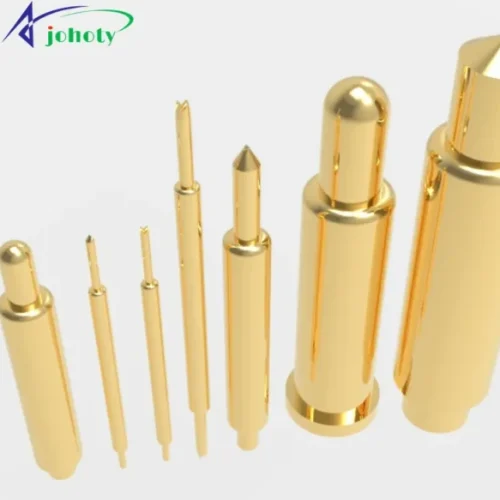
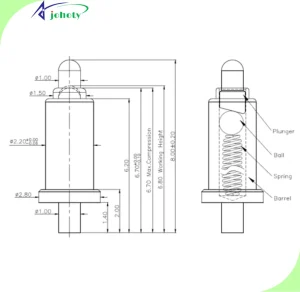
In terms of definition, through hole pogo pins are a type of spring loaded connector that is soldered through PCB holes (non patch). Electrical vertical conductivity, repeatable mechanical buffering, and extremely high connection stability. The structure usually consists of four main parts:
- Tail pin: Insert it into the PCB hole for soldering and fixing, with a length range usually from 0.50mm to 6.00mm. The regular customized depth is 3.2mm, which can be flexibly adjusted.
- Barrel: Generally made of brass plated with gold, it serves a dual purpose of protection and conductivity.
- Plunger: a contact end that allows for up and down movement, ensuring reliable contact engagement through spring compression.
- Spring: Provide precise and sustainable stable elasticity to the plunger. Johoty’s customized springs often have a lifespan of up to 200,000 cycles.
One noteworthy data is that barrel outer diameter is between 0.50mm and 10.00mm. The required PCB aperture for matching is 0.80mm to 5.00mm, with a reserved gap of 0.05-0.10mm to ensure uniform distribution of solder. This is the confidence that through hole spring loaded pin can operate stably under high vibration and high impact.
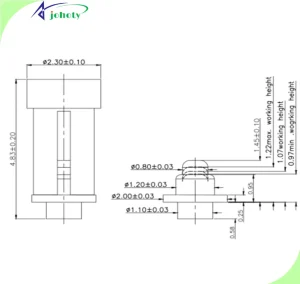
Mechanical strength and reliability of through hole pogo pins
Under strict medical, aviation, and industrial automation, customers’ first concern has never been price. But rather: How many connections can this connection scheme withstand? Will it loosen? Does it fail after thermal expansion and contraction?
Let’s take a look at Johoty’s pogo pin with a diameter of 1.30mm barrel, a tail pin depth of 3.50mm, and an elasticity of 85gf. It has achieved an effective lifespan of over 150,000 cycles of connection at 5Hz. The key lies in:
- Multi segment contact structure to avoid single loss of contact points.
- The gold plating thickness is as high as 5μm, effectively preventing micro arc corrosion.
- There are mechanical limit steps in the tail pin welding area to prevent displacement.
It can be used for battery compartment detection seats, intelligent terminal modules, military data collectors, and robot end sensors. What procurement experts really need is a low failure rate component that can operate stably for years without requiring secondary maintenance.
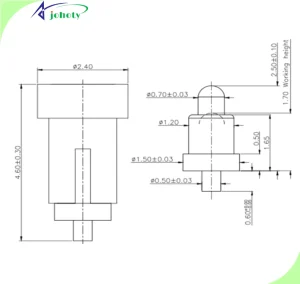
Advantages of welding tail pins through hole pogo pins
Compared to SMT pogo pins, the tail pins of through hole pogo pins are soldered into PCB holes. This type of soldering into PCB holes can have stronger electrical conductivity certainty. This certainty is reflected in two dimensions:
- Larger solder joint area and lower contact resistance: The average resistance of tail pin solder joints is controlled between 5-10mΩ. It can improve stability by about 20-35% compared to SMT pogo pins.
- Strong anti vibration ability: Fixed with larger welding area and PCB holes. It is not prone to cold soldering, false soldering, or thermal tearing due to PCB stress or thermal expansion and contraction. This can better demonstrate anti vibration in automotive ECU and rail transit sensing systems.
Johoty discovered this while conducting stress testing with the client. The tail pin with a depth of 3.20mm remains connected without detachment or virtual soldering under an impact acceleration of 30g. It exceeds the stability requirements for Class 3 solder joints in the IPC standard.
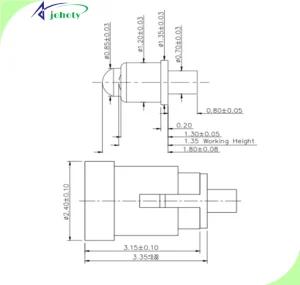
Through hole pogo pins compatible with high-density design
Currently, many customers are designing next-generation portable diagnostic devices, smart meters, or drone control core boards. A core challenge that customers often encounter is how to achieve stable connections within a limited space?
According to the data from the Johoty technical team, the traditional needle socket + pin solution does not have an advantage in terms of volume. But through hole pogo pins with a 1.00mm pitch can save at least 23% of PCB wiring area. Because:
- The barrel and tail pins are highly integrated.
- Fine control of the outer diameter is achieved through CNC cutting, with a tolerance of up to ± 0.02mm.
- Support L-shaped tail pin design for vertical soldering and lateral routing.
In customer’s original design, it was planned to use a pogo pin connector with a 72 pin signal and power. The layout scheme of 1.00mm pitch through hole pogo pins proposed by Johoty was adopted. The originally required 52.00mm space was compressed to 39.8mm, resulting in a system response improvement of approximately 7.6%. Customer feedback: The difficulty of wiring winding has significantly decreased.
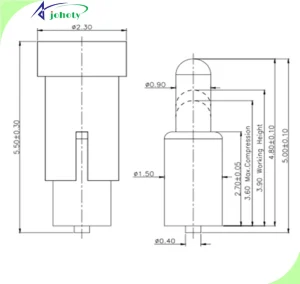
High consistency elasticity of through hole pogo pins
Many customers may overlook one thing: pogo pins are not simply contacts, but connections with controllable pressure. When multiple pogo pins are working simultaneously, the consistency of elasticity directly determines the stability of the contacts.
Johoty’s through hole pogo pins use stainless steel piano wire to produce springs (SUS304-WPB). Batch sorting is carried out using a laser bomb gauge, spring force tolerance is controlled within ± 5gf.
Our German energy equipment company customer experienced probe rebound failure due to uneven contact points on the test board. After switching to Johoty’s customized through hole pogo pins, the false triggering rate of the entire redundant testing system decreased by 91.3%. Passed the customer’s on-site 72 hour alternating aging test.
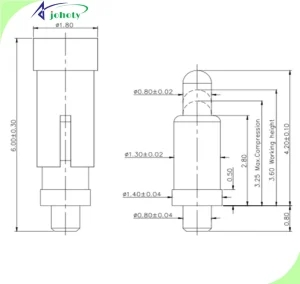
Coating and anti-corrosion of through hole pogo pins ensure long service life
Offshore platforms, electrolytic cells, and outdoor terminal equipment often operate in high humidity, high salt, and highly corrosive environments. Ordinary connectors often oxidize and become unusable within a few months.
To address this issue, Johoty adopts:
- Barrel gold plating thickness is as high as 5μm, and the tail pin gold plating is ≥3μm. When necessary, you can get 5-layer or 6-layer composite electroplating.
- Plating process involves at least a 3-layer composite structure (gold-nickel-copper) to prevent electrochemical migration.
- Control surface roughness within Ra 0.4μm to reduce the number of attached ions.
Many customers showed no oxidation black spots or corrosion pits on Johoty through hole pogo pins during the 96 hour neutral salt spray test. Customers often say that if my equipment is bad, I can still remove through hole pogo pins and reuse them.
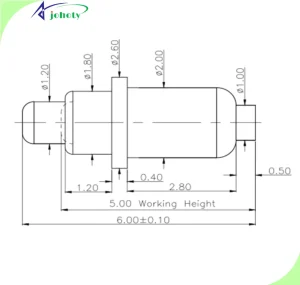
Typical tail pin depth of through hole pogo pins and PCB hole ratio
| Pogo Pin Diameter (mm) | Recommended PCB Hole Dia (mm) | Tail Pin Depth Suggestion (mm) | Notes |
|---|---|---|---|
| φ0.60 mm | φ0.80 mm | 2.00 mm | High-density applications |
| φ0.80 mm | φ1.00 mm | 2.00 mm | Used in miniature electronics |
| φ1.00 mm | φ1.20 mm | 2.50 mm | Low to medium-density applications |
| φ1.20 mm | φ1.40 mm | 3.00 mm | Stable connection, low-frequency devices |
| φ1.50 mm | φ1.70 mm | 3.00 mm | Standard PCB applications |
| φ1.80 mm | φ2.00 mm | 3.20 mm | Industrial applications, high stability |
| φ2.00 mm | φ2.20 mm | 3.50 mm | Strong contact force, high durability |
| φ2.50 mm | φ2.80 mm | 4.00 mm | High-current applications |
| φ3.00 mm | φ3.30 mm | 4.50 mm | Industrial-grade, high power applications |
| φ3.50 mm | φ3.80 mm | 5.00 mm | High power, strong connection demand |
| φ4.00 mm | φ4.30 mm | 5.50 mm | High current, high voltage applications |
| φ5.00 mm | φ5.30 mm | 6.00 mm | Large equipment, high power demand |
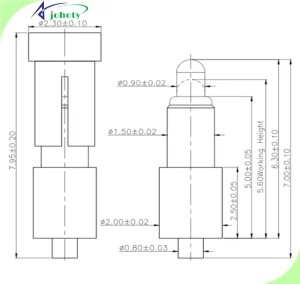
Through Hole Pogo Pins application in ODM, OEM, EMS
Johoty often needs to provide customized and high-quality electronic solutions for customers. Through hole pogo pins can provide reliable connectivity in ODM, OEM, and EMS. They can improve product performance, reduce rework and customer complaints caused by connection issues.
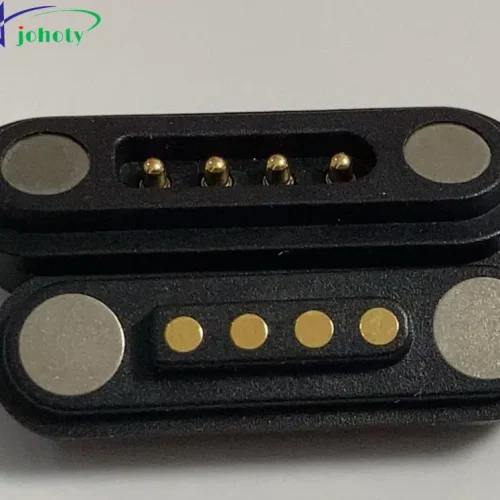
Smart devices: Many smartphones, tablets, and wearable devices rely on precise electrical connections. Through hole pogo pins can maintain stable performance in high-frequency, high-precision signal transmission. These smart devices can operate reliably based on customized shapes, mechanical dimensions, and electrical parameters.
Automotive electronics: In the automotive industry, electronic components are crucial for reliability and stability. Through hole pogo pins can work in vehicle navigation system, auto drive system, vehicle entertainment system, etc. With their high stability and vibration resistance, automotive electronic devices can operate normally in various driving environments.
Medical equipment: Many medical equipment customers require Johoty to provide extremely high connection stability and security. Through hole pogo pins can meet the requirements of medical equipment for high precision and reliability. For example, customers often require corrosion resistance and a lifespan of up to 200,000 cycles under various medical solutions. After customer verification, through hole pogo pins can operate stably for a long time in blood glucose monitoring and electrocardiogram (ECG).
Aerospace: In the aerospace industry, almost every customer requires stable and high-performance electronic connection components. Through hole pogo pins can work stably in high temperatures, vibrations, and extreme environments. They can provide reliable connections for electronic devices in spacecraft during flight.
How to choose right through hole pogo pins?
Pogo pin depth and outer diameter: The depth and outer diameter of pogo pins can directly affect the contact effect. The depth of through hole pogo pins often matches the depth of the target PCB hole. Their outer diameter also adapts to the size of PCB holes. Normally, depth needs to ensure stable contact force. The outer diameter should ensure a good contact area.
PCB hole size: Different devices and PCB designs require holes of different sizes. Johoty’s through hole pogo pins have completed over 20,000 hole sizes and can connect to PCBs of various specifications. The standard PCB hole size is 0.80mm-1.20mm, and the outer diameter of the pins is selectable based on the size of the hole. The common outer diameter size is 1.00mm-1.20mm.
Electrical performance requirements: Select the appropriate through hole pogo pins based on the required current load and operating frequency. Johoty can customize them according to different currents, voltages, and frequencies to ensure optimal electrical transmission performance.
Environmental requirements: High temperature, vibration, humidity or other extreme conditions require the selection of through hole pogo pins with resistance to environmental interference. Pogo pin design usually uses materials with high heat resistance and oxidation resistance, then, they can work stably in extreme environments.
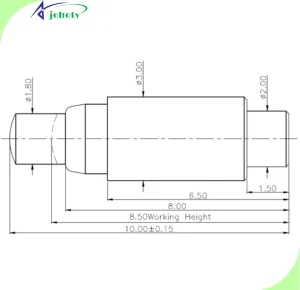
Conclusion: Understanding through hole pogo pins is equivalent to mastering the most secretive core of engineering systems
Johoty always believes that a truly mature system design does not depend on how advanced chips you choose. Can you make every connection point stable, precise, and repeatable. Through hole pogo pins are a type of underlying device that achieves contemporary extreme reliability in a traditional form.
At Johoty, through hole pogo pins undergo 23 tests before leaving the factory. From electrical conductivity, plug-in fatigue, elastic consistency to solder joint shear strength, it is only to reduce one unexpected factor for the customer’s project.
Welcome to contact Johoty now. We will provide you with sample testing, structural joint design, and tail pin depth matching suggestions. Make your next connection plan free from connection issues.