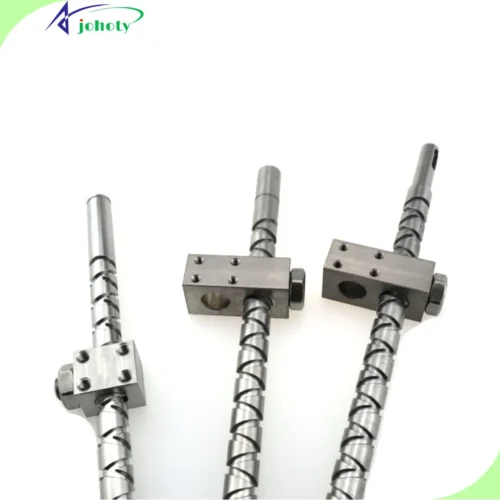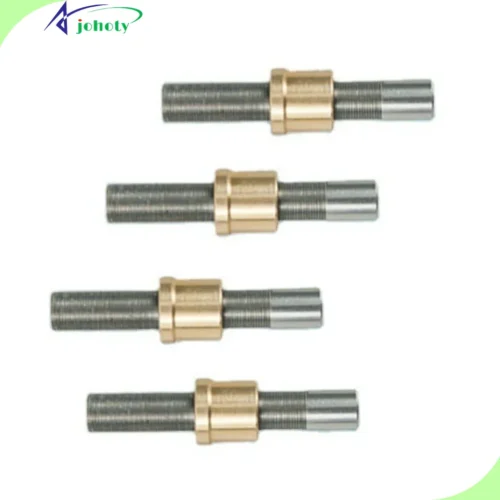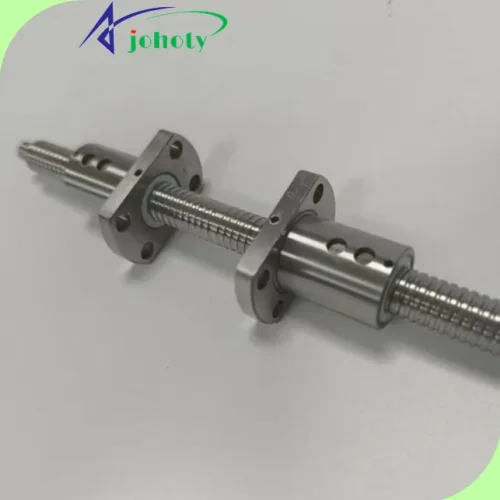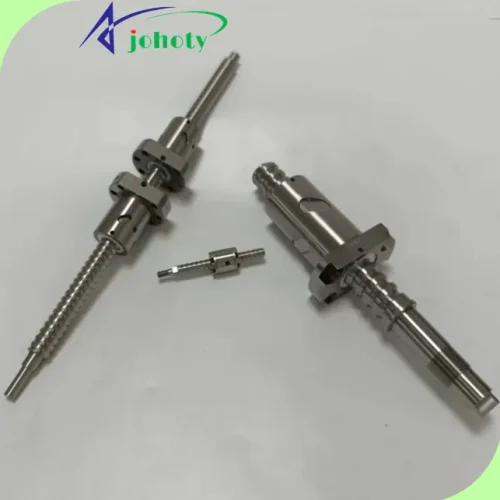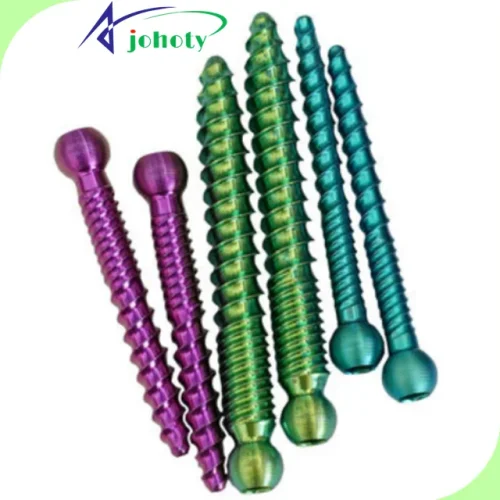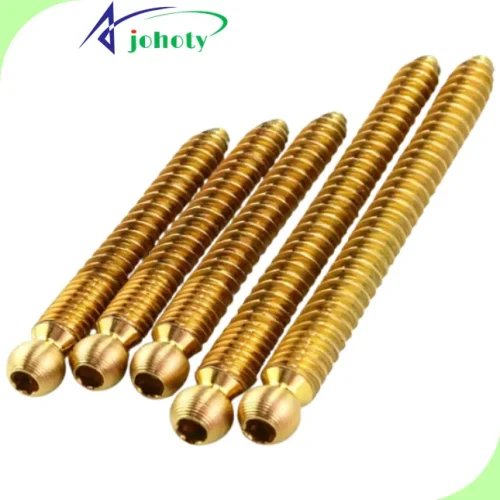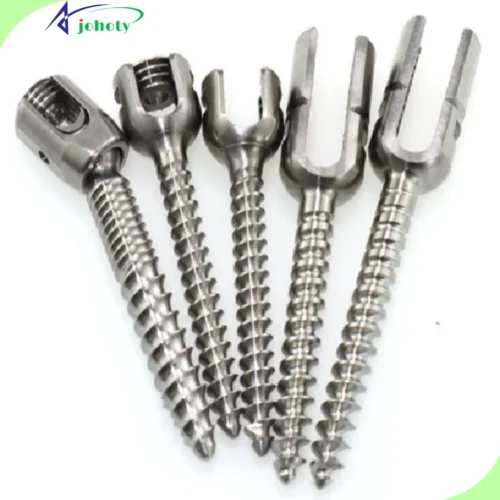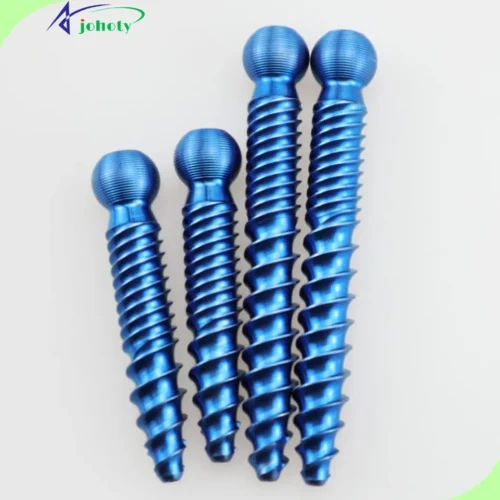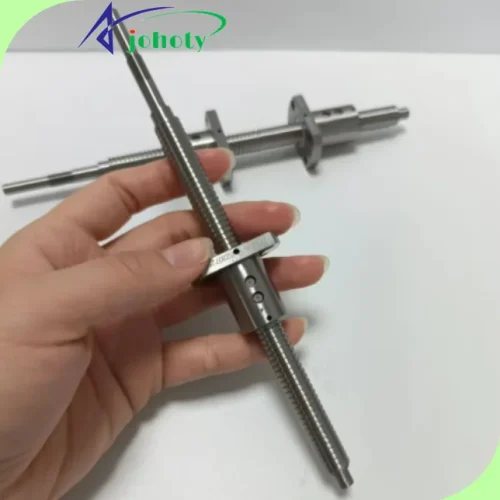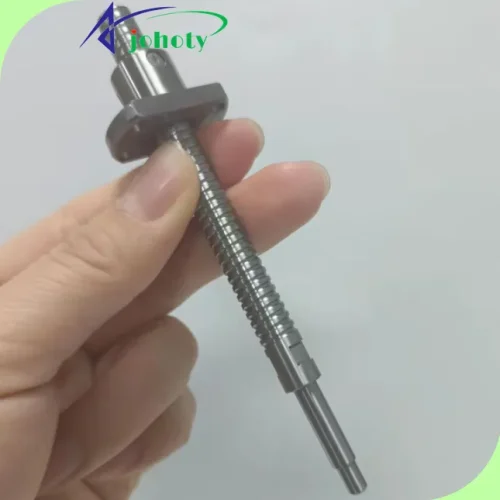
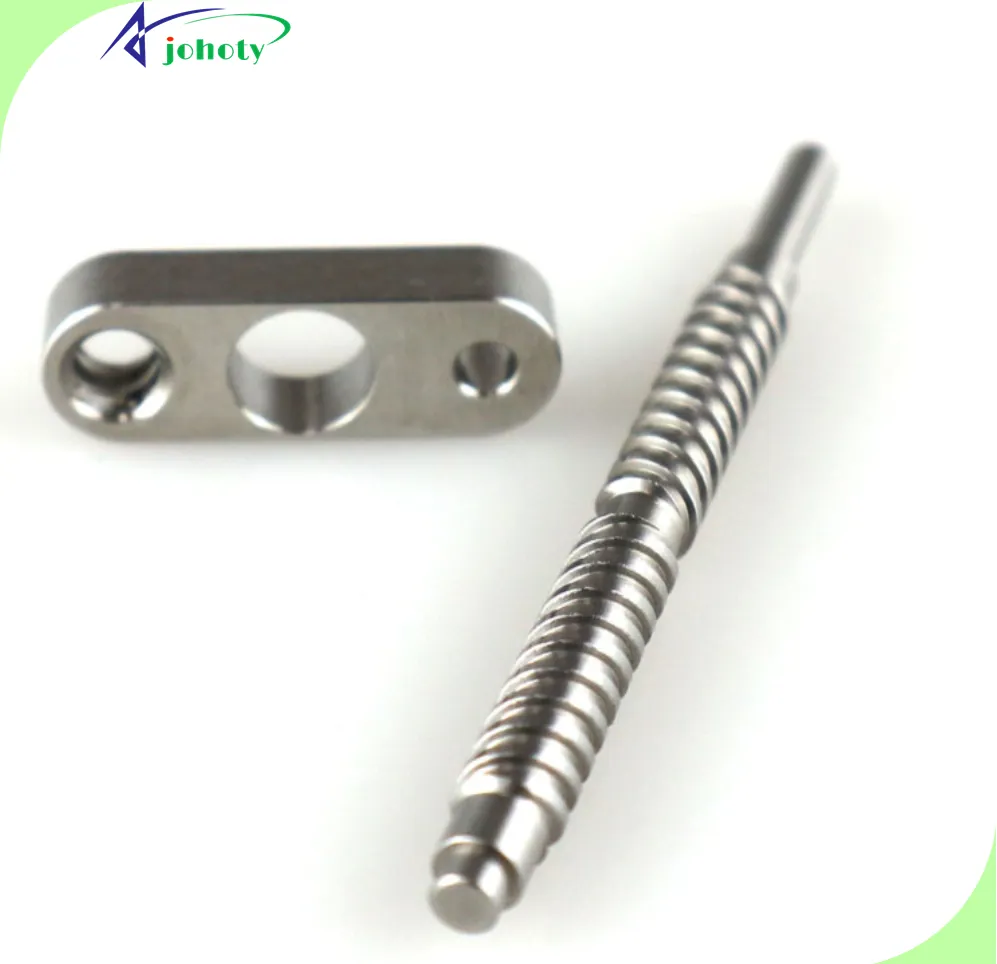
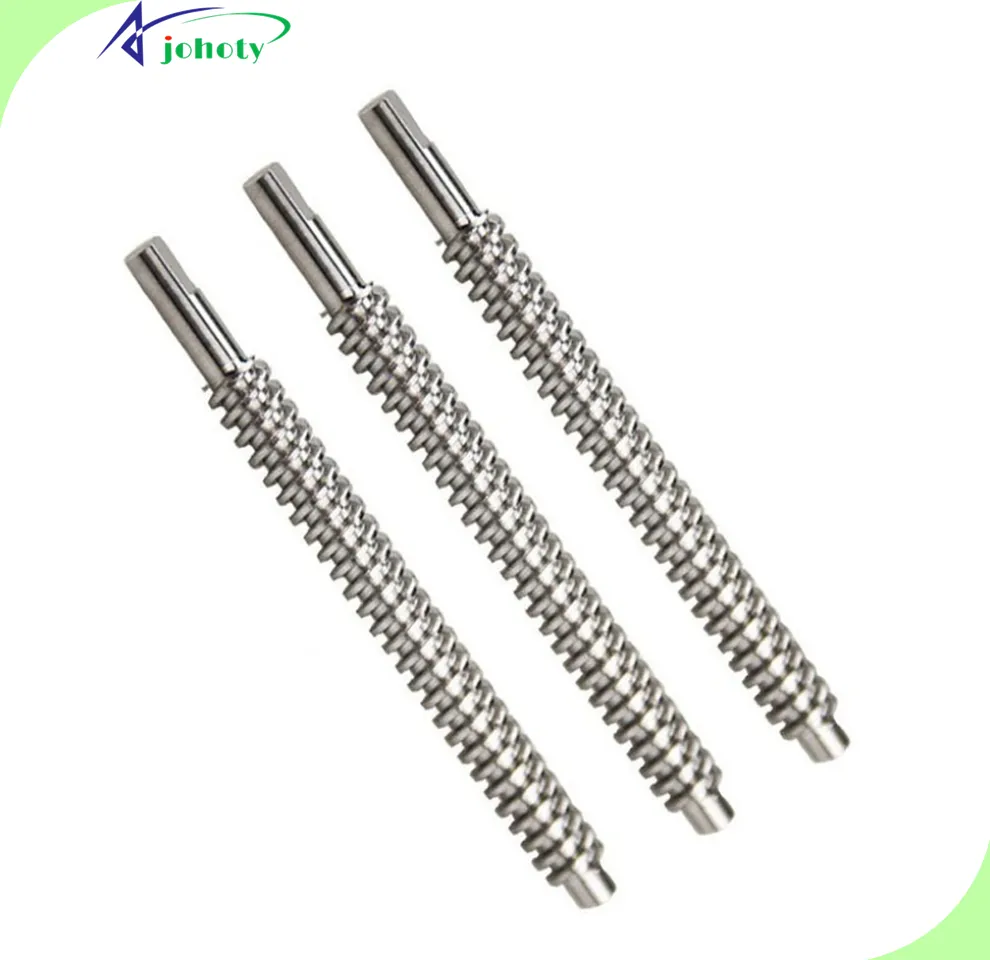
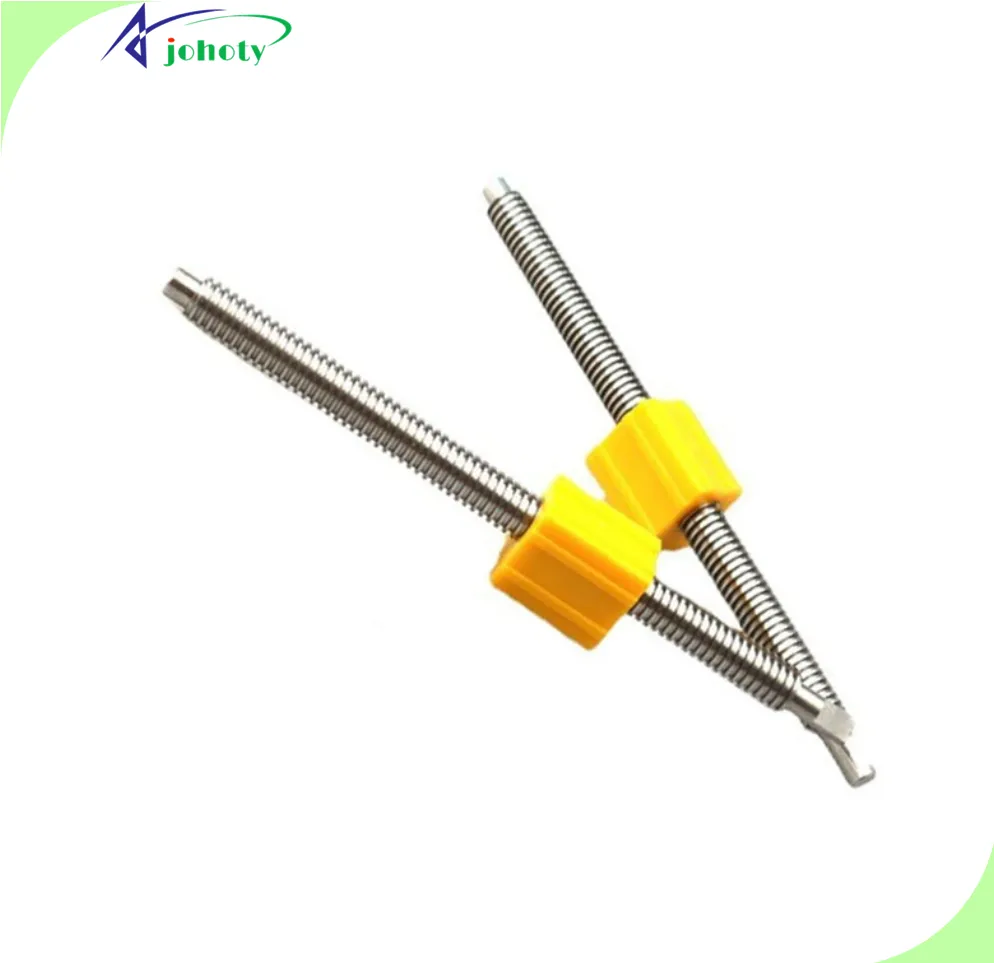
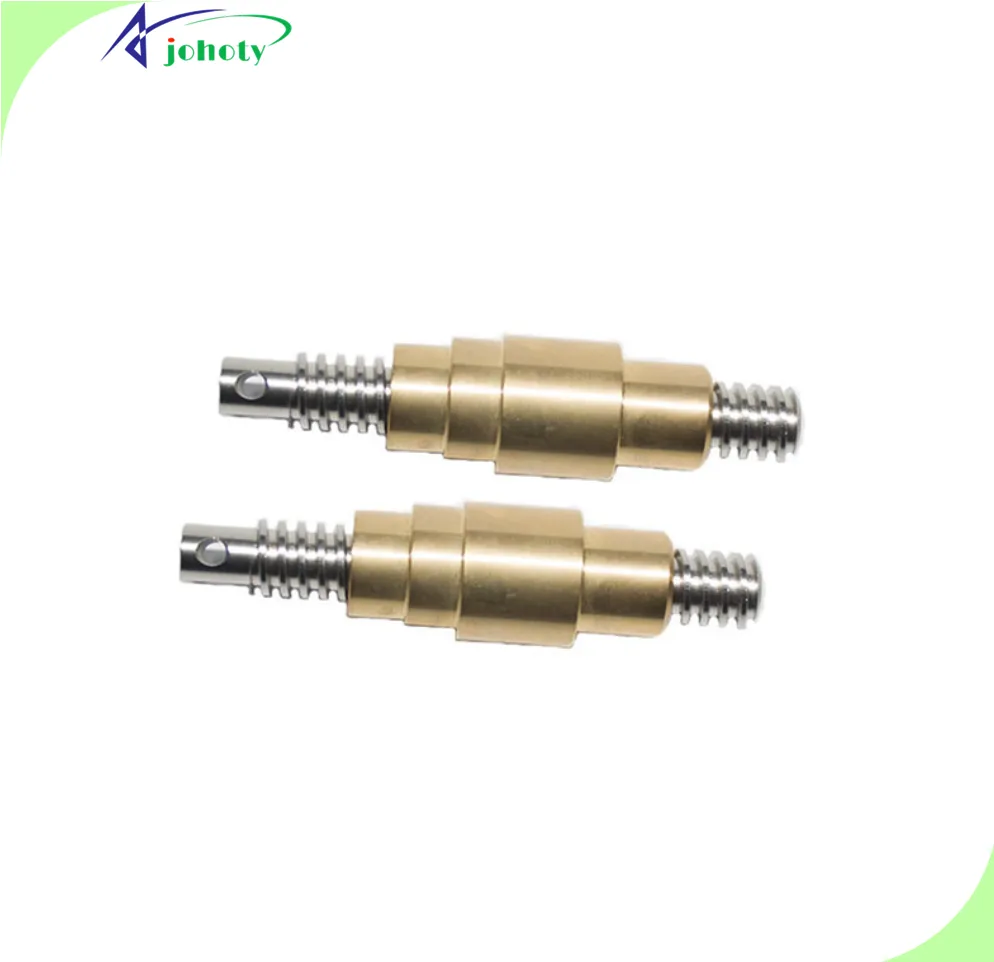
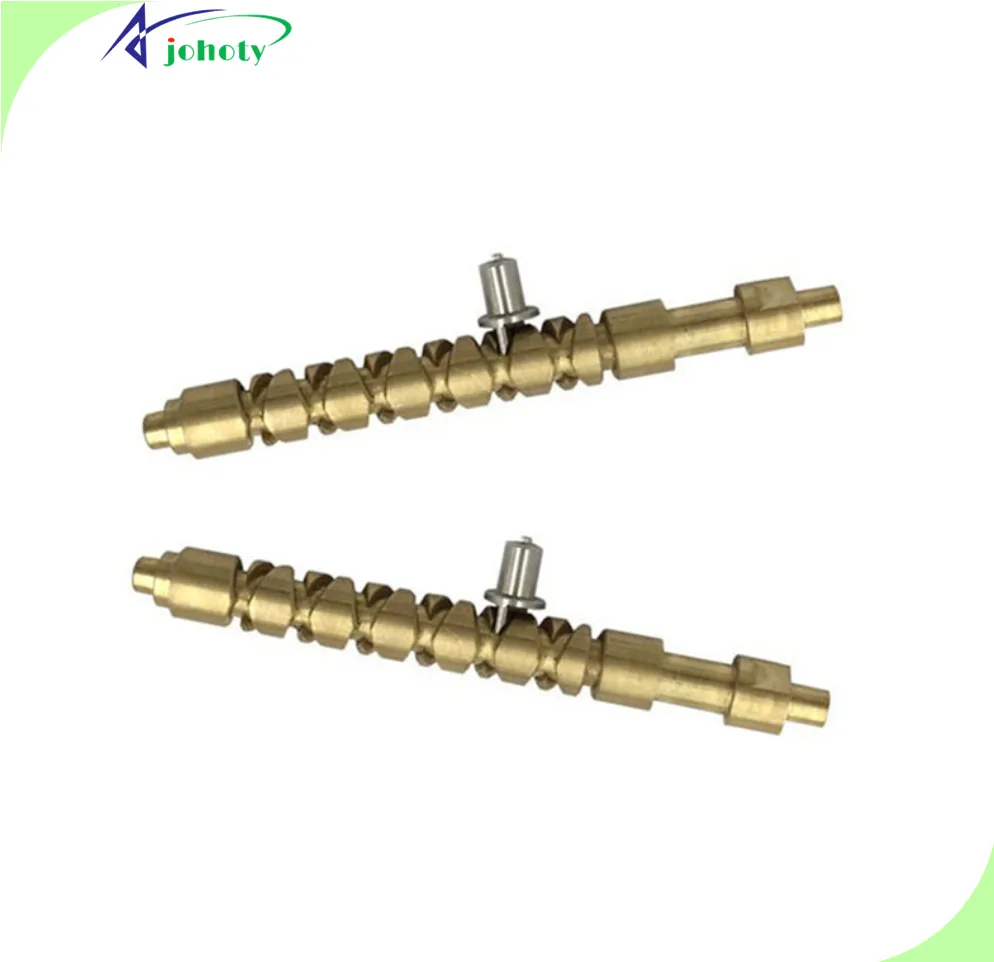
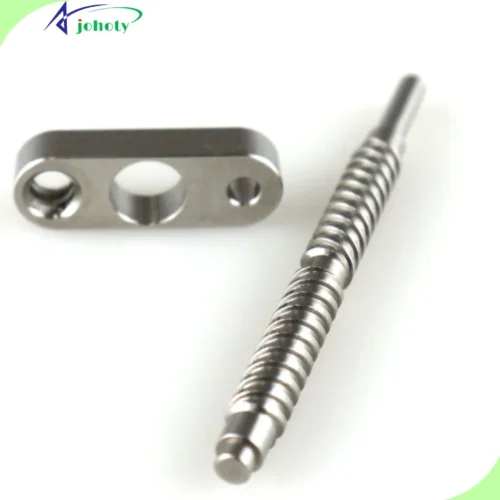
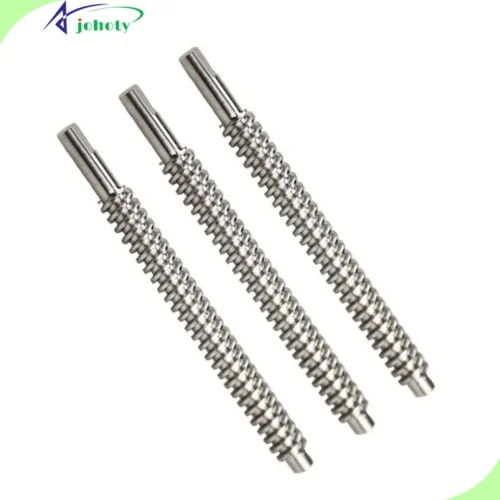

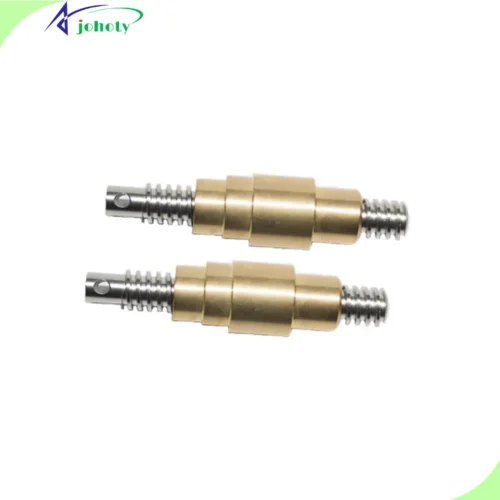
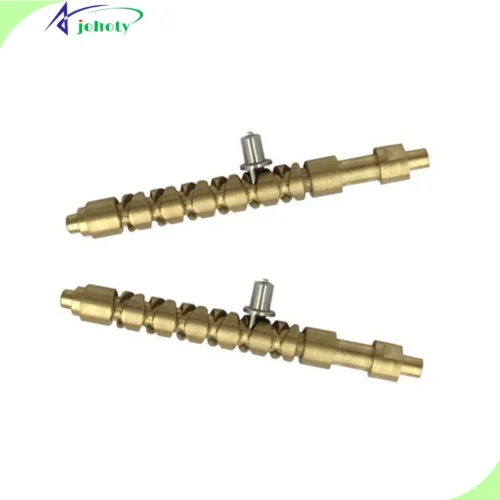
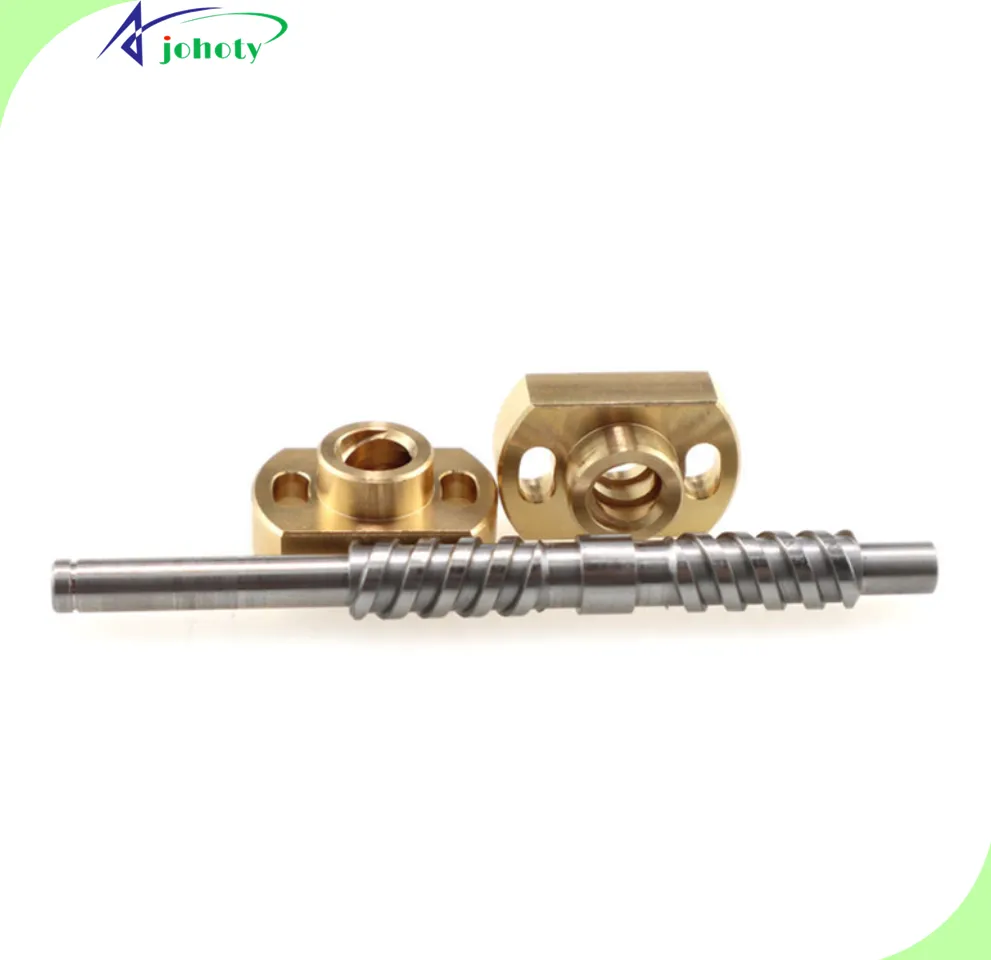
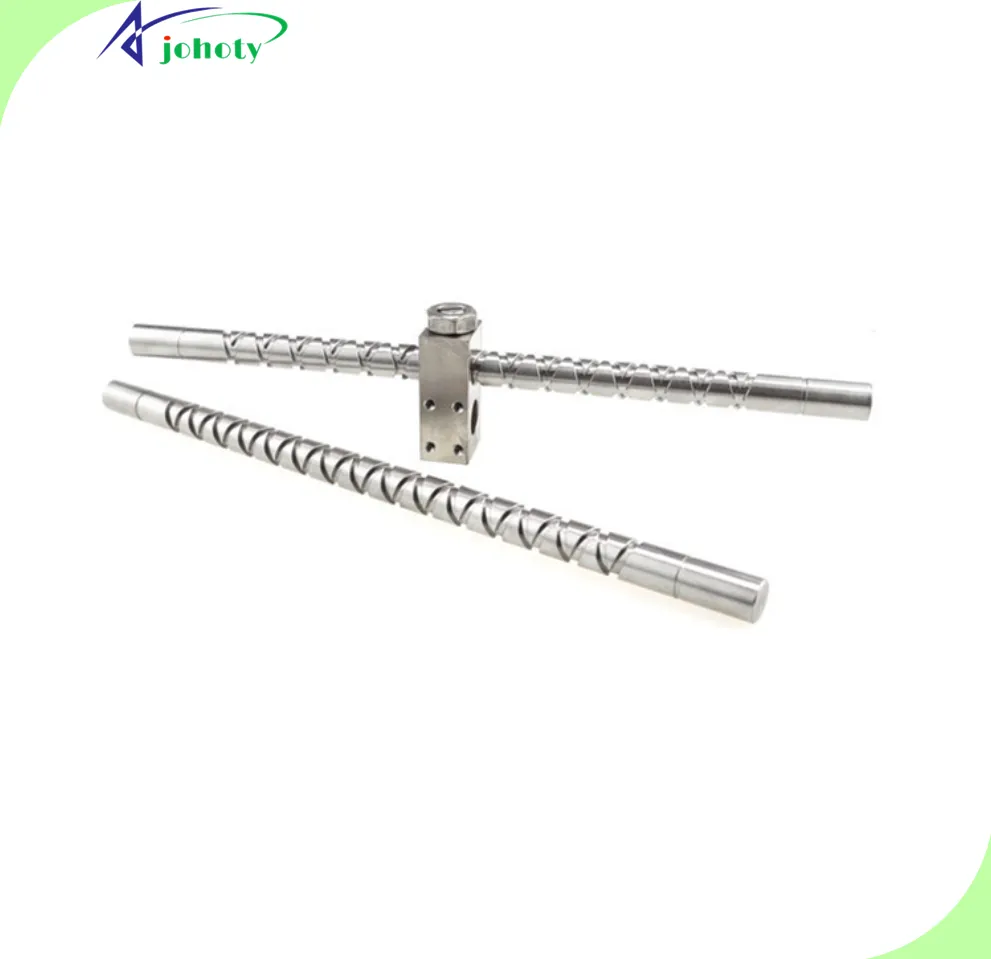
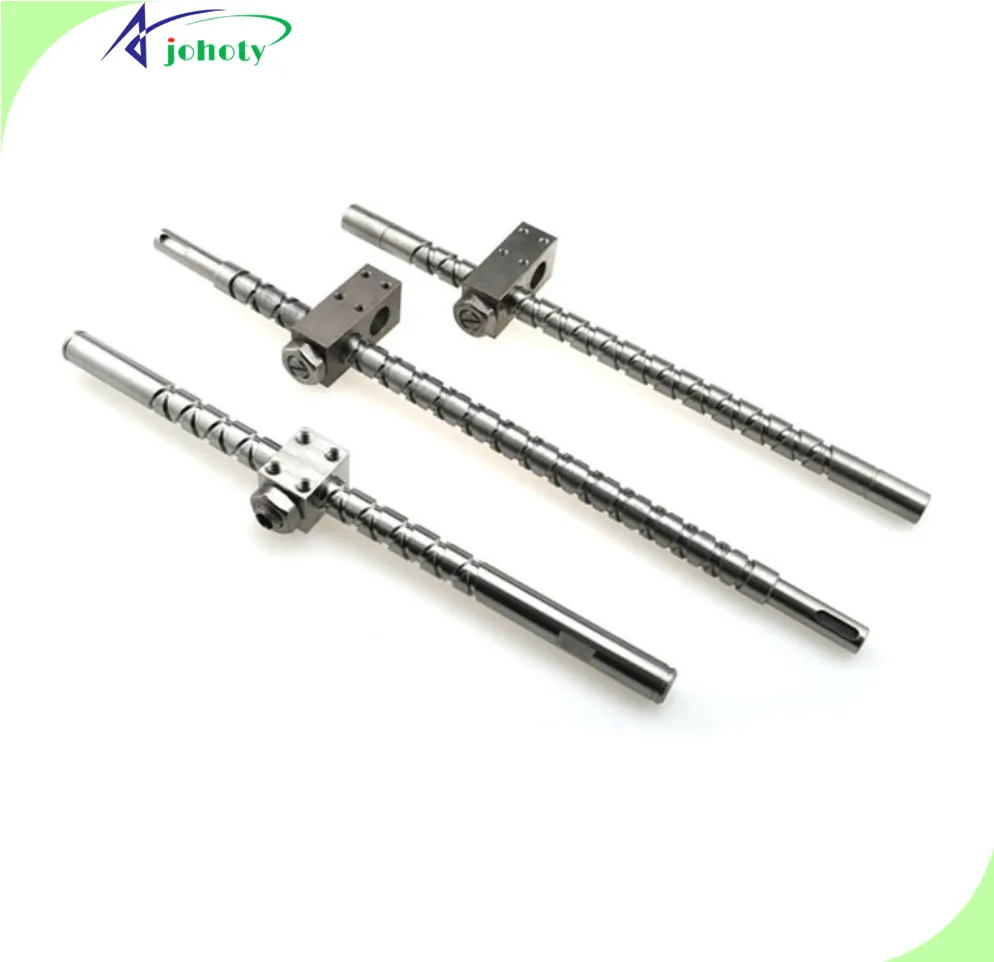
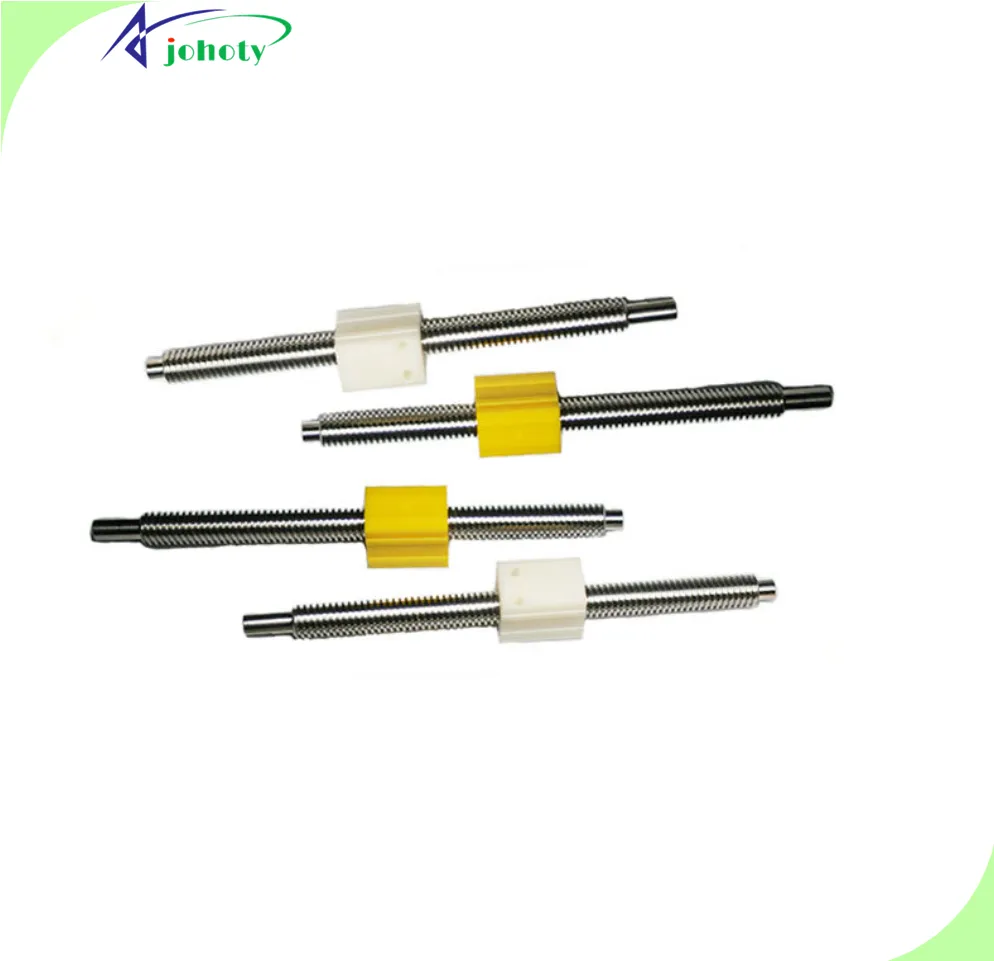
Description of ACME screw
Mechanical parameters:
Thread angle: precise 29°, flat top/bottom contour, anti-stress concentration transition.
Lead accuracy: ± 0.05-0.10 mm/300 mm, ranging from ordinary to higher precision levels, and can be customized to higher levels.
Pitch/lead: customized according to requirements, single head/multi head thread.
Materials: Carbon steel C45, alloy steel 40Cr, stainless steel 304/316, cold drawn steel, etc.
Hardness: HB 160-250, suitable for area quenching and surface hardening.
Processing capability: Length 50-3,000 mm, diameter 8-60 mm, coaxiality ≤0.02 mm/300 mm.
Thread machining: rolling, turning, grinding.
Nut material: Bronze POM, Nylon, brass, PTFE composite material.
Surface treatment: black oxidation, electroplated zinc, nickel, solid lubricating coating, corrosion-resistant coating.
Applications:
- Suitable for linear transmission systems with medium load, high wear resistance, and structural stability requirements.
- Precision clamping and position adjustment mechanism.
- Fixtures/automated positioning components.
- Medical equipment and experimental equipment transmission pairs.
- Semiconductor auxiliary tooling and testing fixtures.
- Medium precision CNC assembly unit.
- Small stroke transmission of robot end effector.
Key Performance:
Wear resistance and long lifespan: Flat top/flat bottom profiles have excellent wear resistance under medium load conditions.
Strong transmission stability: low noise, constant friction torque.
Adjustable anti backlash: can be matched with pre tightened nuts to meet the requirements of medium precision positioning.
High degree of freedom in design: supports short stroke high rigidity design to long stroke smooth transmission.
Good fault tolerance: More resistant to dirt and stains than ISO trapezoidal threads, and more suitable for multi scene environments.
Compatibility:
- Compatible with ACME standard profiles, non-standard variants can be made according to customer drawings.
- Confirm lead and tolerance, replace Trapezoid/Tr series.
- Can match existing ACME screw seats, couplings, and nut seats.
- Fully matched manufacturing can be carried out according to the customer’s installation dimensions, end processing, keyway, and flat position.
- Customized according to the drawings, directly compatible with existing automation platforms or slide structures.
Value of Johoty (China manufacturer) on ACME screw
- Provide a 29° flat/top ACME screw with a lead accuracy of ± 0.05-0.10mm/300mm. Flexible customization, precise machining, strong wear resistance and stability, and high adaptability. Meet trapezoidal linear transmission from ordinary level to higher precision level.
- High precision and flexible customization, unlimited batch size: from ordinary grade to more precise grade ± 0.05-0.10mm/300mm.
- Rolling/turning/grinding can be adjusted according to demand, and engineering development support is provided for a minimum order of 1 piece.
- Strong ability to process complex ends: can be completed in one go: concentric turning, keyway, hexagonal, flat, threaded ends, steps, and overall machining of installation surfaces. Ensure the coaxiality and parallelism of the entire ACME screw after installation.
- Engineering compensation design capability: Based on customer support spacing and installation errors, the lead, coaxiality, nut clearance, and fine-tune material hardness of ACME screw.
- Rolling improves fatigue life: Johoty uses high-pressure rolling technology to compact the material structure. The fatigue life and surface wear resistance are significantly improved, which is helpful for high-frequency reciprocating.
- International engineer friendly technical collaboration mode: supports STEP drawings/machining suggestions/material substitution solutions/initialization of friction testing parameters. Reduce engineer debugging time.
Challenges and Solutions of ACME screw
From nominal accuracy to system error control, lead accuracy and motion stability of ACME screw
Engineers’ Challenges:
- Will the cumulative lead error under long travel affect the positioning accuracy/repeatability accuracy?
- How does the 29° ACME screw control backlash, crawling, and noise under high loads?
- How is accuracy measured? I don’t want to write just one number?
Johoty’s solutions:
Clearly state: lead accuracy: ± 0.05-0.10 mm/300 mm, Johoty can provide a full-length error curve according to project requirements.
Thread shape and processing: 29° ACME screw, with a flat top structure at the top and bottom of the teeth. Johoty adopts precision rolling/turning + online lead detection to ensure smooth transmission.
How to measure and control: Each ACME screw can provide a lead error detection report through a laser interferometer/specialized measuring instrument. Includes single section error, cumulative error, and pitch deviation.
Supplementary assembly: straightness, coaxiality, surface roughness, and nut fit clearance can be controlled according to customer design requirements. This can adapt to medium to high-precision linear motion.
High load, wear and life, ACME screw can run from energy to long-term stability:
Engineers’ Challenges:
- What is the wear and lifespan of the threaded contact surface under high load, frequent forward and reverse rotation, and impact?
- How much will the backlash increase after long-term operation? What are the lubrication requirements and maintenance cycles?
- Is there traceable data for materials, heat treatment, and surface treatment?
Johoty’s solutions:
- Materials and Heat Treatment System: Provides quenching and surface hardening for carbon steel, alloy steel, and stainless steel, and can be designed with different hardness and core toughness according to load levels. Designed in conjunction with tin bronze, self-lubricating engineering plastics, and other nuts to reduce the risk of wear and jamming.
- Surface and lubrication design: Optional nickel plating, blackening, phosphating, and solid lubrication coatings are available to improve corrosion resistance and reliability under dry friction.
- Lifespan and Verification Method: Supports life estimation and experimental verification based on customer given loads, strokes, and cycles. Provide data on wear and backlash changes for evaluating maintenance intervals.
- Extreme working conditions: Customized sealing and lubrication solutions can be provided for dusty, humid, and weakly corrosive environments.
Customized engineering support&quality traceability: from ordinary procurement ACME screws to key sports partners
Engineer’s Challenges:
- Projects often have non-standard structures such as lead, diameter, tooth profile, end processing, installation space, etc., all of which require customization.
- Can you provide complete drawings, 3D models, and dimensional chain analysis support?
- What is the stability, batch consistency, and traceability of bulk supply?
Johoty’s solutions:
- Customization capability range: Supports flexible customization of ACME screws from ordinary to higher precision levels. Single/multi head thread, left/right rotation, non-standard lead, special length. Both ends of the shaft neck, keyway, flange, etc. are processed as a whole.
- Engineering collaboration: Provide 2D drawings + 3D STEP, which can cooperate with customers for joint review of interface dimensions, installation structures, and tolerance stacking. Reduce the number of trial production iterations. Engineers directly connect with your technical team to discuss backlash goals, lubrication methods, and assembly processes during the design phase.
- Quality system and traceability: The production process adopts a combination of incoming material inspection, process sampling inspection, and factory full inspection. Key dimensions and lead accuracy can be accompanied by inspection reports as needed. Each batch of ACME screws has a unique batch number and material/heat treatment/testing records. Support quality traceability and consistency control for long-term projects.
- Rest assured Information: Johoty is familiar with mechanical engineering projects. Provide English technical documentation, material certification RoHS/REACH. Facilitate internal project initiation and certification for customers.
Why Choose Johoty’s ACME Screw ?
Johoty’s ACME screw has a ±0.05 precision and 29° fine tuning, save >15% costs for you, ship in 2~3 weeks, Johoty can offer flexible custom. It’s time to Contact Johoty now!
Benefits of Johoty’s ACME Screw

Predictive lifespan and reliability under harsh operating conditions:
Engineer’s challenges: The microstructure of materials and their performance degradation under long-term alternating loads. Engineers require high-strength materials to withstand loads. More precise and controllable heat treatment is needed to ensure the dimensional stability and wear resistance of ACME screws throughout their lifespan. Avoid machine failure and shutdown caused by premature wear or plastic deformation.
Benefits provided by Johoty: Johoty can offer a range of high-quality 4140/42CrMo to specific stainless steels. Equipped with core, data-driven quenching and tempering heat treatment and surface hardening medium frequency quenching. Ensure the optimal combination of ACME screw toughness and surface hardness. Johoty can provide validated and predictable fatigue life and wear resistance data. You can accurately calculate safety factors and maintenance cycles during the design phase, reducing project risks caused by material failures.

Low friction, high rigidity, and sealing compatibility:
Engineer’s Challenges: The standard ACME screw is a 29 ° thread angle, flat top and flat bottom, easy to understand. In practical manufacturing, ensuring the accuracy and consistency of thread shape is a major challenge. An imperfect thread shape can lead to stress concentration, abnormal wear, increased friction coefficient, and efficiency loss. The flatness of the top and bottom of the thread directly affects the compatibility and service life of the sealing dust ring.
Benefits provided by Johoty: We have accumulated experience in high-precision thread grinding and whirlwind milling technology. The geometric accuracy of the thread shape is highly consistent from one end of the ACME screw to the other. This has lower operating friction, higher transmission rigidity, and more uniform load distribution. The precise leveling of the thread top/bottom eliminates obstacles for you to integrate an efficient sealing system. Prevent early failure of seals caused by burrs or uneven shapes on threads.

System-level positioning accuracy and assembly uncertainty:
Engineer’s Challenges: Is lead accuracy ± 0.05-0.10 mm a statistical value or a guaranteed value? Can the control of cumulative errors, the coaxiality and runout of threads relative to the shaft shoulder, and the bearing position be fully defined on the drawing? The repeated calibration caused by these errors during assembly is a huge time and cost black hole.
Benefits provided by Johoty are to elevate precision control from a single parameter to system correlation. Ensure that the lead accuracy is within the nominal range, and strictly monitor the cumulative error of the ACME screw throughout the entire length of the manufacturing and testing process. Ensure that the concentricity, perpendicularity, and runout of key installation reference surfaces and threads meet the requirements of high-order assembly. This provides you with the certainty of immediate installation and use, significantly reducing the debugging workload and uncertainty during the system integration phase. Help you improve the quality and manufacturability of the entire product.

Non-standard design, supply chain agility, and technological cost reduction:
Engineer’s challenges: requiring non-standard design of special diameter lead combinations, customized end structures, or special PTFE coatings. Engineers are often limited by the high customization costs of local suppliers, lengthy delivery times, and rigid communication processes. Difficult to achieve optimal design within budget and cycle.
Benefits provided by Johoty: We have fast engineering response capabilities and supply chain flexibility. Efficiently undertake and implement ACME screws ranging from ordinary to refined. Customized requirements for oil storage tank structures designed to meet specific lubrication conditions and hollow structures optimized for weight reduction. You can easily break through standard part limitations and engage in innovative design. Enjoy Johoty’s agile response and competitive cost structure. Realize cost driven engineering without sacrificing quality, enhancing the competitiveness of your final product.
Applications of Johoty’s ACME Screw
High load positioning system:
Challenge: Accumulated lead error leads to positioning deviation.
Function: ACME screw controls positioning drift with a lead accuracy of ± 0.05-0.10 mm/300 mm.
Customization: Customize the thread profile and surface hardening according to the load curve.
Solution: Optimize stress distribution and reduce deformation through Johoty’s ACME screw’s 29° tooth profile angle.
Efficiency: Repeated positioning accuracy improved by 40%, maintenance costs reduced by 18%.
Advantages: Flat tooth crown/sole reduces contact stress and extends ACME screw fatigue life.
Vacuum environment transmission mechanism:
Challenge: Lubricant volatilization pollutes the chamber.
Function: The flat thread crest design of ACME screw allows for the embedding of solid lubricating film.
Customization: Customized dry lubrication coating and low air release material.
Solution: Johoty’s ACME screw operates stably without oil in an environment of 10⁻⁶ Pa.
Efficiency: Vacuum pumping cycle shortened by 25%.
Advantage: The 29° thread profile angle ensures self-locking and prevents slipping due to pressure loss.
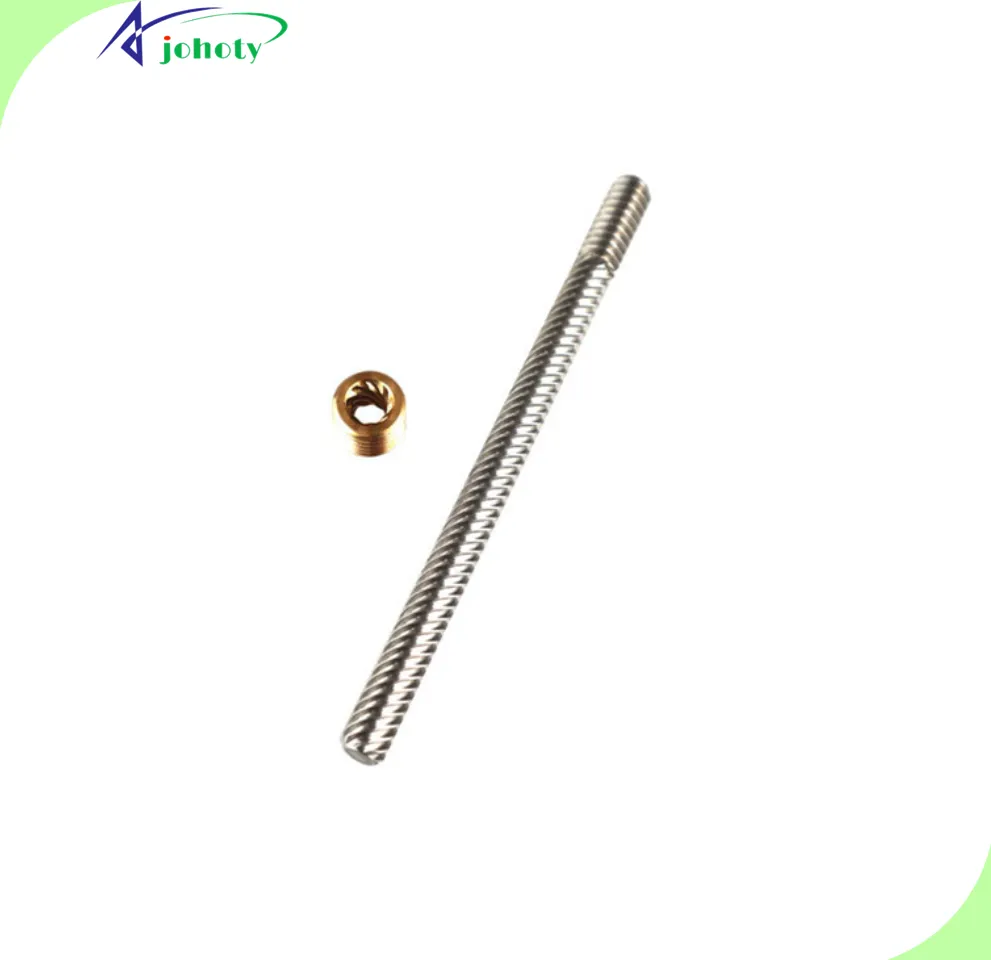
Medical linear drive device:
Challenge: The contradiction between biocompatibility and micro step smoothness.
Function: ACME screw achieves lead accuracy of 0.01 mm micro feed.
Customization: Electrolytic polishing of 316L stainless steel with customized lead compensation.
Solution: Use Johoty’s ACME screw to control particle detachment through the flatness of the tooth base.
Efficiency: Transmission efficiency of 92%, with a lifespan of over 2 million cycles.
Advantage: Flat tooth crown avoids tissue fiber entanglement.
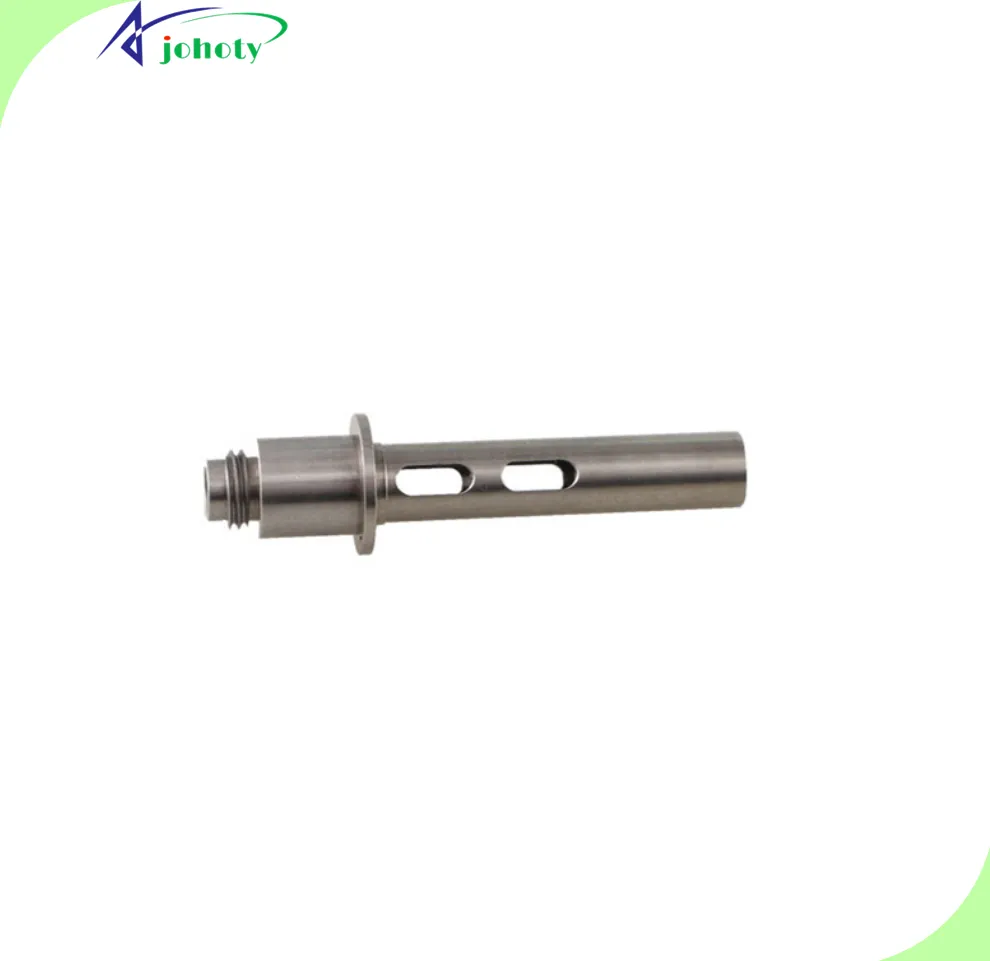
Heavy-duty lifting mechanism:
Challenge: Impact load causes local plastic deformation of the thread.
Function: The 29° thread profile angle of ACME screw enhances the root shear strength of teeth.
Customization: Medium frequency quenching process and distribution of variable lead error.
Solution: ACME screw maintains lead stability under 5,000N impact.
Efficiency: Energy consumption reduced by 15% and wear reduced by 60%.
Advantage: Johoty’s customized ACME screw allows for non-standard lead to diameter ratio optimization.
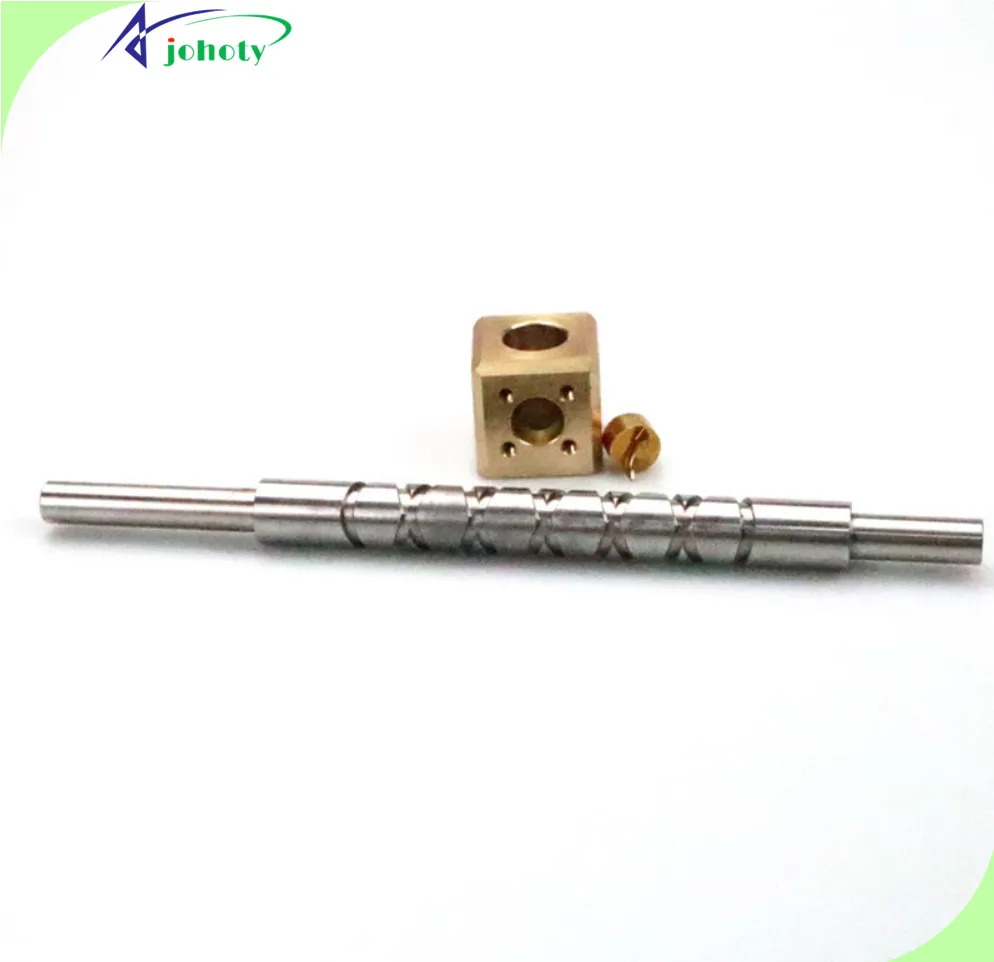
Precision injection molding machine shooting table:
Challenge: The back pressure of molten plastic causes the screw to retract.
Function: The flat thread base of Johoty’s ACME screw enhances its creep resistance.
Customization: Johoty can flexibly you offer double nut preloading and temperature compensation lead.
Solution: Lead error ≤0.08mm/300mm under 230℃ working condition.
Efficiency: The repeated precision of injection molding has been improved by 32%.
Advantage: The 29° angle of Johoty’s ACME screw provides a larger contact area to disperse axial forces.
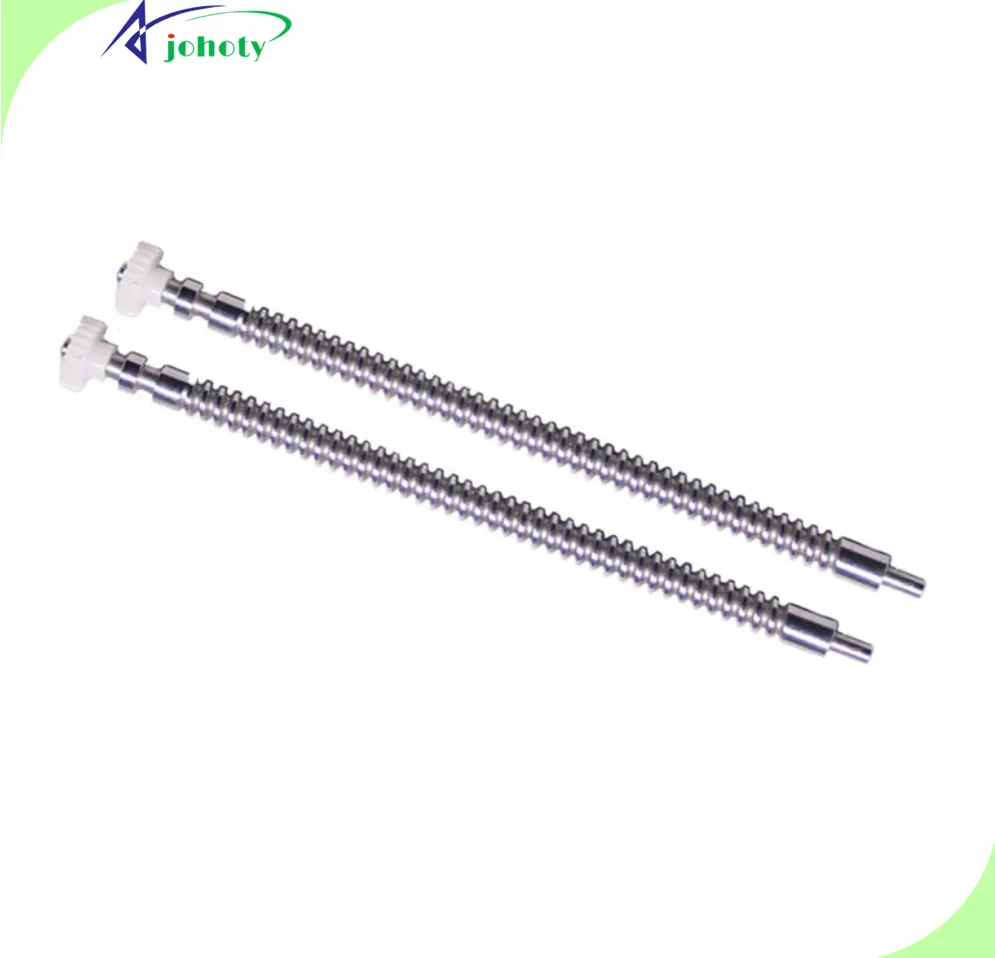
Optical Platform Leveling System:
Challenge: Micro vibration transmission affects optical path stability.
Function: Our ACME screw precision control step response ≤0.1 arc sec.
Customization: Polymer metal composite nut and damping thread.
Solution: Suppress structural resonance through Johoty’s custom ACME screw thread shape optimization.
Efficiency: The leveling time has been reduced from 45s to 28s.
Advantage: Johoty’s customized ACME screw can achieve zero backlash transmission.
Semiconductor wafer transfer machinery:
Challenge: Metal particle contamination in clean rooms.
Function: Flat thread crest design of Johoty’s ACME screw reduces friction debris.
Customization: Ceramic coating and vacuum specific lubricating grease.
Solution: Meet the ISO Class 3 particulate emission standard.
Efficiency: MTBF increased to 18,000 hours.
Advantage: Johoty’s specially customized ACME screw ensures wafer positioning repeatability of ± 0.05mm in lead accuracy.
Corrosion-resistant actuators for offshore platforms:
Challenge: Salt spray corrosion causes thread jamming.
Function: Johoty’s fine-tuned 29° angle of the ACME screw provides greater tolerance for the thickness of the anti-corrosion coating.
Customization: Design compatible with ultra-corrosion-resistant alloy and cathodic protection.
Solution: The lifespan exceeds 10 years in an environment with a Cl ⁻ concentration of 20,000ppm.
Efficiency: The failure rate has decreased from 35% to 8%.
Advantage: Customized ACME screws allow for corrosion allowance design without affecting lead accuracy.
Advantages of Johoty’s ACME screw
Johoty‘s ACME screw excellent precision controllability and system error compensation capability:
Problem solved: The accumulation of transmission errors is a fatal issue in precision systems with long travel and high loads. The accuracy of the standard ACME screw is fixed and cannot be optimized for specific applications. Engineers must adopt complex error compensation algorithms or add expensive feedback components at the system level. This will increase system complexity and cost.
Johoty’s advantages:
- On demand matching accuracy: For non-critical segments or cost sensitive applications, a specification of ± 0.10 mm/300 mm can be selected to optimize costs. For the core precision section, a specification of ± 0.05 mm/300 mm is specified. This flexibility achieves the optimal allocation of cost and performance.
- System level error pre compensation: In ultra-long ACME screws, inherent thermal expansion and gravity sag can lead to nonlinear errors. Johoty allows engineers to provide expected temperature fields and support conditions. By customizing the lead tuning or pre compensation, these system errors can be partially offset during the manufacturing phase. This is a higher-level solution designed internally rather than externally patched. It can reduce the complexity of later debugging.
Structural strength and stability advantages of ACME screw 29 ° thread angle and flat tooth top/bottom:
Problem solved: Traditional trapezoidal 30 ° thread angles or other thread shapes can affect their lifespan and rigidity when subjected to high axial loads. Because the stress concentration problem of the threaded tooth root is prominent, and the contact stress distribution with the nut is not ideal.
Johoty’s advantages:
- Enhanced thread strength: Compared to the standard profile, the 29 ° design increases the root thickness of the thread. Improve the shear and bending resistance of ACME screw, suitable for impact loads or high cycles.
- Optimized contact force and lubrication: Flat thread tips and soles provide better retention space for lubricants, forming a more stable lubricating oil film. This can reduce the friction coefficient and wear, and the contact stress distribution between the nut and threaded rod is more uniform during operation. Avoiding early failure caused by edge stress concentration. Johoty’s ACME screw is often required for high reliability and long lifespan of fault free operating equipment.
- Improved sealing and cleaning: The flat structure is easier to match with customized nut seals, effectively preventing contamination from entering. Tolerance is more effective in harsh environments.
Deep synergistic customization potential of ACME screw material and surface treatment:
Problem solved: The material and surface treatment scheme for standard ACME screws are often fixed. This will make it difficult to cope with highly corrosive environments, extreme temperatures, or clean environments that require extremely low friction coefficients.
Johoty’s customization:
- Integrated design of materials, heat treatment, and performance: Engineers can customize specific 4140 and 4340 according to load and lifespan requirements. With customized quenching and tempering heat treatment processes, you can achieve the desired strength and toughness.
- Accurate application of functional surface engineering:
Hard chrome coating: standard wear-resistant and anti-corrosion solution.
Non electrolytic nickel coating: provides a uniform anti-corrosion layer, suitable for complex geometric shapes. - Nitriding treatment: forming a highly hard compound layer on the surface to enhance wear resistance and fatigue strength, maintain good toughness. For high cycle / load, it is a disruptive performance improvement.
- PTFE composite coating: Provides extremely low friction coefficient and self-lubricating properties while ensuring adhesion. This ACME screw can meet the needs of clean rooms or maintenance free lubrication.
Johoty’s ACME screw provides interfaces of system integration and geometric degrees of freedom:
Problem solved: End machining, shoulder design, and fixing of key installation dimensions for standard ACME screws. This forces engineers to make compromises when designing support structures and couplings, increasing the complexity of parts and assembly errors.
Johoty’s engineering value:
- Complete definition of end interface: Engineers can directly customize the geometric shape of both ends of the ACME screw according to the design of the bearing seat and coupling. Including precision ground center holes, shaft diameters with specific tolerances, keyways, and flanges. This achieves seamless and rigid connection with the supporting bearings and drive units. Maximized the reduction of cumulative errors in the assembly chain and improved the overall rigidity of the system.
- Collaborative design of non-standard diameter and lead: In applications where space is limited or specific reduction ratios/speeds are required, the limitations of the standard series can be overcome. Customize non-standard ACME screw diameter and lead combinations to achieve optimal layout of the transmission system in the entire machine.
FAQ
Engineers’ concerns:
- The nominal lead accuracy looks good, but can it still be maintained for mass production batches and long travel segments?
- Will the actual positioning accuracy of ACME screw run out after being installed on the rack and pre tightened?
Key technical points and solution ideas of Johoty:
Process path selection:
- Ordinary precision: precision cold rolling or turning+shaping, online pitch detection, can stably achieve ± 0.10 mm/300 mm.
- High precision: After rough machining, local precision grinding or trimming can compress the critical working stroke to ± 0.05 mm/300 mm.
The distribution of lead error rather than a single point:
- Not just looking at a single 300mm segment, but measuring the pitch error curve of the entire ACME screw.
- Control the error band separately for the critical stroke of 500-800mm in the middle. Clearly indicate in the testing report for your convenience in compensating for system errors.
Considering the accuracy of the assembled system:
- Simulate assembly deformation in advance according to the bearing seat spacing, fixation support/fixation fixation fixation, etc. provided by the engineer.
- In the drawing, it is agreed that the coaxiality and roundness of the two end necks should be based on the runout of the shoulder and threaded section.
- Ensure that the lead error of the ACME screw does not suddenly deteriorate due to bending or preload force during actual clamping.
Deliverable engineering documents:
- Each batch provides: lead error curve, statistical values of key sections, material and heat treatment records.
- Engineers can directly input ACME screw parameters into their own positioning accuracy calculation model, rather than relying on empirical estimation.
Engineers’ concerns:
- ACME is essentially sliding friction. Will long-term high load and frequent reciprocating wear out quickly and increase the gap?
- How to balance lifespan, efficiency, and self-locking/safety?
Key points and solutions of Johoty’s technology:
Choose based on load stroke cycle number:
- Based on equivalent axial load, working stroke, reciprocating frequency, and total number of cycles, estimate the contact stress and pressure multiplied by velocity first.
- Based on the bronze, wear-resistant cast iron, engineering plastic, and lubrication conditions of the nut material, determine whether it is necessary to increase the thread diameter or lead? Switching to multi head threads to reduce unit tooth surface pressure?
Gap control and compensation methods:
- Normal level: Control the initial backlash within the range given by the engineer, and estimate the maximum acceptable backlash after wear.
- High demand applications: Use double nuts + adjusting washers or wedge-shaped structures to form adjustable pre tightening. Design the nut as a structure that can be fine-tuned and pre tightened again to extend its useful life, rather than being scrapped at once.
Balance between efficiency and self-locking:
- Evaluate whether self-locking occurs and avoid accidental reverse drive under high loads by using a tooth profile angle of 29°, lead, and friction coefficient.
- For applications that require high efficiency, the friction coefficient can be reduced through material pairing, surface treatment, and lubrication.
- Reduce the lead angle to retain a certain degree of self-locking ability, while balancing manual operation force and safety.
Lifespan and maintenance strategy:
- Provide estimated lifespan ranges for nut materials and lubrication, showing you the number of cycles or total travel.
- Simple and executable maintenance recommendations: regular grease replacement cycle, recommended lubricant type, dust cover in polluted environment, thread protection.
Engineers’ concerns:
- Standard ACME screws are commonly used in conventional environments. Can ACME screws work stably under high temperature, corrosive media, dust or low temperature?
- Is there any hidden design detail that can reduce on-site debugging and maintenance risks?
Johoty’s technical points and solution ideas:
Materials and Heat Treatment:
- Choose according to the environment: alloy steel + surface hardening, stainless steel, special corrosion-resistant steel. For ordinary to higher precision ACME screws, surface induction hardening or nitriding can be used. Improve the surface hardness and wear resistance of the thread, while maintaining the toughness of the core and avoiding easy bending of the long axis.
- The maximum allowable working temperature and hardness maintenance during high temperatures.
Surface and lubrication:
- In corrosive or heavily polluted environments, corrosion-resistant nickel plating and special organic coatings can be used. The lubrication groove and oil storage chamber structure inside the nut reduce maintenance frequency.
- For low-temperature applications, consider the low-temperature flowability of lubricants and indicate lubricant type requirements in the drawings if necessary.
Engineering of installation end and support structure:
- For long stroke ACME screws, it is agreed in the drawing stage that the end journal dimensions and tolerance levels are suitable for commonly used bearing seats. When necessary, perform dynamic balancing or at least control the rotational straightness to ensure controllable vibration at medium to high speeds.
- These details are usually not reflected in the product catalog, but they directly affect the difficulty of on-site debugging for engineers.
Traceable quality and parameters:
- Each ACME screw is marked with a batch number, material, heat treatment, and lead inspection record.
- For ACME screws that require precise compensation, lead error data files can be provided. Engineers can perform software compensation in the control system to improve overall accuracy without excessive hardware stacking.